
Ohtani ’26 Freeman: The Dodgers Campaign That Runs on ITFDB
With Los Angeles back in the 2026 National League Championship Series, an imaginary campaign ticket pairing Shohei Ohtani and Freddie Freeman brings together two modern Dodgers stars, vintage political typography and Vin Scully’s unforgettable baseball call.
Los Angeles punched its ticket to another National League Championship Series on October 7, defeating the Atlanta Braves 4–1 in Game 4 and taking the Division Series three games to one. The decisive moment came on Andy Pages’ seventh-inning, two-run single. Freddie Freeman had already helped reshape the series with a Game 3 home run, while Shohei Ohtani remained central to the conversation surrounding the Dodgers’ lineup.
October baseball is a strange time to think about campaigns, but the visual comparison almost writes itself. Fans choose their heroes, debate decisions and argue over which names deserve their confidence. The Dodgers have assembled a roster loaded with recognizable personalities, yet Ohtani and Freeman represent a particularly compelling pairing.
One is a global baseball phenomenon whose two-way abilities changed the expectations attached to a modern superstar. The other is an established championship first baseman whose postseason history has already given Los Angeles one of its most enduring World Series memories. Put their surnames on an imaginary campaign ticket and the joke becomes immediately legible.
FREEMAN ITFDB / Los Angeles Baseball
The campaign is imaginary. The names and the Dodgers history behind them are very real.
Why Is Ohtani ’26 Freeman Relevant to the Dodgers’ NLCS Run?
This year’s playoff story has not been a simple procession of individual heroics. Freeman’s October response against Atlanta was especially important after a difficult late-season stretch. His Game 3 homer off Chris Sale helped Los Angeles win 3–1, putting the club one victory from the NLCS.
Ohtani’s NLDS followed a different rhythm. Manager Dave Roberts moved him through several batting-order positions while searching for the most effective configuration. In Game 4, Ohtani occupied the cleanup spot, an unusual assignment for a player whose Dodgers career had generally placed him near the top of the order.
That contrast makes their pairing interesting. A postseason roster needs both the established stars and the unexpected contributors. Pages delivered the clinching hit, pitchers navigated the series, and the Dodgers advanced through a collective effort. Ohtani and Freeman remain recognizable faces of the larger era rather than the sole authors of every October victory.


What Does ITFDB Mean in Dodgers Culture?
ITFDB stands for “It’s Time for Dodger Baseball.” Those words are inseparable from Vin Scully, the legendary broadcaster who gave the franchise one of the most recognizable opening calls in American sports.
For generations, the phrase announced the beginning of a familiar Los Angeles ritual. It belonged to evenings at Dodger Stadium, radio broadcasts, traffic-filled drives home and the anticipation of another baseball game. Its meaning extends well beyond a particular lineup or season.
The Dodgers themselves reinforced that connection when their 2024 City Connect uniform included the #ITFDB reference as a tribute to Scully. The organization explained that meaning in its official City Connect announcement .
On a campaign-style graphic, ITFDB works like an election slogan without making a political statement. The names identify the imagined candidates; the acronym supplies the shared language of the people supporting them. It connects the current Dodgers roster with a much older Los Angeles baseball identity.
How Freddie Freeman Became an October Symbol
Freeman’s most famous Dodgers postseason image arrived during the 2024 World Series. His walk-off grand slam in Game 1 against the Yankees immediately entered baseball history. It also helped establish the veteran first baseman as a central figure in the franchise’s current championship narrative.
His return to Atlanta in the 2026 NLDS added another emotional layer. Freeman had been a franchise cornerstone for the Braves before joining Los Angeles. Some fans at Truist Park greeted him with boos, but his home run against Sale was an unmistakable contribution to the Dodgers’ advancement.
Online, the moment produced discussions about loyalty, former teams and the affection Los Angeles supporters feel for Freeman. Those responses help explain why his name remains culturally powerful even when the immediate highlight belongs to someone else.
How the Ohtani Freeman ’26 Graphic Borrows Campaign Design
The Ohtani ’26 Freeman design uses the visual grammar of an American election poster: oversized surnames, a prominent year, disciplined horizontal rules and a short, memorable slogan.
The choice to avoid player portraits is important. Instead of depicting a specific swing or scoreboard, the design asks the names themselves to carry the meaning. White serif lettering feels established and ceremonial; the red ’26 marker supplies urgency; the royal-blue background makes the baseball connection immediate.
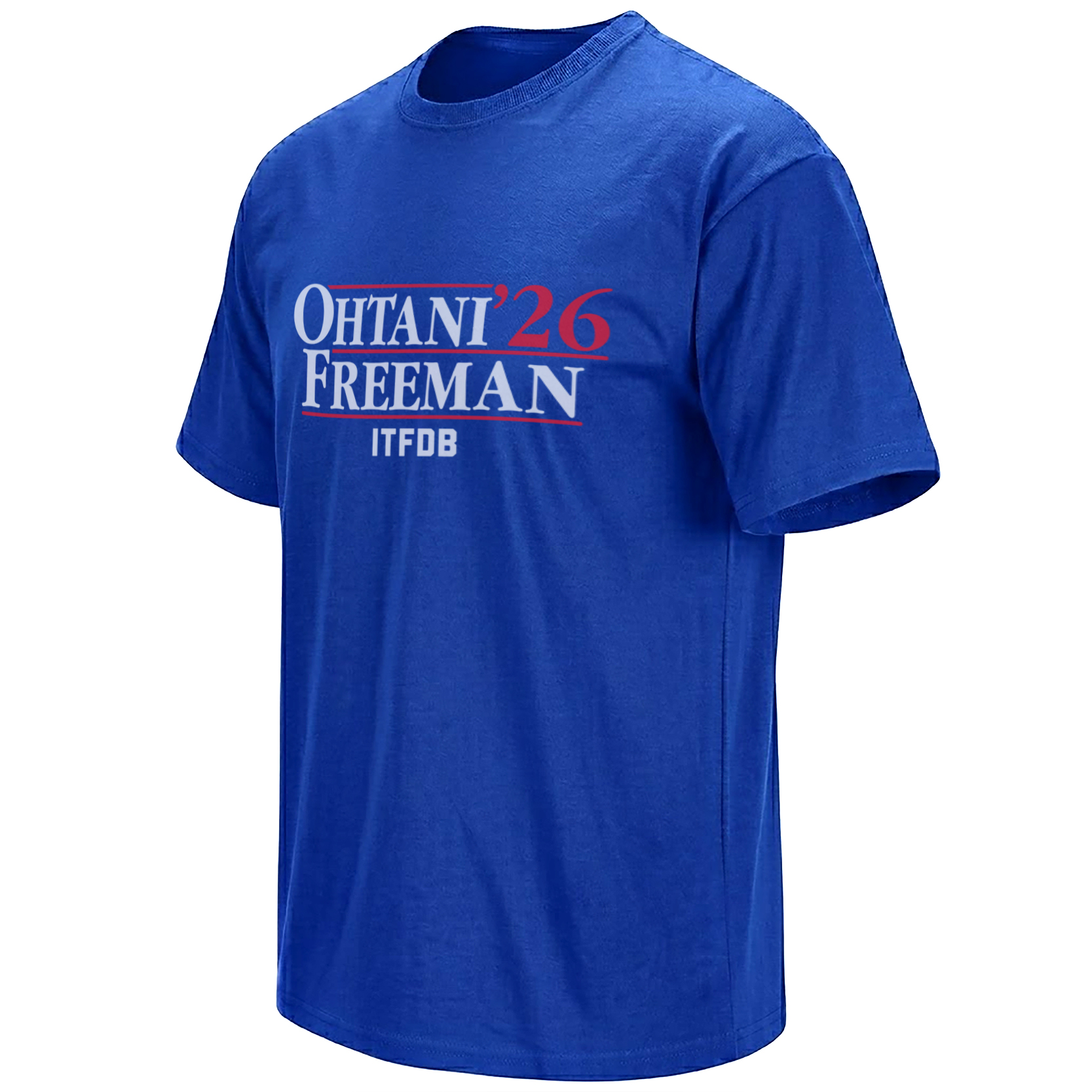
The broader Los Angeles Dodgers collection offers a visual archive of the team’s current stars, October moments and recurring fan references. The MLB collection places this playful graphic within the larger language of baseball fandom.
Readers following individual players can also explore the latest Shohei Ohtani designs and Freddie Freeman graphics .
Why the Campaign Joke Works Without an Actual Election
The shirt is not affiliated with a political campaign. Its humor depends on borrowing a universally recognizable design format and filling it with two baseball surnames that matter to Los Angeles.
A real postseason creates uncertainty, but the poster speaks in the language of confidence. It imagines Ohtani and Freeman as running mates, not because they play identical roles, but because their different baseball identities represent complementary sources of belief.
As the Dodgers prepare to meet Milwaukee in the NLCS, the underlying message remains open-ended. The season has not reached its final outcome. The graphic captures the confidence of a fan base at this moment, rather than pretending to know how October will finish.
Frequently Asked Questions
What does Ohtani ’26 Freeman mean?
It is an imaginary campaign-style baseball ticket pairing Dodgers stars Shohei Ohtani and Freddie Freeman for the 2026 season.
What does ITFDB stand for?
ITFDB means “It’s Time for Dodger Baseball,” the famous phrase associated with longtime Dodgers broadcaster Vin Scully.
Did the Dodgers advance to the 2026 NLCS?
Yes. Los Angeles eliminated the Atlanta Braves in four games, clinching the series with a 4–1 victory on October 7, 2026.
Why are Ohtani and Freeman featured together?
Both are defining figures of the Dodgers’ current championship era, combining Ohtani’s global star power with Freeman’s veteran leadership and memorable postseason history.
Is Ohtani Freeman ’26 an actual political campaign?
No. It is a baseball-themed visual parody using campaign typography and the Dodgers’ ITFDB expression, not an actual election ticket.
Vin Scully’s familiar opening words have outlived generations of lineups. The Ohtani ’26 Freeman graphic brings that long-running tradition into another October, when familiar stars and new playoff heroes are writing the next chapter.
Ohtani ’26 Freeman captures the Dodgers’ 2026 NLCS atmosphere through vintage campaign typography, Shohei Ohtani and Freddie Freeman’s star pairing, and the historic ITFDB phrase associated with Vin Scully and Los Angeles baseball.