Falcons Stankonia: Atlanta’s Football Duo Meets OutKast
Bijan Robinson and Drake London step into the visual world of a landmark OutKast album, connecting modern Falcons football to the city that helped redefine Southern hip-hop.
Atlanta had another reason to celebrate its football identity on October 5, 2026. The Falcons defeated the New Orleans Saints 45–24 on Monday Night Football, powered by an explosive offensive display in which Bijan Robinson rushed for 145 yards and Drake London added 96 receiving yards.
The result followed a Thursday night victory against Green Bay that had already demonstrated the influence of Atlanta’s leading offensive players. Suddenly, the conversation around the Falcons felt different. Their playmakers were generating real momentum, and two recognizable jersey numbers — Robinson’s 7 and London’s 5 — were becoming natural symbols of the team’s offensive identity.
But Atlanta’s cultural imagination has always stretched beyond the football field. When a graphic places Robinson and London against a distressed black-and-white American flag, another influential Atlanta duo immediately comes to mind: André 3000 and Big Boi of OutKast.
The connection is the cover of Stankonia, one of the most recognizable images in Southern hip-hop history. Reinterpreting that image through Falcons players creates a visual conversation between two forms of Atlanta identity separated by more than two decades.
Why the Original Stankonia Cover Still Matters
OutKast released Stankonia on October 31, 2000. Their fourth studio album brought together Southern rap, funk, experimental production, and unpredictable songwriting at a moment when Atlanta’s musical influence was becoming impossible to ignore.
Songs including “Ms. Jackson,” “So Fresh, So Clean,” and “B.O.B. (Bombs Over Baghdad)” helped establish the album’s reputation for balancing mainstream appeal with an adventurous sound.
The cover was photographed by Michael Lavine, with design and art direction credited to Mike Rush. Big Boi and André 3000 stood before a large monochrome American flag, its familiar symbols stripped of conventional red and blue.
The image was direct, confrontational, and memorable. Rather than using elaborate fantasy illustration, it presented two distinct personalities against an instantly recognizable national symbol. That contrast became part of the album’s lasting visual identity.

Big Boi and André 3000 on the original Stankonia cover. Photography: Michael Lavine. Art direction/design: Mike Rush. Album artwork reproduced from the Polyvinyl Record Co. album listing. Rights belong to their respective owners.
From André 3000 and Big Boi to London and Robinson
The Falcons reinterpretation uses two athletes whose football roles are different but complementary. Drake London, the team’s #5 receiver, contributes size, physicality, and the ability to win contested catches. Bijan Robinson, wearing #7, creates problems for defenses through rushing vision, acceleration, and versatility.
This contrast makes the two-person arrangement meaningful. A successful offense depends on players creating different threats, and Atlanta’s leading receiver and running back bring recognizable personalities to the same frame.
There is no suggestion that London represents one specific OutKast member musically or that Robinson represents the other. The parody instead borrows the visual grammar of a famous duo portrait, replacing the musicians with football players connected to the same city.
The original photograph becomes a cultural template. Its black-and-white flag remains recognizable, but the people standing in front of it belong to a new Atlanta conversation.
Album Release
Wide Receiver
Running Back
Atlanta’s 2026 Offense Gives the Crossover New Energy
The timing of the artwork also feels relevant to the current season. In Atlanta’s September 24 victory over Green Bay, Robinson rushed for 194 yards while London recorded 194 receiving yards. The Falcons won 35–14, an unusually balanced demonstration of rushing and passing dominance.
Against New Orleans eleven days later, Robinson opened the scoring with a 59-yard touchdown run. His two rushing scores contributed to another convincing road win, while London remained the team’s leading receiving presence.
Quarterback Michael Penix Jr. deserves recognition for his role in that improvement. Atlanta’s renewed offensive rhythm cannot be attributed exclusively to two players, but Robinson and London provide an especially clear expression of the team’s identity.
The 2026 game results are context for the cultural crossover. The album-cover parody is not a claim that OutKast collaborated with the Falcons or released the design to commemorate one particular victory.
Atlanta made its musical identity unmistakable decades ago. Its newest football duo gives that visual language another way to speak.
Why Stankonia Is an Especially Atlanta Reference
OutKast’s importance extends beyond commercial success. André 3000 and Big Boi challenged assumptions about what Southern hip-hop could sound like and helped make Atlanta central to broader national music conversations.
Their work remains a cultural reference for people who identify with Atlanta’s creativity, humor, ambition, and willingness to develop its own style instead of copying an established center.
The Falcons occupy a separate but equally visible place in that city identity. Football and music reach different audiences, yet both help define how a city represents itself to the outside world.
An album-cover parody works because it recognizes that shared geography. The joke is not merely two football players replacing two musicians. It is that Atlanta fans can understand both images as belonging to their city.
The Design Language: An Album Cover Reimagined
The Falcons Stankonia Shirt uses a rectangular composition positioned on a black shirt. A heavily distressed American flag forms the background, and two figures in black Atlanta uniforms occupy the foreground.
London appears on the left in jersey #5, standing upright, while Robinson takes the right side in jersey #7 with white gloves extended toward the viewer. The contrasting poses echo the individuality that made the original album cover memorable.
The artwork uses grayscale imagery, subtle distressing, and recognizable jersey numbers rather than oversized team slogans. Its muted surface recalls vintage music merchandise and old record-store graphics.
The choice to omit the OutKast logo and album title is significant. Recognition depends on the audience understanding the historic portrait arrangement. For someone familiar with Stankonia, the reference arrives almost immediately.
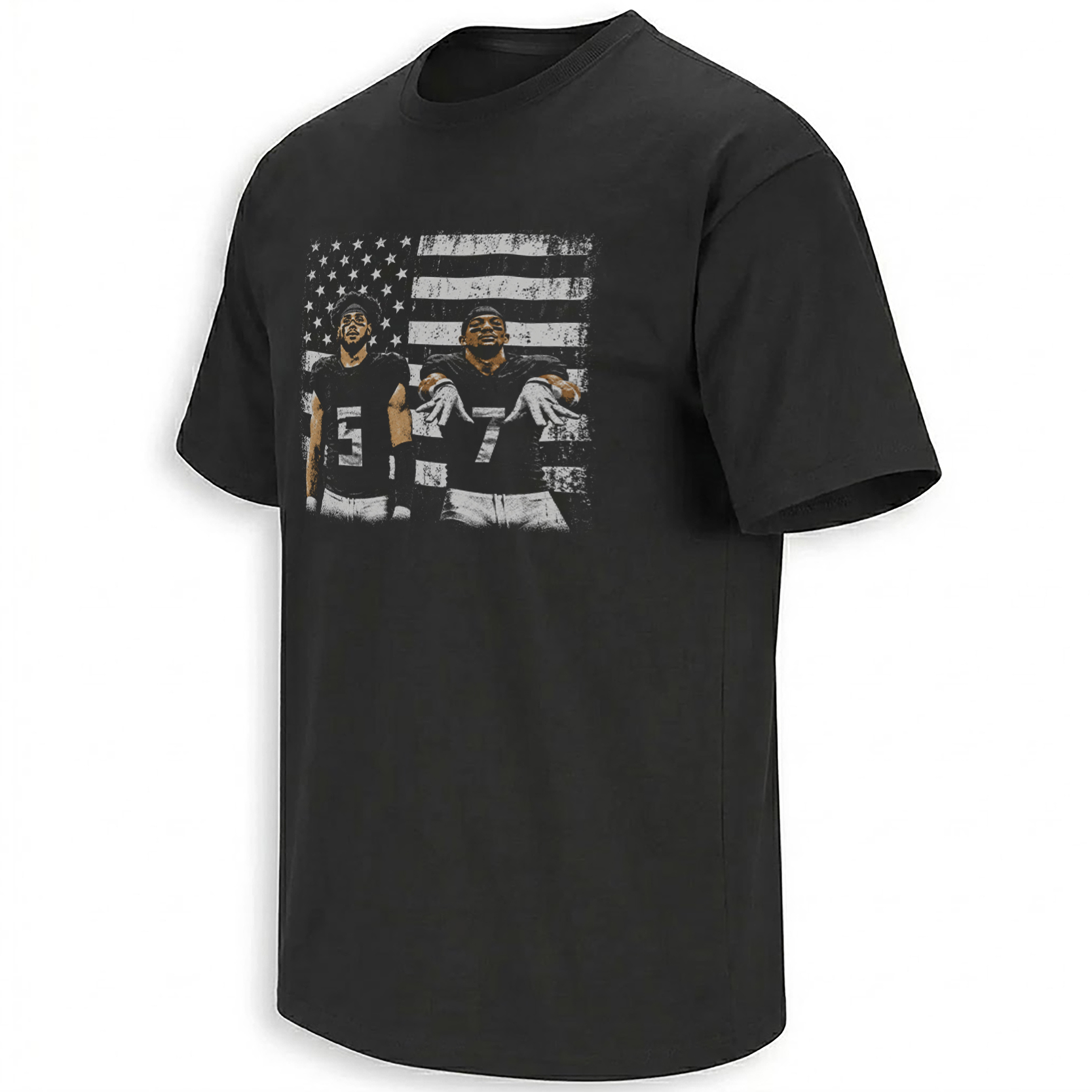
A football reinterpretation of a defining Atlanta hip-hop image, with the Falcons duo replacing OutKast’s iconic two-person portrait.
View the crossover graphic →How Fans Connect Music and Football Culture
The continuing appeal of Stankonia is visible in hip-hop communities, where listeners regularly return to its experimentation, individual tracks, and influence on later Southern music.
Meanwhile, Falcons supporters are discussing a developing 2026 offense that has produced consecutive commanding victories. The two conversations are not identical, but the parody allows them to meet through one piece of visual shorthand.
The Atlanta Falcons collection provides the broader football context, while the NFL collection connects the graphic with wider fan culture.
Readers interested in specific player references can explore searches for Bijan Robinson, Drake London, and OutKast-inspired artwork.
This is an album-cover-inspired football parody, not an official OutKast, NFL, or Atlanta Falcons collaboration. The underlying artwork references the historical Stankonia cover rather than reproducing a specific official music release.
Frequently Asked Questions
What album inspired the Falcons Stankonia design?
OutKast’s Stankonia, released October 31, 2000, inspired the composition featuring two people before a monochrome American flag.
Who appears on the Falcons version?
Drake London, Atlanta Falcons wide receiver #5, and Bijan Robinson, running back #7, appear in the football reinterpretation.
Who created the original Stankonia cover?
Photographer Michael Lavine shot the OutKast portrait, with art direction and design credited to Mike Rush.
Why does the Stankonia reference fit Atlanta football?
OutKast and the Falcons both belong to Atlanta’s cultural identity, allowing the artwork to connect Southern hip-hop history with contemporary NFL players.
The Falcons Stankonia graphic captures how a historic album cover can become a fresh expression of the city that inspired it.
Falcons Stankonia reimagines OutKast’s 2000 album cover with Bijan Robinson #7 and Drake London #5, blending Atlanta football culture, Southern hip-hop history, and vintage monochrome artwork.