
Woo Pig Sooie: The Sound Arkansas Keeps Carrying From One Generation to the Next
Arkansas can change coaches, quarterbacks, seasons and expectations. The Hog Call survives all of it — because “Woo Pig Sooie” belongs to Razorback identity before it belongs to any scoreboard.
Three days before Arkansas hosts No. 15 Tennessee at Donald W. Reynolds Razorback Stadium, the most predictable sound in Fayetteville has nothing to do with the final score. At some point, thousands of arms will rise, fingers will move and one enormous “Woooo” will begin to climb.
That is the unusual power of “Woo Pig Sooie.” It does not require Arkansas to be undefeated. It does not depend on one superstar. It is older than the current conference landscape, older than modern television and old enough that generations of Razorback families learned it before they learned many of the names on the roster.
The phrase is officially known as the Hog Call, and Arkansas Athletics describes it as one of the most recognizable chants in sports. The full ritual is physical as well as verbal, turning a cheer into something closer to choreography shared by an entire stadium.
Arkansas does not simply have a slogan printed beneath its mascot. It has a phrase the crowd physically performs together.
What Does “Woo Pig Sooie” Mean?
In the simplest terms, “Woo Pig Sooie” is the University of Arkansas Hog Call — the cheer Razorback fans use to rally their teams. But trying to translate it like an ordinary sentence misses the point. Its meaning comes from participation.
Arkansas’ official instructions begin with fans raising their arms while stretching out the “Woo.” The hands come down on “Pig,” then the right arm extends on “Sooie.” The sequence repeats three times before the crowd finishes with “Razorbacks!”
The drawn-out opening is important because it lets the sound grow across a large space. One section can start it, another can join it and within seconds an arena or stadium can become one voice.

The Razorback Name Came Before the Hog Call
Arkansas Athletics traces the Razorback identity to 1909. After a 16–0 victory over LSU, coach Hugo Bezdek described his team as playing like a “wild band of Razorback hogs.” The comparison landed immediately. In 1910, students voted to replace the school’s old Cardinals nickname with Razorbacks.
The Hog Call arrived later, becoming part of Arkansas school-yell culture during the 1920s. That sequencing explains why the two pieces fit together so naturally today: first came the animal identity, then came a sound built to summon it.
1909 gave Arkansas the “wild band of Razorback hogs” description. Students formally adopted Razorbacks in 1910. By the 1920s, “Wooo, Pig, Sooie” had become the school yell commonly known as the Hog Call.
Why the Profile Hog Matters to the Design
The hog on this artwork is not just a generic farm-animal illustration. Arkansas identifies its distinctive side-view mark as the Profile Hog, a symbol built around the leaner, more aggressive image associated with the wild Razorback.
That distinction matters visually. The animal appears moving forward, with its ridge, snout and tusks creating a shape recognizable even without color. Three horizontal stripes underneath add velocity before the eye reaches “RAZORBACKS” and, finally, “WOO PIG SOOIE.”
The black-and-gray treatment deliberately avoids the bright cardinal-red approach used by many Arkansas graphics. Instead, it feels closer to an old athletic department shirt or faded stadium souvenir — useful for a design built around a tradition rather than one particular season.
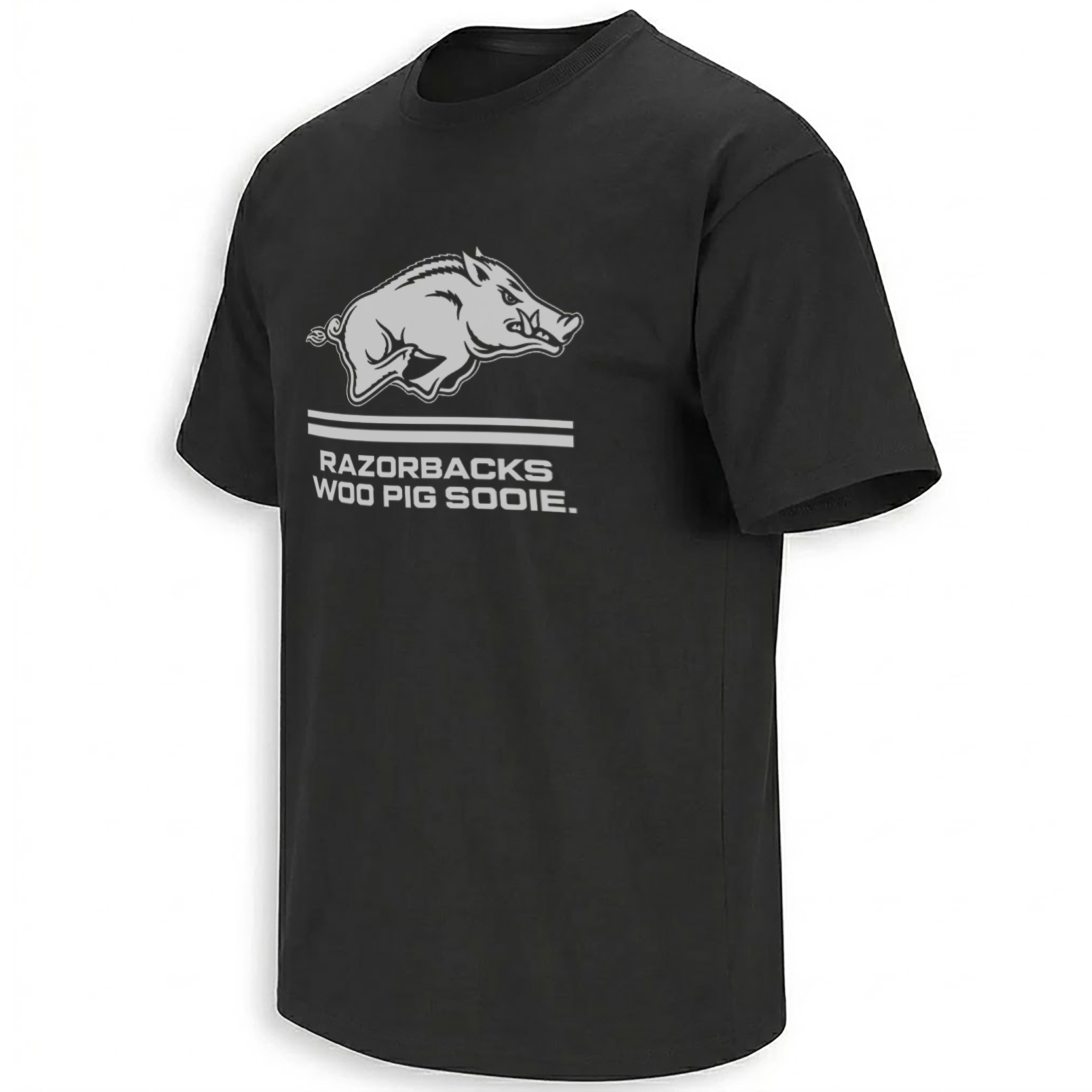
A monochrome charging Razorback, racing stripes and the famous Hog Call compress more than a century of Arkansas identity into one compact visual.
View the tradition piece →Why the Chant Still Matters in 2026
Arkansas enters another home Saturday with No. 15 Tennessee coming to Fayetteville. Results change the mood around any program, but traditions become most visible precisely because they survive those fluctuations.
“Woo Pig Sooie” works after a touchdown, before kickoff, at basketball games, baseball weekends and university events. It also travels. Two Arkansas fans can encounter each other far outside the state and use the call as instant recognition.
That makes the wider Arkansas Razorbacks collection less like one-sport merchandise and more like a running archive of Hog culture — football Saturdays, March basketball, Omaha baseball and traditions that cross all of them.
The broader NCAA collection places the phrase inside what makes college sports distinctive in the first place: schools do not only have teams. They have chants, gestures, songs and rituals inherited from people who attended decades earlier.
Frequently Asked Questions
What does Woo Pig Sooie mean?
“Woo Pig Sooie” is the traditional University of Arkansas Hog Call used by Razorbacks fans to cheer Arkansas athletic teams.
How do Arkansas fans Call the Hogs?
Fans raise their arms during a long “Woo,” pull both arms down on “Pig,” extend the right arm on “Sooie,” repeat the call three times and finish with “Razorbacks!”
When did Woo Pig Sooie become an Arkansas tradition?
Arkansas historical material dates the school yell commonly known as the Hog Call to the 1920s.
Why is Arkansas called the Razorbacks?
Coach Hugo Bezdek described his 1909 football team as playing like a wild band of Razorback hogs, and students officially adopted Razorbacks as the school nickname in 1910.
What is the Profile Hog?
Profile Hog is Arkansas Athletics’ name for its distinctive side-profile Razorback symbol.
Is Woo Pig Sooie only a football tradition?
No. Calling the Hogs is a broader Arkansas athletics tradition used across Razorback sports and university culture.
The Woo Pig Sooie graphic preserves Arkansas in its most durable form: one unmistakable hog and the words Razorback crowds have been taught to answer for generations.
Woo Pig Sooie Shirt combines the Arkansas Razorbacks Profile Hog with the historic Hog Call that has defined Fayetteville fan culture since the 1920s, using a clean black-and-gray vintage athletics layout.