
The Baby Lion Roars Again: Yoshinobu Yamamoto Owns Another October Night
Ten strikeouts against Atlanta gave the Dodgers a 2–1 NLDS lead and added another serious postseason chapter to one of the funniest Shohei Ohtani–Yamamoto jokes in Dodgers culture.
The joke says Yoshinobu Yamamoto is a baby lion. The baseball keeps making that description harder to believe.
On October 6 at Truist Park, Yamamoto stepped into NLDS Game 3 opposite Chris Sale and gave Los Angeles exactly the kind of start that has turned his October résumé into something much larger than a cute nickname. Seven innings. Four hits. One run. One walk. Ten strikeouts. A postseason career high.
The Dodgers won 3–1 and moved ahead of Atlanta 2–1 in the best-of-five series. Yamamoto’s tenth and final strikeout came against Austin Riley on a 90.8 mph splitter in the seventh, a pitch that completed the most strikeout-heavy postseason appearance of his Major League career.
The Baby Lion started as an affectionate visual joke. October keeps turning it into an ace mythology.
What Happened in Yamamoto’s 10-K NLDS Game?
Atlanta created its only serious trouble in the fifth inning, loading the bases with one out and pushing a run across on a Drake Baldwin groundout. Yamamoto did not allow the frame to become a collapse. He limited the damage, worked out of it and kept pitching through the seventh.
That mattered because Game 3 arrived with the series tied 1–1. The Dodgers were not protecting a comfortable advantage; they were trying to regain control of a matchup that had shifted to Atlanta. Dave Roberts’ pregame confidence was uncomplicated: he said he trusted Yamamoto “undoubtedly.”
By the final line, Yamamoto had become the first Dodger since Blake Snell in the 2025 Wild Card round to deliver at least seven postseason innings with 10 strikeouts and no more than one run allowed. He also joined Shohei Ohtani and Hiroki Kuroda among Japanese-born pitchers to reach double-digit strikeouts in a postseason start.
Why Is Yoshinobu Yamamoto Called the Baby Lion?
The nickname is much more specific than a generic “lion-hearted competitor” metaphor. Its origin is visual.
During Game 2 of the 2024 World Series, cameras caught Yamamoto repeatedly opening his mouth in a roar-like celebration while shutting down the Yankees. Fans in Japan began comparing the expression to a young lion trying to sound ferocious. Shohei Ohtani then amplified the comparison on Instagram Stories by placing Yamamoto’s roaring face beside a baby lion making almost the same expression.
Because Instagram Stories expire, the original post is no longer a persistent embed that can responsibly be dropped into a current article. But contemporary Japanese coverage documented Ohtani’s side-by-side post and the fan response around it. The comparison did not disappear when the Story did.
The lion in the design is not a random symbol added because Yamamoto is dominant. It points back to a specific Ohtani social-media joke that followed Yamamoto from the 2024 World Series into Dodgers fan culture.
Then the “Little Lion” Became a World Series MVP
The joke became funnier because Yamamoto’s postseason reputation kept moving in the opposite direction. In 2025 he built one of the defining pitching runs of the Dodgers’ championship repeat, eventually earning World Series MVP and returning on zero days’ rest to pitch 2 2/3 scoreless relief innings in Game 7.
By DodgerFest in February 2026, reporters were asking Ohtani whether the little lion had graduated into an adult one. Ohtani agreed that the World Series performance had earned Yamamoto an upgrade — and then immediately joked that because his teammate had skipped DodgerFest, he had been demoted back to little lion status.
Why No. 18 Makes the Graphic More Than a Meme
The design places Yamamoto in Dodgers No. 18 in front of a much larger pale-blue lion, and that number carries its own baseball language. In Japan, 18 has long been associated with an ace pitcher. Yamamoto wore it before coming to Major League Baseball and kept it in Los Angeles.
That makes the visual hierarchy unusually efficient. The royal-blue base establishes Dodgers identity. The vintage player-name banner gives the composition the feel of an old collectible poster. Yamamoto’s caricature supplies personality. The lion behind him acts almost like a second shadow — larger, louder and making the same open-mouth expression.
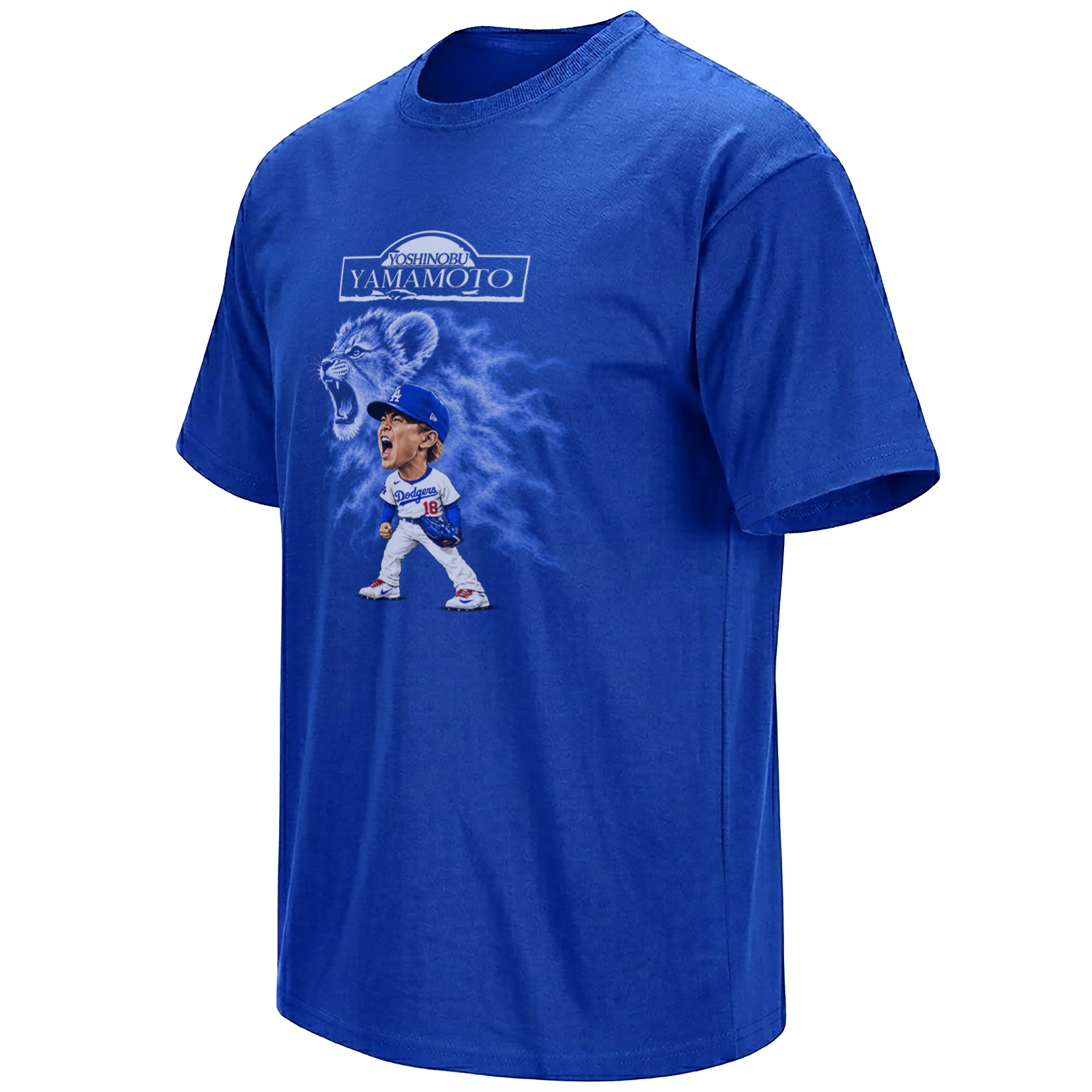
Yamamoto’s matching roar and the pale-blue lion turn an Ohtani inside joke into a player graphic that now carries several Octobers of Dodgers memory.
View the Baby Lion piece →October Changed the Meaning of the Lion
In 2024, “baby lion” worked because Yamamoto looked unexpectedly animated while pitching. In 2025, it became an affectionate contrast between the cute image and a World Series MVP performance. After Tuesday’s 10-strikeout start, the joke has acquired another layer: Dodgers fans can use a deliberately small animal to describe a pitcher who increasingly feels enormous in postseason games.
That tension is what keeps the meme alive. If Yamamoto were simply portrayed as a giant roaring lion, the visual would become ordinary sports mythology. Making him the little lion preserves Ohtani’s teasing relationship with him and the self-aware humor that made the comparison spread in the first place.
More Yamamoto moments sit naturally inside the Los Angeles Dodgers collection, while the broader postseason visual archive continues through the MLB collection. Designs centered specifically on the pitcher can be found through the Yoshinobu Yamamoto search.
Because Ohtani is part of the origin story rather than a random secondary mention, his wider EllieShirt archive is also relevant through the Shohei Ohtani product search.
Frequently Asked Questions
Why is Yoshinobu Yamamoto called the Baby Lion?
Fans compared Yamamoto’s roaring celebration during the 2024 World Series to a young lion, and Shohei Ohtani amplified the joke by posting Yamamoto and a baby lion side by side on Instagram Stories.
Did Shohei Ohtani really participate in the Baby Lion joke?
Yes. Ohtani posted the original comparison and later joked at DodgerFest 2026 that Yamamoto had become an adult lion after his World Series heroics before being demoted back to a little lion for skipping the event.
What did Yamamoto do in 2026 NLDS Game 3?
Yamamoto threw seven innings against Atlanta, allowed four hits and one run, walked one and struck out a postseason career-high 10 as Los Angeles won 3–1.
What is the Dodgers-Braves NLDS situation after Game 3?
Los Angeles leads the best-of-five series 2–1 and enters Game 4 one victory from advancing to the National League Championship Series.
Why does Yamamoto wear No. 18?
No. 18 has traditional ace-pitcher significance in Japanese baseball, and Yamamoto has carried the number from his career in Japan to the Dodgers.
What does the Baby Lion Shirt represent?
The design combines Yamamoto’s Dodgers No. 18 identity, his roaring on-field expression, Ohtani’s Baby Lion joke and the postseason reputation that has grown around him from 2024 through the 2026 NLDS.
The Yoshinobu Yamamoto Baby Lion graphic preserves the humor that started with Ohtani while the 10-strikeout NLDS performance gives the little lion another postseason reason to roar.
Yoshinobu Yamamoto Baby Lion Shirt connects Dodgers No. 18 with Shohei Ohtani’s viral little-lion joke and Yamamoto’s 10-strikeout performance in 2026 NLDS Game 3, turning a playful roar into an October ace graphic.