Cleveland Has Said “This Year’s Our Year” for Decades. Then the 2026 Browns Started 3–1.
The funniest part of being a Browns fan is that hope never learns. Nearly six decades of Super Bowl-era seasons sit inside one orange timeline—and suddenly the oversized 2026 at the bottom feels slightly less ridiculous.
There are fan bases that use “this is our year” as an ordinary preseason prediction. In Cleveland, it feels closer to an inherited ritual. The words contain confidence, self-awareness, scar tissue and the understanding that everyone in the room has probably heard the same sentence before.
That is what makes the Browns’ 2026 start dangerous in the best possible way. Cleveland improved to 3–1 on October 1 by beating Pittsburgh 27–24 on a 56-yard Andre Szmyt field goal with ten seconds remaining. The win was the Browns’ third in a row, their first three-game winning streak since 2021.
Suddenly, the annual joke has evidence.
Hope springs eternal because Cleveland keeps finding new reasons to believe—and new memories that should have taught everyone not to.
“This Is Our Year” was already a Browns joke before the season began
On January 1, long before Cleveland reached 3–1, a Browns fan opened the new calendar with a Reddit post titled “Happy New ‘This Is Our’ Year.” The replies sounded like generations of Browns football compressed into one conversation.
One fan corrected the phrase to “There’s Always Next Year.” Another wrote that “it’s always our year.” Someone else supplied the line that could function as the emotional motto for the entire fan base: “Hope springs eternal.”
That mixture of optimism and self-protection is crucial. Browns fans know the history. The joke works precisely because the people saying “this is our year” understand why everybody else laughs.
Why the timeline begins with 1967
The design does not begin with the founding of the Browns. It begins with 1967—the calendar year of the first Super Bowl—and then stacks season after season toward the present.
That choice separates Cleveland’s historic greatness from its Super Bowl-era frustration. The Browns were champions before the modern Super Bowl became football’s defining destination. Their most recent NFL championship came in 1964, when Cleveland defeated the Baltimore Colts 27–0.
The problem is everything that followed. The franchise has produced legends, playoff teams, famous rivalries, heartbreaking AFC Championship runs and multiple generations of supporters without making the Super Bowl.
Listing 1967 through 2025 does not erase Cleveland’s pre-Super Bowl championships. It isolates the modern wait. The oversized 2026 then asks the same question Browns fans have asked at the beginning of countless seasons: what if this one finally breaks the pattern?
Then Cleveland actually gave the joke momentum
The October 1 win over Pittsburgh had exactly the emotional structure required to activate Cleveland optimism. The Browns built an advantage, watched the Steelers erase an 11-point fourth-quarter lead, then found one final drive when the game appeared to be slipping away.
Szmyt’s 56-yarder put Cleveland ahead with ten seconds left. Grant Delpit intercepted Aaron Rodgers one second before the end. Huntington Bank Field had the sort of ending that makes rational fans do irrational math about January.

Deshaun Watson finished with 268 passing yards. Cleveland’s defense produced five sacks and two interceptions. For a fan base conditioned to expect the trap door, the Browns instead found a way to survive it.
Nobody needs to plan a parade after four games. That restraint is part of why the artwork works. It does not claim Cleveland has won anything. It simply highlights 2026 more aggressively than every previous season and allows fans to participate in the recurring ritual one more time.
Why “Hope Springs Eternal” is the real punchline
The strongest line on the graphic may not be “This Year’s Our Year” at all. It is the smaller phrase underneath: HOPE SPRINGS ETERNAL.
That wording turns the shirt away from simple bragging. It admits that belief keeps regenerating regardless of evidence. A disappointing December becomes a draft conversation. The draft becomes training camp optimism. Training camp becomes Week 1. A couple of wins become standings math. Then another autumn begins.
For Cleveland, that cycle is communal rather than merely naive. Browns fandom has survived relocation, expansion-era rebuilding, endless quarterback debates, playoff droughts and brutal endings because the team is embedded in family memory and local identity. Hope is part of the cost of admission.
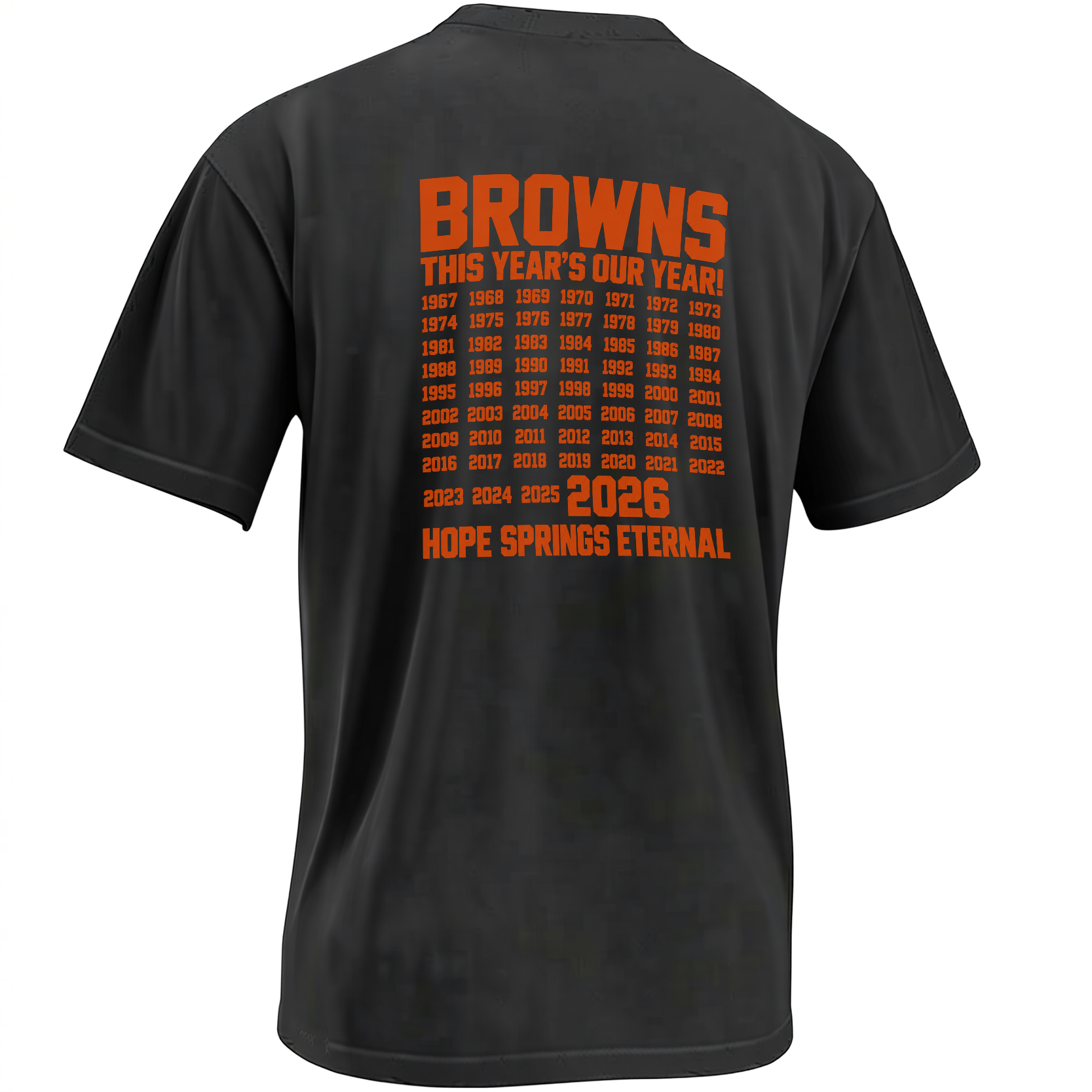
A nearly six-decade orange timeline that turns repeated Browns optimism into a visual archive, then gives 2026 one oversized chance to be different.
View the Cleveland piece →Why the artwork looks like a record of emotional endurance
The design is almost entirely typography. “BROWNS” occupies the top in heavy orange block letters. “THIS YEAR’S OUR YEAR!” establishes the recurring promise. Then the center fills with tightly packed years, creating a rectangle that resembles a ledger or archive.
The visual joke arrives when the rhythm breaks. Every old season receives roughly equal treatment until 2026 explodes in scale near the bottom. The current year is not objectively more important yet. The fan has simply decided to believe that it might become more important.
Orange against black is enough to establish Cleveland without relying on a helmet, mascot or individual player. That makes the design less about one roster and more about the psychology of Browns fandom itself.
From the Dawg Pound to the wider NFL memory
This is why a 2026 Browns graphic can function as both optimism and satire at the same time. Cleveland fans are laughing at the repetition while participating in it. The wearer can point to all those previous years and still say, with a straight face or a grin, that this one is different.
The broader Cleveland Browns collection works as a running visual archive of that culture—from players and rivalry moments to the slogans fans use to survive another season. The NFL collection places that Cleveland optimism inside the wider language of football memes, game-day emotion and city identity.
At 3–1, nobody knows whether the oversized 2026 will age like prophecy or become another line in the joke. That uncertainty is exactly why the shirt feels alive right now.
Frequently Asked Questions
What does the Browns “This Year’s Our Year” shirt mean?
It jokes about the recurring optimism of Cleveland Browns fans by listing Super Bowl-era seasons from 1967 through 2025, then dramatically enlarging 2026 as the latest year fans are willing to believe could finally be different.
Why does the Browns timeline start in 1967?
The first Super Bowl was played in January 1967. Starting there separates Cleveland’s historic pre-Super Bowl championships from the long modern-era wait represented by the design.
When did Cleveland last win an NFL championship?
The Browns’ most recent league championship came in 1964, when Cleveland defeated the Baltimore Colts 27–0 in the NFL Championship Game.
What does “Hope Springs Eternal” mean for Browns fans?
It describes the habit of beginning each new season with renewed belief despite decades of disappointment, a sentiment Browns fans themselves were using online before the 2026 season developed.
Why does the 2026 version feel especially timely?
Cleveland opened 3–1 and entered October on a three-game winning streak after a dramatic 27–24 victory over Pittsburgh, giving the annual “our year” joke an unusually convincing early-season backdrop.
The This Year’s Our Year graphic turns decades of Cleveland optimism into one orange timeline, while the wider Browns archive continues recording whatever 2026 becomes.
This Year’s Our Year Shirt turns the Cleveland Browns’ Super Bowl-era wait into a 1967–2026 timeline, pairing an oversized 2026 with “Hope Springs Eternal” as the 3–1 Browns give Dawg Pound optimism fresh life.