
Austin Riley and Chris Sale Set Atlanta’s October Tone
Atlanta’s Wild Card Series has already swung from euphoria to survival mode, but the images that defined Game 1 remain unmistakable: Chris Sale throwing 100 mph past Bryce Harper, then Austin Riley flipping the game with one violent eighth-inning swing.
Twenty-four hours changed the emotional temperature of Atlanta’s postseason. The Braves walked out of Game 1 feeling as if they had finally found an answer to Philadelphia’s recent October grip on them. By the end of Game 2, the Phillies had answered back with a 4-3 victory in 10 innings and turned the Wild Card Series into one game for everything.
That makes the opening game even more useful as a portrait of what Atlanta needs again. Chris Sale supplied the pressure from the mound. Austin Riley supplied the release at the plate. One looked like an ace trying to rewrite his own postseason history; the other looked like a hitter erasing six months of frustration with a single swing.
In fan culture, that pairing almost writes its own vocabulary. “FINAL SALE” fits a pitcher who wants the discussion to end when he takes the ball. “STONE COLD AUSTIN RILEY” turns a wrestling-name joke into something closer to an October personality after Riley’s cold-blooded three-run homer.
Game 1 gave Atlanta two kinds of postseason violence: Sale attacking hitters from the mound and Riley ending the argument with one swing.
Chris Sale finally got his Braves October start
Sale had waited a long time for this particular stage. Back trouble prevented him from pitching during Atlanta’s 2024 postseason appearance, and the Braves missed October entirely in 2025. When he finally took the mound against Philadelphia on September 29, it was his first playoff start in five years and his first as a Brave.
He pitched like somebody determined not to waste it. Sale struck out nine across 6⅓ innings, his longest and highest-strikeout postseason start to that point. The first inning produced the image that captured his adrenaline best: with Bryce Harper at the plate, the 37-year-old reached back for a 100 mph fastball and blew it past him for strike three.
That velocity mattered because it was not just a radar-gun curiosity. Sale entered October after another elite regular season, posting a 2.16 ERA and reaching 200 strikeouts for the ninth time in his career. The playoff question around him was never whether his career had been impressive. It was whether this version of Chris Sale could author an Atlanta October chapter that finally matched the reputation.

Then Riley changed the ending
Sale’s line alone was not enough. Philadelphia moved ahead in the seventh, and Atlanta entered the bottom of the eighth trailing 3-2. Two outs later, with two Braves aboard, Riley faced All-Star closer Jhoan Duran.
Duran threw 99.9 mph. Riley turned it around.
The three-run homer changed 3-2 Philadelphia into 5-3 Atlanta and gave Riley another entry in an unusual personal postseason pattern. MLB noted that the previous Braves hitter to produce a go-ahead homer while trailing in the eighth inning or later of a playoff game was also Riley, against the Phillies in 2023.
It was especially sharp because Riley’s regular season had been difficult by his own standards. October reset the emotional ledger immediately. Manager Walt Weiss described the postseason as a clean slate, and Riley supplied the most literal version possible: one swing, one lead, one celebration that made the previous months temporarily irrelevant.

Why “Stone Cold Austin Riley” suddenly fits October
The phrase begins with an obvious pop-culture collision. “Stone Cold Steve Austin” remains one of professional wrestling’s most recognizable names, while Atlanta’s third baseman happens to be Austin Riley. Replacing one Austin with another creates the joke instantly.
But the Stone Cold Austin Riley Shirt works because the art does not treat that reference delicately. Riley appears in an emotional yell beside distressed, oversized lettering that resembles a fight poster more than a conventional baseball nameplate.
After Game 1, “Stone Cold” gained situational meaning. The humor still comes from wrestling nostalgia, but the baseball context now points to a two-out swing against an elite closer with Atlanta trailing in October.
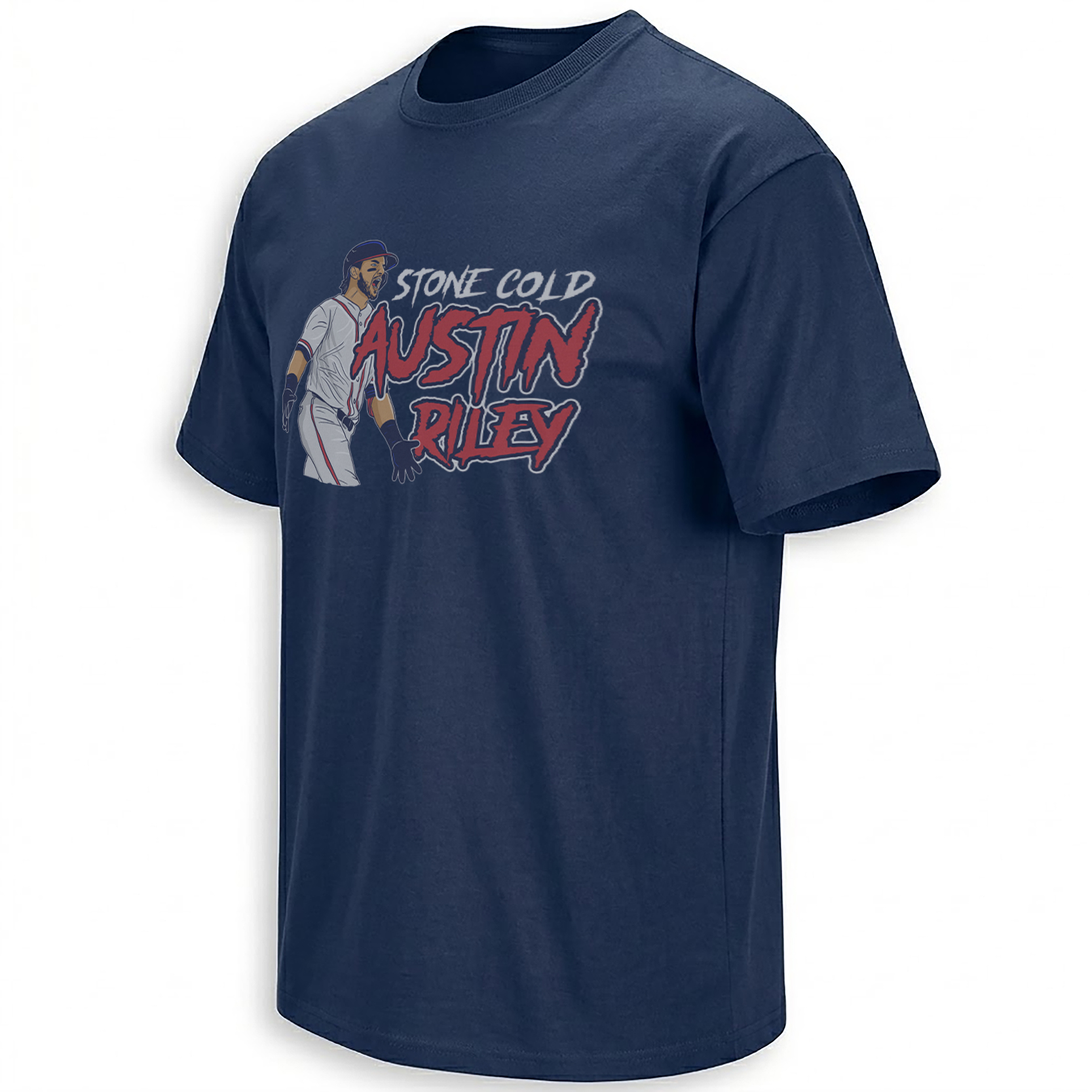
Darker Braves streetwear treatment for the wrestling-baseball crossover.
View the piece →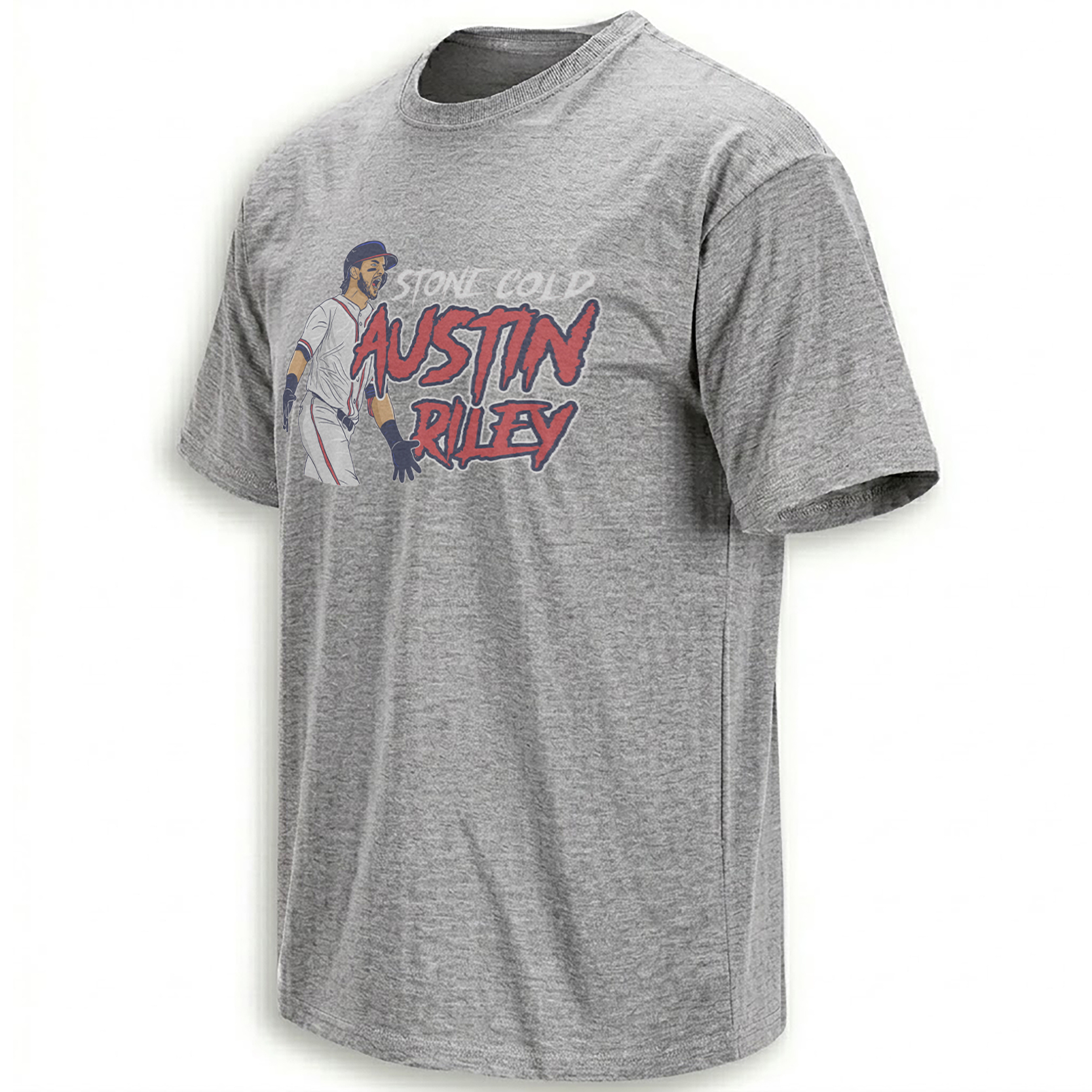
The neutral base puts the distressed Riley typography at the center.
See the graphic →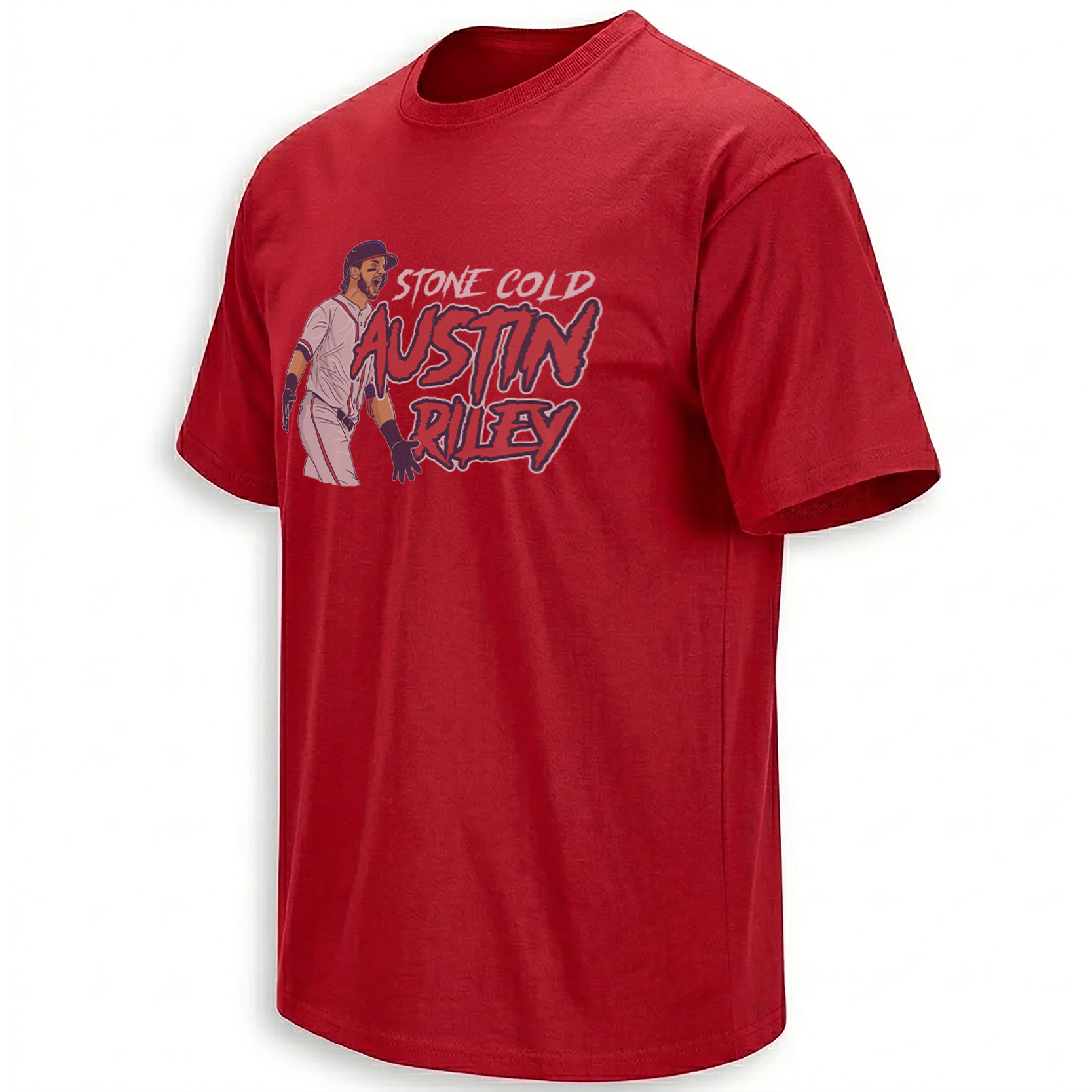
The loudest version, closer to the visual energy of a postseason fight poster.
Open the design →“Final Sale” turns an ace into a closing statement
Chris Sale’s design uses a completely different kind of wordplay. There is no crossover character or borrowed persona. His surname is enough. “FINAL SALE” already sounds absolute: no negotiation, no reopening the discussion.
Visually, that fits his pitching identity. Sale is shown driving through his left-handed delivery while the giant red word “SALE” dominates the composition. The image is about motion rather than portraiture — long limbs, unusual arm slot and aggression moving toward the hitter.
After the Harper strikeout and nine-strikeout start, the phrase reads less like retail signage and more like the tone of an ace trying to close off an opponent’s options.
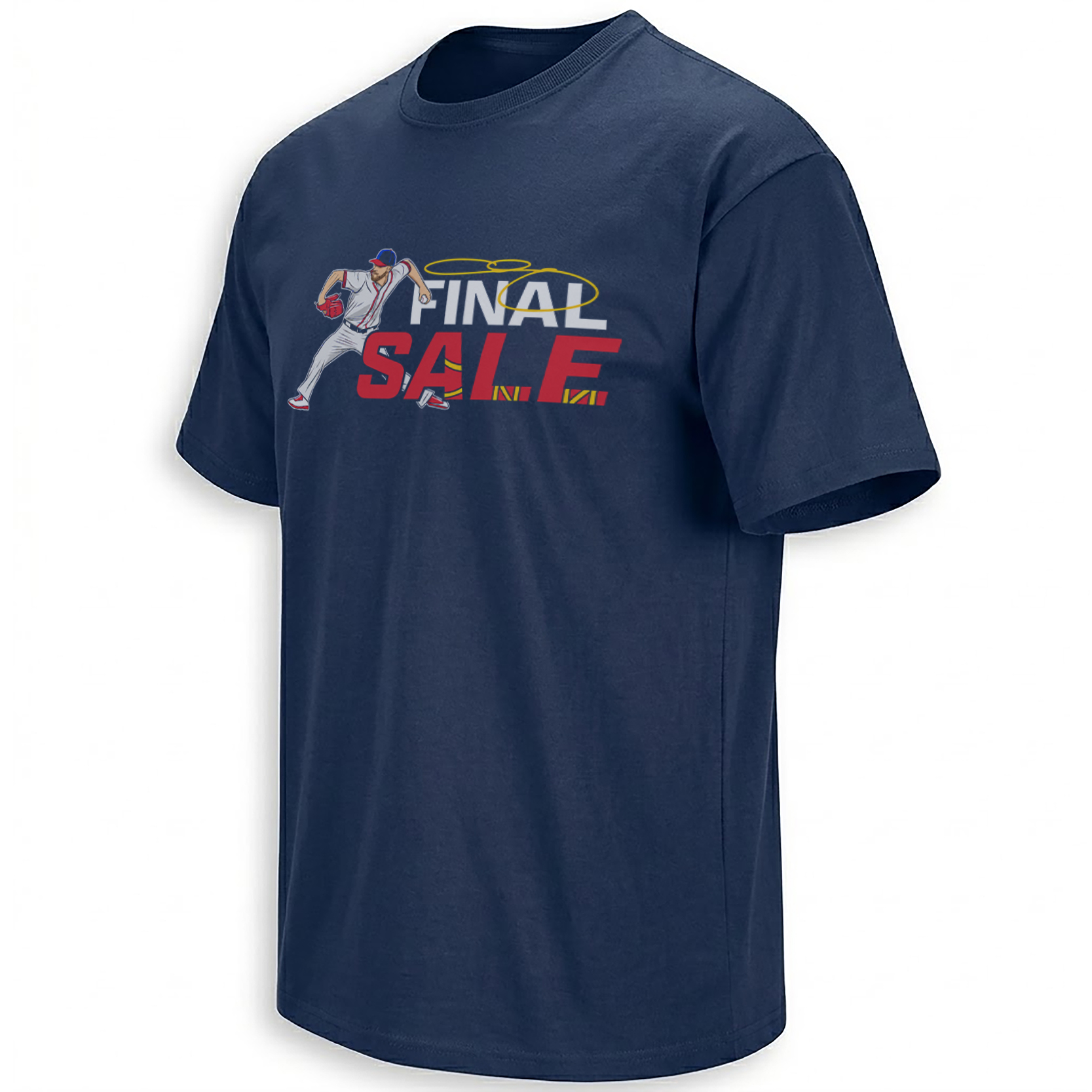
A surname-driven Braves graphic now tied naturally to Sale’s 100-mph, nine-strikeout Wild Card performance.
View the piece →Game 2 changed the stakes, not the memory
Philadelphia’s extra-inning Game 2 win prevented the opening night from becoming a clean series narrative. That is exactly why Game 3 now matters so much. Atlanta is no longer celebrating a 1-0 lead; it is trying to recreate the intensity that produced it.
This is also where the two designs work together without needing to become a matching set. Riley represents the hitter who produced the decisive blow. Sale represents the veteran ace who established the emotional temperature. One is wrestling-sized personality; the other is minimalist surname wordplay.
The wider Atlanta Braves collection now sits inside a live postseason story rather than a completed celebration. The broader MLB collection works the same way, collecting the player phrases and visual jokes that emerge before anyone knows which teams will still be playing a week later.
For player-specific browsing, Ellie Shirt also has direct searches for Austin Riley designs and Chris Sale designs.
FAQ: Riley, Sale and Braves-Phillies Game 3
What did Austin Riley do in Wild Card Game 1?
Riley hit a go-ahead three-run home run with two outs in the eighth inning, turning a 3-2 Braves deficit into a 5-3 lead.
How did Chris Sale pitch in Game 1?
Sale worked 6⅓ innings and struck out nine, the longest and highest-strikeout postseason start of his career to that point.
Did Chris Sale really throw 100 mph to Bryce Harper?
Yes. Sale struck Harper out with a 100 mph fastball in the first inning.
Why is the Austin Riley design called “Stone Cold”?
The phrase is a name-based wrestling reference that replaces Stone Cold Steve Austin with Braves third baseman Austin Riley.
What does “Final Sale” mean on the Chris Sale design?
It turns Sale’s surname into a familiar two-word phrase and reframes it as a closing statement for Atlanta’s ace.
What is the Braves-Phillies series score?
The 2026 NL Wild Card Series is tied 1-1 after Philadelphia won Game 2 in 10 innings, setting up a deciding Game 3 at Truist Park.
If Atlanta advances, Riley’s homer and Sale’s start become the opening chapter of a longer run. If not, they remain two sharp snapshots from a series that briefly looked ready to tilt toward Braves Country.
Stone Cold Austin Riley and Final Sale Chris Sale capture Atlanta’s 2026 Wild Card Game 1 through Riley’s dramatic three-run homer, Sale’s 100-mph intensity and the Braves’ winner-take-all fight with Philadelphia.