
Seven Seconds in Rio: How Lamar, Zay and Tyler Loop Created an Instant Ravens Classic
The first NFL game ever played in Rio de Janeiro ended with a sequence that sounded impossible even after it happened: seven seconds, one Lamar Jackson laser, one Zay Flowers catch, one timeout and Tyler Loop from 56 yards.
Seven seconds normally means overtime. Dallas had just reached Baltimore’s goal line, failed to finish the drive and settled for Brandon Aubrey’s tying field goal. The score was 31–31. The ensuing touchback placed the Ravens at their own 35-yard line. Almost every ordinary football instinct said the game had reached its pause button.
Baltimore treated the clock differently. Lamar Jackson took the snap and fired over the middle to Zay Flowers. Flowers gained 27 yards. Jackson immediately searched for the official, called timeout and preserved one second. Tyler Loop walked onto the field at Maracanã Stadium and converted from 56 yards.
Ravens 34. Cowboys 31. No overtime. No second chance. The NFL’s first night in Rio had somehow saved its most Brazilian image for the final play: a football game decided by a kick inside one of the world’s most famous soccer stadiums.
The ending did not feel like a drive. It felt like one continuous motion: throw, catch, timeout, kick, eruption.
Why the Seven Seconds Became the Real Lamar Jackson Moment
Jackson finished the night efficiently — 15 completions on 20 attempts, two passing touchdowns and another 50 yards rushing — but the defining play was not a touchdown. It was quarterback processing.
The throw had to arrive fast enough for Flowers to secure it and get down. Jackson then had to locate an official before the final second vanished. Baltimore later explained that it had practiced end-of-game situations since training camp. In Rio, that work became visible in real time.
That is the cultural logic behind the If There’s 7 Seconds Left We’re Good design . The phrase should not be read as a verbatim Jackson quote. It works as the conclusion a Ravens fan could reasonably draw from the play: if No. 8 still has the ball and the clock is not at zero, the game may not be finished.
Zay Flowers Had to Finish Lamar’s Part of the Equation
The final sequence is often reduced to Jackson and Loop because quarterbacks and kickers occupy the obvious ends of the story. Flowers is what connects them.
Baltimore needed roughly eighteen yards to enter its end-of-game kicking range. Flowers delivered 27. His route created the window, Jackson’s velocity made the timing possible and Flowers understood that extra yards after the catch were less valuable than reaching the turf while time still existed.
That cooperation is why the seven-second possession became historically unusual. ESPN Research, as cited by the Ravens, identified it as the quickest game-winning drive in its database dating to 1978.
Then Tyler Loop Changed His Own Story
For Loop, the kick carried baggage that the scoreboard could not show. His previous game-winning opportunity had ended painfully: a 44-yard miss in Pittsburgh at the end of his rookie season that was tied directly to Baltimore’s playoff fate.
Rio gave him the same pressure in a much larger frame. International game. Maracanã. One second. Fifty-six yards.
He made it.
After the ball went through, Loop sprinted away from his teammates and performed Cristiano Ronaldo’s “Siuuu” celebration. At a stadium synonymous with Brazilian football history, the Ravens kicker celebrated the most important American-football kick of his young career using one of soccer’s most globally recognizable gestures.

Baltimore framed the kick as a redemption moment for Loop, whose previous game-winning opportunity had ended with a miss at the close of his rookie season.
Jim Nantz Needed Four Words
Great sports calls become permanent when they explain the image without slowing it down. As Loop’s kick went through, CBS play-by-play voice Jim Nantz supplied exactly that kind of line: “A trio in Rio!”
The phrase works on two levels. A field goal is three points — the trio — and those three points arrived in Rio. It is compact, musical and impossible to separate from the highlight once you have heard it.
That makes the A Trio In Rio Shirt a different type of memory object from the Lamar design. One preserves the phrase attached to the kick. The other preserves the impossible amount of time that made the kick possible.
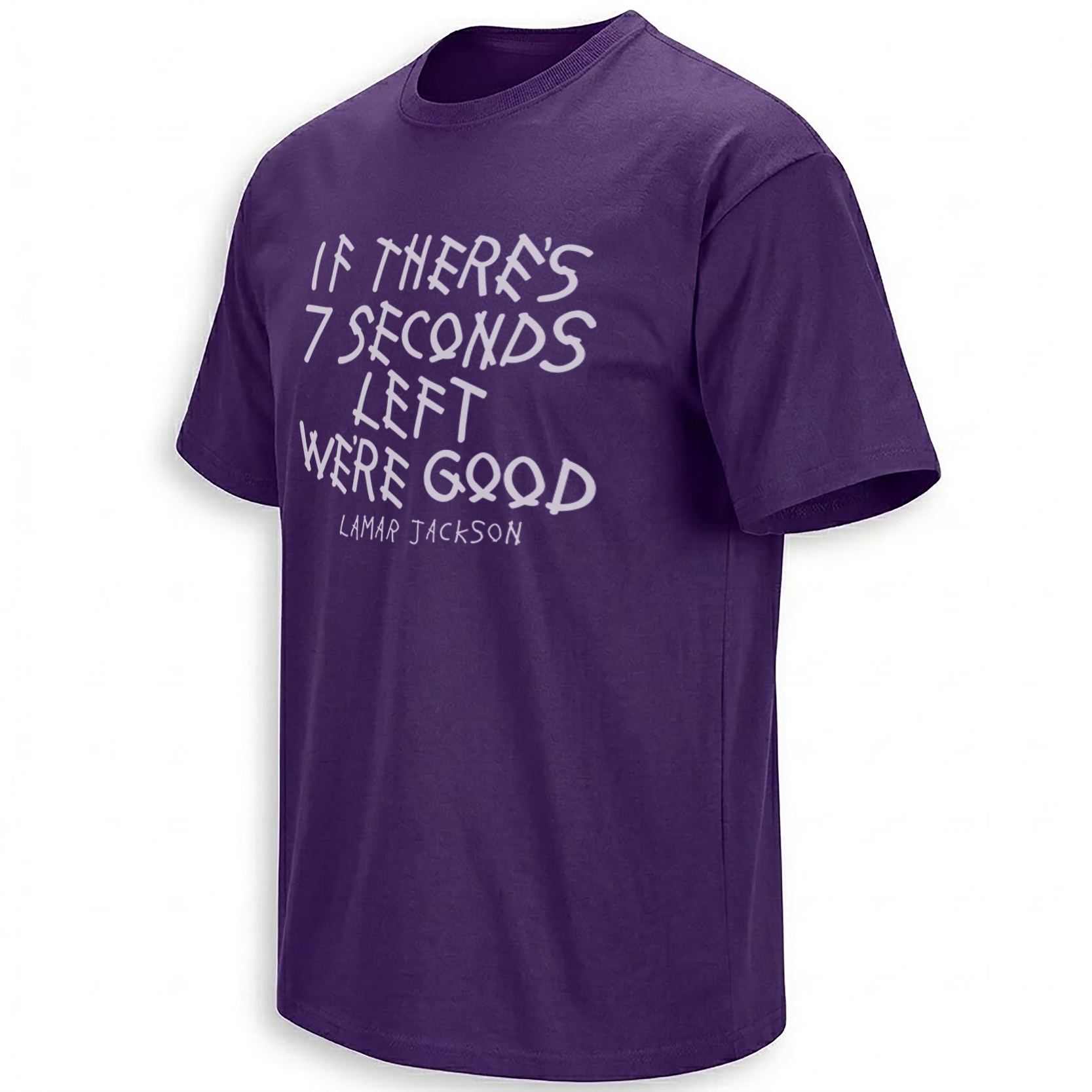
A typography-first Lamar Jackson graphic built around the clock awareness, throw and one-second timeout that created Baltimore’s winning opportunity.
View the seven-second piece →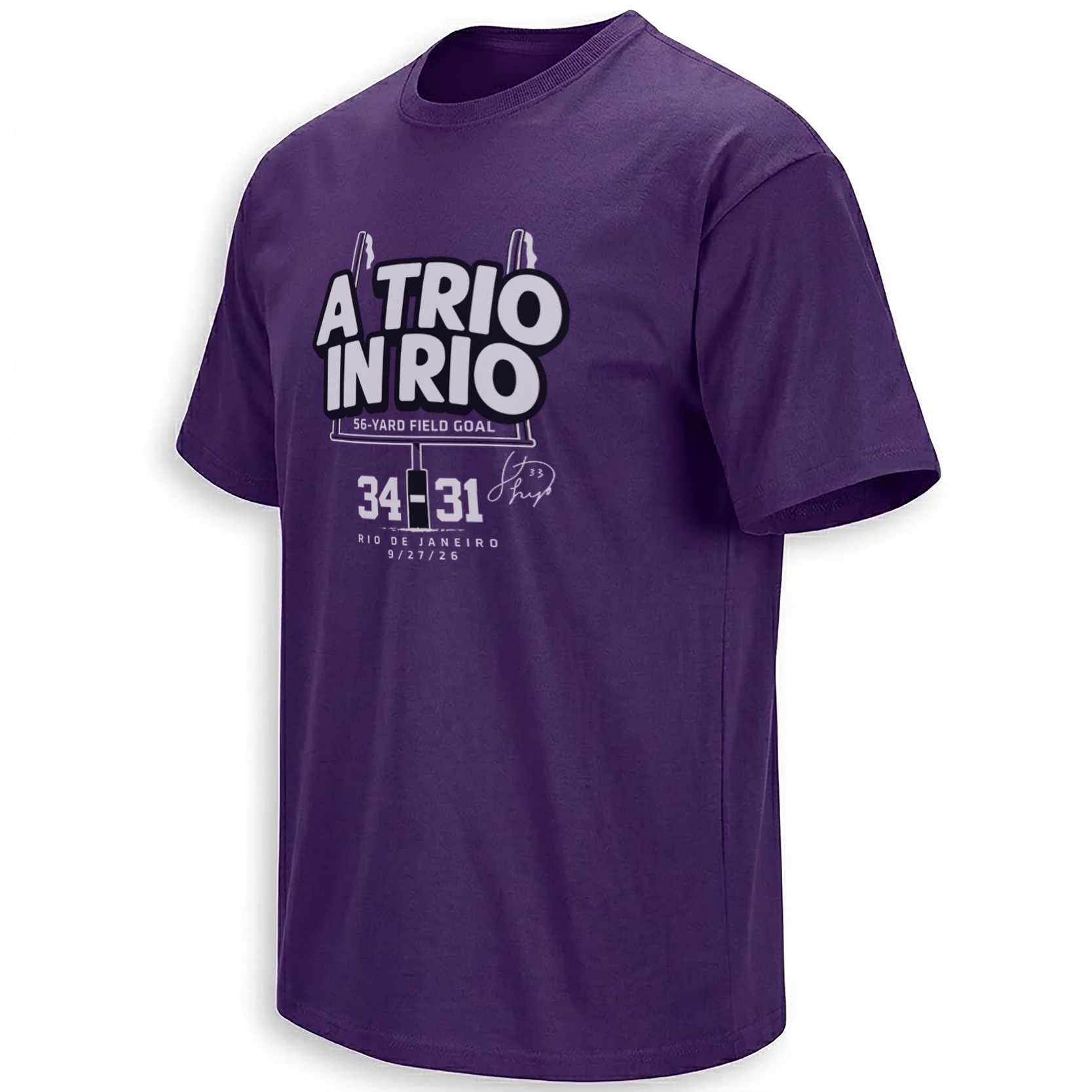
Jim Nantz’s broadcast call, the 56-yard distance, 34–31 score and Rio date turn Loop’s walk-off kick into a commemorative game poster.
View the walk-off piece →Why This Win Mattered Beyond One International Game
Baltimore had spent the previous week hearing a familiar criticism after allowing another fourth-quarter lead to disappear against New Orleans. Against Dallas, an eleven-point advantage nearly disappeared again. The difference was the finish.
The Ravens defense forced Dallas to settle for three points near the goal line. Jackson and Flowers refused to concede overtime. Loop converted the kick. Three different units had to execute within the same tiny window.
That is what made the Rio ending emotionally useful for Baltimore. It was not clean football. The Ravens gave up 415 total yards and watched another comfortable lead become dangerous. But instead of repeating the old ending, they created a completely new one.
The two graphics deliberately divide the final sequence. The Lamar design is rough, handwritten and clock-focused, making “7 SECONDS” the visual protagonist. The Loop design is more commemorative: goalpost, distance, final score, location and date. Together they operate like consecutive frames from the same highlight.
From Rio Into the Ravens Archive
Both designs belong naturally inside Ellie Shirt’s Baltimore Ravens collection , where individual plays, player identities and franchise moments form a running visual record of the season.
The broader NFL collection places the Rio finish inside the wider 2026 football conversation, while fans following the quarterback specifically can continue through the Lamar Jackson search archive and Tyler Loop pieces through Tyler Loop search .
Frequently Asked Questions
What happened with seven seconds left in Ravens-Cowboys?
Lamar Jackson completed a 27-yard pass to Zay Flowers and immediately called timeout, leaving one second for Tyler Loop to attempt the winning field goal.
How long was Tyler Loop’s game-winning field goal?
Loop converted from 56 yards to give Baltimore a 34–31 victory as time expired.
What does “A Trio in Rio” mean?
Jim Nantz used the phrase after Loop’s kick. “Trio” references the three points produced by the field goal, scored in Rio de Janeiro.
Is “If There’s 7 Seconds Left We’re Good” a direct Lamar Jackson quote?
No. The phrase works as fan-confidence language inspired by Jackson’s execution and clock awareness during the final seven-second possession.
Why was the kick especially important for Tyler Loop?
It became a major redemption moment after his previous game-winning opportunity, a 44-yard attempt at the end of his rookie season, had missed.
The Lamar Jackson seven-second piece preserves the setup, while A Trio In Rio preserves the finish — two graphics for the two halves of Baltimore’s impossible night at Maracanã.
Ravens Rio designs capture Baltimore’s seven-second 34–31 win over Dallas through Lamar Jackson’s 27-yard strike to Zay Flowers, Tyler Loop’s 56-yard walk-off and Jim Nantz’s unforgettable “A Trio in Rio” call.