
UTSA’s Hispanic Heritage Game Turned the Alamodome Into a Fiesta Football Stage
The Roadrunners arrived in special San Antonio-inspired helmets, celebrated Hispanic Heritage with mariachi and folklórico, then produced 59 points in one of the wildest offensive games in program history.
Before UTSA and Colorado State even kicked off on September 26, the Roadrunners had already made clear that this would not look like an ordinary home game. The white helmet was covered with Fiesta color. The Roadrunner itself had been transformed. A multicolored ribbon crossed the shell, “San Antonio” appeared in script on the opposite side, and small Alamo silhouettes tied the uniform directly to the city.
UTSA promoted the look with two words: “¡Por la cultura!” It was an appropriate phrase for a program whose identity has always been inseparable from San Antonio itself.
Then the football started and refused to become background entertainment. Colorado State returned the opening kickoff 94 yards for a touchdown, quickly built a 14–0 lead and looked ready to derail the celebration. UTSA answered by scoring 35 consecutive points and eventually escaped a 104-point shootout, 59–45.

This Was Designed as a San Antonio Game, Not Just a UTSA Game
The cultural programming extended far beyond equipment. UTSA’s annual Hispanic Heritage Game included themed thundersticks for the first 15,000 fans and a halftime tribute by the Spirit of San Antonio marching band with Mariachi Los Paisanos and Ballet Folklorico San Antonio.
That distinction matters. UTSA is not borrowing a cultural theme from somewhere outside the program. It represents a city where Hispanic and Mexican American traditions shape daily life, visual culture, festivals, food, music and neighborhood identity. Fiesta colors are not an abstract palette in San Antonio; they carry local recognition.
Cascarón-like color, papel-picado geometry, folk-art patterning, the Alamo, Fiesta energy and “San Antonio” script all move the uniform beyond a generic heritage-month recolor.
That is why the helmet reveal felt so natural. A Roadrunner rendered in bright pink, green, orange and turquoise still reads immediately as UTSA, but it also looks distinctly rooted in the city surrounding the Alamodome.
Then the Game Became as Loud as the Uniform
Colorado State struck first in the most violent possible way: Mel Brown returned the opening kickoff 94 yards for a touchdown. On the Rams’ first offensive snap, K’saan Farrar found Terrence Smith Jr. for a 74-yard touchdown. Less than two minutes into the game, UTSA was down 14–0.
The Roadrunners responded without hesitation. Brandon High Jr. scored from 16 yards, Will Henderson III added a 13-yard touchdown run, David Amador II turned a short reception into a 27-yard score and DJ Allen Jr. raced 58 yards for another touchdown. A’Marion Peterson’s five-yard run completed a stretch of 35 unanswered UTSA points.
The second half refused to settle down. Colorado State kept closing the gap. UTSA kept answering. Mekhi Anderson returned a kickoff 100 yards for a touchdown and later caught a 14-yard score. Peterson’s 47-yard touchdown with two minutes remaining finally gave the Roadrunners enough separation.
The Hispanic Heritage Game did not simply produce a colorful uniform. It produced one of the loudest scoreboards UTSA has ever seen.
Why the Roadrunner Graphic Works Without Saying “Hispanic Heritage”
The UTSA Hispanic Heritage Shirt takes a subtler approach than putting the event name across the chest.
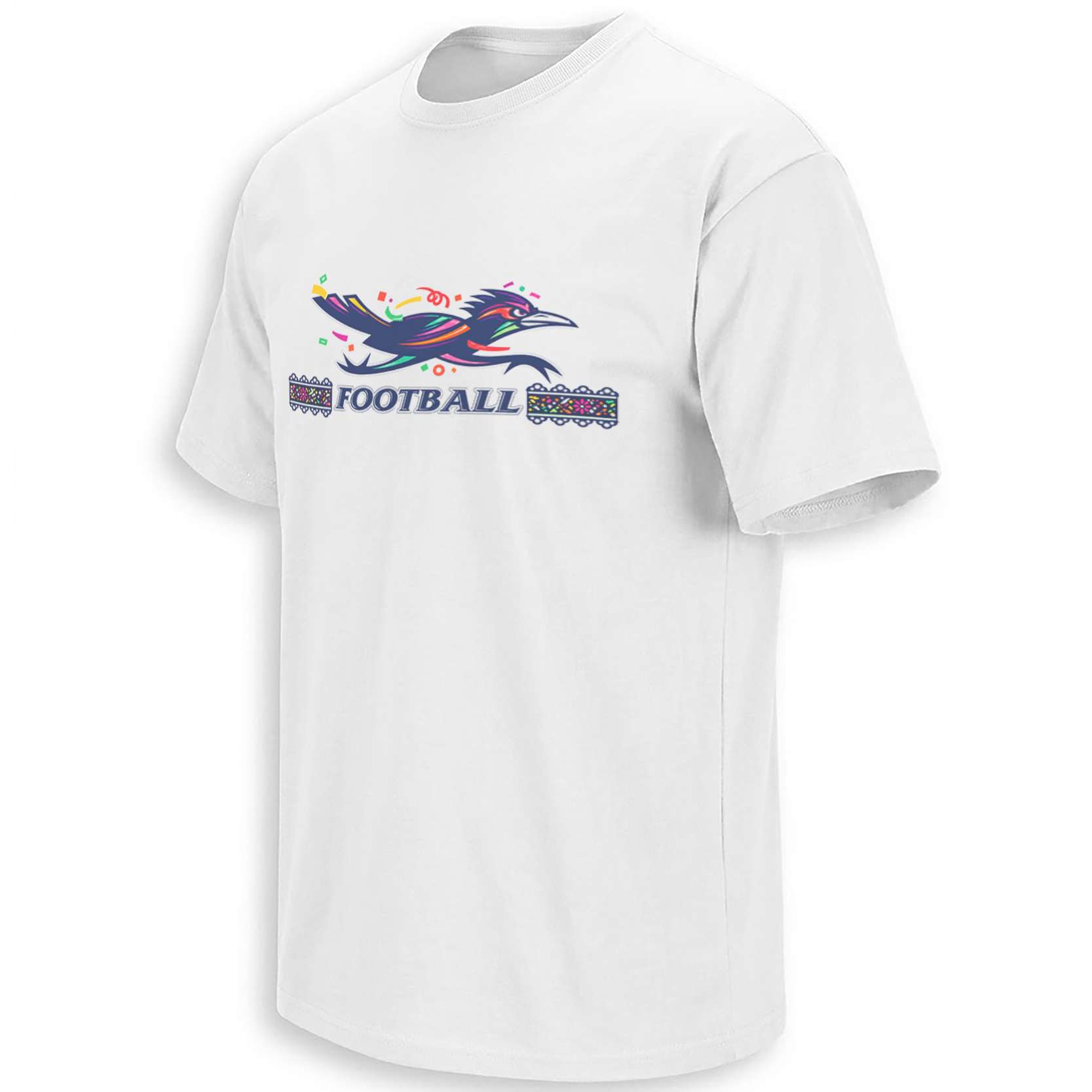
A multicolored Roadrunner, confetti forms and patterned horizontal bands translate the visual language of San Antonio’s Hispanic Heritage Game into a clean football mark.
View the Fiesta Football piece →The white background is important because it gives every accent room to breathe. Navy keeps the Roadrunner attached to UTSA’s normal identity, while orange, turquoise, green, red, yellow and pink move through the bird’s feathers almost like strips of Fiesta decoration.
Below it, the word “FOOTBALL” remains traditional and controlled. That contrast is useful. The typography anchors the graphic in college athletics while the Roadrunner and decorative borders carry the cultural movement.
The patterned bars on either side resemble woven or embroidered decorative bands. Small shapes around the bird read like confetti or pieces of a cracked cascarón. None of those details requires a large “Hispanic Heritage Month” label because the color language does the cultural work visually.
59 Points Gave the Graphic a Specific Memory
Without the game itself, the artwork would still function as a San Antonio culture piece. The 59–45 result gives it something more specific to preserve.
UTSA finished with 542 yards — 303 passing and 239 rushing — and scored the second-most points in program history. Six Roadrunners reached the end zone. Owen McCown threw for 303 yards and three touchdowns. The win moved UTSA to 3–1, its best four-game start since 2021.
The 104 combined points also established a new high for any game involving UTSA. That means the day now exists in two forms: visually, as one of the program’s most distinctive uniforms; statistically, as one of its wildest games.
From “Los Correcaminos” to Fiesta Football
The Hispanic Heritage approach fits a broader UTSA habit of allowing San Antonio culture into its football identity. “Los Correcaminos,” Fiesta-influenced graphics and the “210” language all reinforce a program that does not try to separate itself from the city.
The wider UTSA Roadrunners collection works as a visual archive of those team-specific moments, while the NCAA collection places them alongside college-football traditions, rivalry language and cultural game-day graphics from around the country.
Frequently Asked Questions
When was UTSA’s 2026 Hispanic Heritage Game?
UTSA hosted Colorado State at the Alamodome on September 26, 2026, for its annual Hispanic Heritage Game.
What was special about UTSA’s Hispanic Heritage helmet?
The helmet featured a multicolored Roadrunner, Fiesta-inspired decorative ribbon, Alamo details and “San Antonio” script.
What does “¡Por la cultura!” mean in the UTSA campaign?
The phrase translates to “For the culture” and was used by UTSA Football while revealing the Hispanic Heritage uniform and helmet.
What was the final score of UTSA vs. Colorado State?
UTSA defeated Colorado State 59–45 after rallying from an early 14–0 deficit.
Why does the shirt use Fiesta-style colors?
The multicolored Roadrunner and decorative patterns connect UTSA football with San Antonio’s Hispanic Heritage and Fiesta visual culture rather than relying only on standard navy and orange branding.
The Fiesta Football design preserves the colors behind the helmet reveal, the “¡Por la cultura!” message and the 59-point afternoon that followed inside the Alamodome.
UTSA Hispanic Heritage Shirt captures the Roadrunners’ 2026 Fiesta-inspired helmet, San Antonio cultural identity and explosive 59–45 Hispanic Heritage Game win over Colorado State.