
PCA Reached 40–40 on the Same Day October Became Official
Pete Crow-Armstrong’s 40th stolen base did not arrive as an isolated statistical footnote. It happened at Wrigley Field, in front of an MVP-chasing crowd, while the Cubs were simultaneously securing another postseason trip.
Baseball milestones usually create a pause. A batter steps out, a scoreboard graphic appears, the crowd stands, and for a moment the schedule stops moving. Pete Crow-Armstrong created exactly that kind of interruption on September 24 — except his version began with a walk and almost immediately turned into a sprint.
With the first pitch to Seiya Suzuki on the way, Crow-Armstrong broke for second. He reached the bag safely, stood up and officially became the seventh player in Major League history to combine at least 40 home runs with 40 stolen bases in one season.
Wrigley understood what had happened. The scoreboard switched to 40–40. The applause stretched on. “M-V-P” chants rolled through the park, Crow-Armstrong raised his helmet toward the crowd, and an achievement that had spent weeks existing as arithmetic suddenly became one of the season’s permanent Chicago images.
The remarkable part was not simply reaching two round numbers. It was that power, speed, defense and Wrigley emotion had finally converged into one number pair everyone could remember.
The 40th Steal Was the Perfect PCA Milestone
Crow-Armstrong had already completed the power side of the equation on September 6, when his 40th home run made him the first Cub to reach that mark since Derrek Lee in 2005. By September 24, his total had climbed to 45.
That left the stolen bases. The countdown felt especially appropriate for a player whose identity has always involved movement: closing impossible gaps in center field, turning extra bases into routine decisions and forcing defenses to operate faster than they would prefer.
The milestone itself reflected that personality. Crow-Armstrong did not wait for a dramatic late inning. He drew a leadoff walk in the first and immediately ran. Before the afternoon had time to settle, history had already arrived.

Seven Names, and the First One Wearing a Cubs Uniform
The scarcity of the 40–40 club is the reason the number combination carries so much weight. Before Crow-Armstrong, the list consisted of José Canseco, Barry Bonds, Alex Rodriguez, Alfonso Soriano, Ronald Acuña Jr. and Shohei Ohtani. PCA became the seventh.
For Cubs history, the accomplishment is even cleaner: nobody had done it before. Crow-Armstrong was already the first player in franchise history to pair 40 home runs with 30 steals, and his 45 home runs also pushed him past Billy Williams’ long-standing single-season record for a left-handed Cubs hitter.
Wrigley Turned the Statistic Into a Fan Moment
Milestones become cultural moments when the crowd knows the countdown before the player completes it. That had already happened with Crow-Armstrong. Cubs fans were not discovering 40–40 after the game; they were waiting for it.
The reaction after the steal explains why the afternoon traveled beyond a box score. Crow-Armstrong saluted the crowd from second, the stadium stayed on its feet and the familiar “P-C-A” rhythm shifted toward “M-V-P.” By the time he ran out to center field again, he later acknowledged that the response had become emotional.
That social clip belongs in the record of the day because it captures what statistics cannot: the length of the ovation, the body language and the sense that everyone in Wrigley understood they were watching the last missing piece of a season-long chase.
Then the Cubs Clinched the Postseason
The afternoon still had another layer. Chicago beat Miami 2–1, which officially secured a postseason berth. PCA therefore entered the 40–40 club on the same day the Cubs confirmed that their season would extend into October.
That coincidence matters to the emotional value of the achievement. A 40–40 season on a losing team would remain historically impressive, but this one is attached to a competitive Cubs season and another October run. Individual history and team direction occupy the same frame.
Why the 40/40 Graphic Reads Like a Baseball Scoreboard
The Ellie Shirt design makes the number pair impossible to miss. Giant red 40/40 typography stretches across a royal-blue field, reducing the story to the same visual shorthand that appeared on scoreboards and social graphics as soon as the milestone became official.
Two PCA illustrations explain the statistic without requiring a paragraph. One shows the swing and the power that produced 45 home runs. The second shows the horizontal aggression of a dive or slide, representing the speed half of the equation. PETE CROW-ARMSTRONG underneath anchors the numbers to the player; 40/40 CLUB turns them into a historical category.
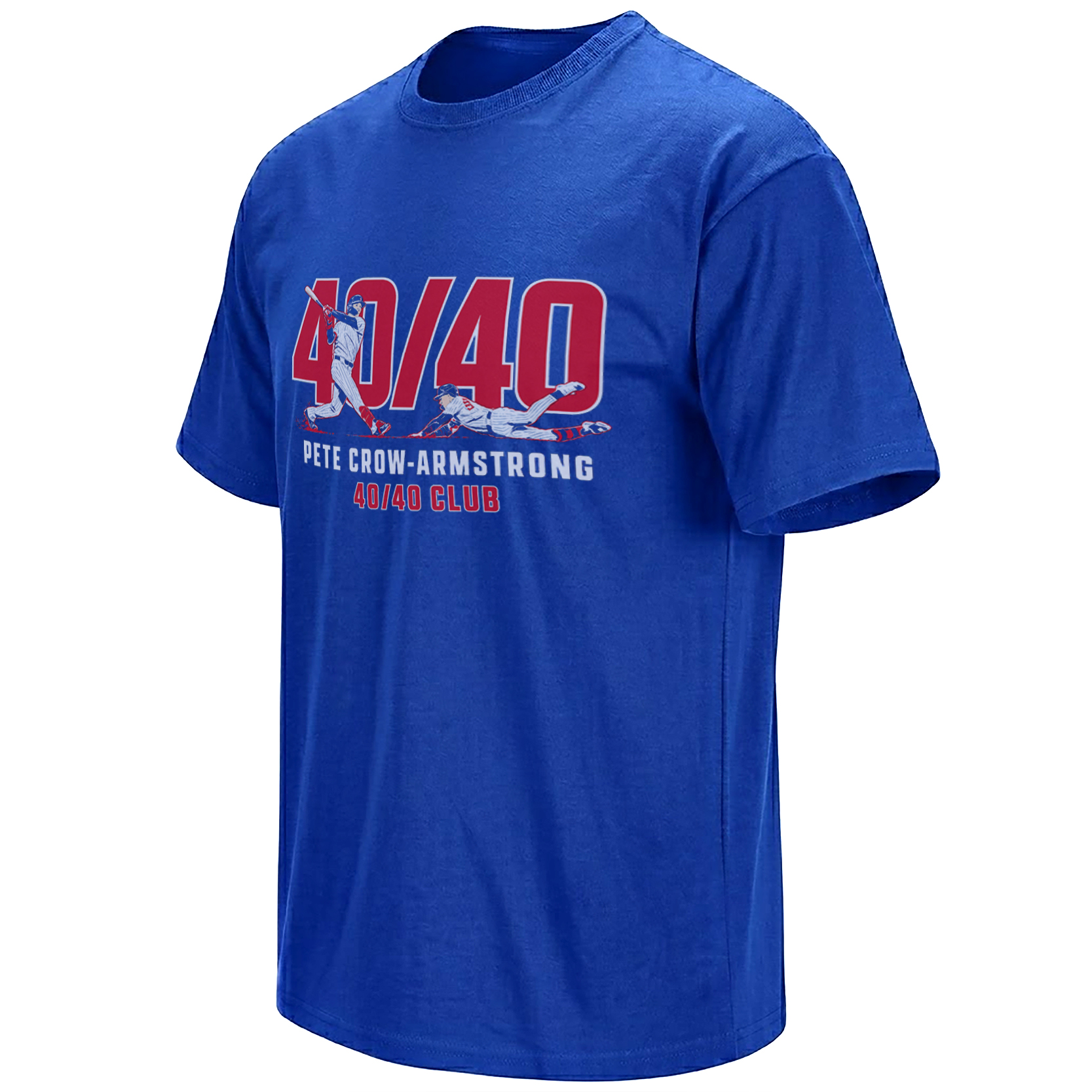
A milestone-first Cubs graphic preserving the power-speed combination that put PCA into one of baseball’s smallest statistical clubs.
View the 40/40 piece →The wider Chicago Cubs collection follows PCA moments, postseason graphics and Wrigley culture across the season, while the MLB collection connects those Chicago stories to the broader 2026 baseball landscape.
Readers looking specifically for Crow-Armstrong pieces can also use Ellie Shirt’s Pete Crow-Armstrong product search, keeping the player-level archive separate from general Cubs designs.
Frequently Asked Questions
When did Pete Crow-Armstrong join the 40–40 club?
He stole his 40th base on September 24, 2026, against the Miami Marlins at Wrigley Field.
How many home runs did PCA have when he reached 40 steals?
Crow-Armstrong had already hit 45 home runs when stolen base No. 40 made the 40–40 season official.
How rare is a 40–40 season?
Crow-Armstrong became only the seventh player in Major League history to record at least 40 home runs and 40 stolen bases in the same season.
Is Pete Crow-Armstrong the first Cubs player in the 40–40 club?
Yes. His 2026 season is the first 40-home-run, 40-stolen-base campaign in Chicago Cubs franchise history.
What else happened for the Cubs on the day PCA reached 40–40?
Chicago defeated Miami 2–1 and clinched a berth in the 2026 postseason, tying Crow-Armstrong’s individual milestone directly to the team’s return to October.
The Pete Crow-Armstrong 40/40 Club graphic preserves the number pair at the center of the moment, while the Chicago Cubs archive tracks the larger postseason story developing around it.
Pete Crow-Armstrong 40/40 Club Shirt captures the September 24 moment PCA became the first Cub and seventh MLB player ever to combine 40 home runs with 40 stolen bases in one season, on the same day Chicago clinched a 2026 postseason berth.