
ADHD&D Asked the Most Dangerous Campaign Question: “What Was the Quest?”
Dungeons, wandering wizards and abandoned objectives make an unusually natural language for internet jokes about distraction — because tabletop players already know how quickly one simple mission can become five completely unrelated adventures.
Every tabletop group knows the moment. The Dungeon Master presents the objective. The party understands it. Everyone nods. Then somebody notices a locked door, another player wants to interrogate an NPC who was supposed to exist for thirty seconds, somebody else becomes emotionally attached to a suspicious animal, and forty-five minutes later no one can clearly explain why the group entered the dungeon.
That chaos is older than any single meme, but internet culture eventually gave it perfect vocabulary: the “side quest.” It is already native to role-playing games, where optional adventures can pull characters away from the central storyline. Online, the same phrase became shorthand for those moments when real life also veers away from the supposed main objective.
ADHD communities picked up that metaphor because it feels visually immediate. Rather than explaining a long sequence of distractions, someone can simply say they went on a side quest. The phrase transforms the detour into game logic: the original task still exists somewhere, but an unexpected objective has temporarily taken over the map.
The joke is not that the adventurer has no mission. The joke is that the world keeps generating better-looking missions on the way there.
“Side Quest” Became Internet Language Far Beyond Games
One long-running example circulated through ADHD meme spaces years ago: instead of calling something a “to-do list,” the idea was to rename it “side quests.” The joke immediately made sense because gaming culture had already taught millions of people what a side quest feels like — optional, tempting and somehow capable of consuming the entire evening.

The comments beneath these posts often follow the same rhythm: somebody starts with one necessary task and ends up studying an unrelated topic, reorganizing something, learning a new hobby or disappearing into another project entirely. That pattern is why “main quest” and “side quest” language survives. It compresses an entire sequence of decisions into two familiar gaming terms.
D&D Already Has the Perfect Structure for the Joke
The crossover works because side quests are not borrowed decoration pasted onto D&D. They are part of the actual adventure vocabulary. Official Dungeons & Dragons material still uses side quests as a way to branch stories, discover characters and send players away from a campaign’s central path.
Tabletop play also creates distractions in ways video games cannot fully control. A developer can mark one objective as important. A Dungeon Master can try to do the same — but the players are free to decide that the unnamed shopkeeper, strange barrel or meaningless hallway is now the emotional center of the campaign.
That is why the punchline “What Was the Quest?” feels less like a generic ADHD slogan and more like something a real table might say near the end of a session. It describes the point where the group suddenly realizes that everyone has been extremely busy without actually doing the thing that began the adventure.
The Wizard Turns Distraction Into a Fantasy Scene
The ADHD&D Shirt succeeds because it does not stop at wordplay. The joke is staged as an actual piece of fantasy storytelling.
A wizard studies a map while standing between competing directions. A large question mark signals that the original plan has already begun to disappear. Signs point toward “RANDOM QUEST” and “SIDE QUEST DISTRACTION,” while treasure chests create exactly the sort of visual temptation an adventurer is unlikely to ignore.
The composition therefore operates like a tiny campaign panel. You can understand the story before reading the bottom line. The wizard had an objective. The road produced options. Curiosity won.
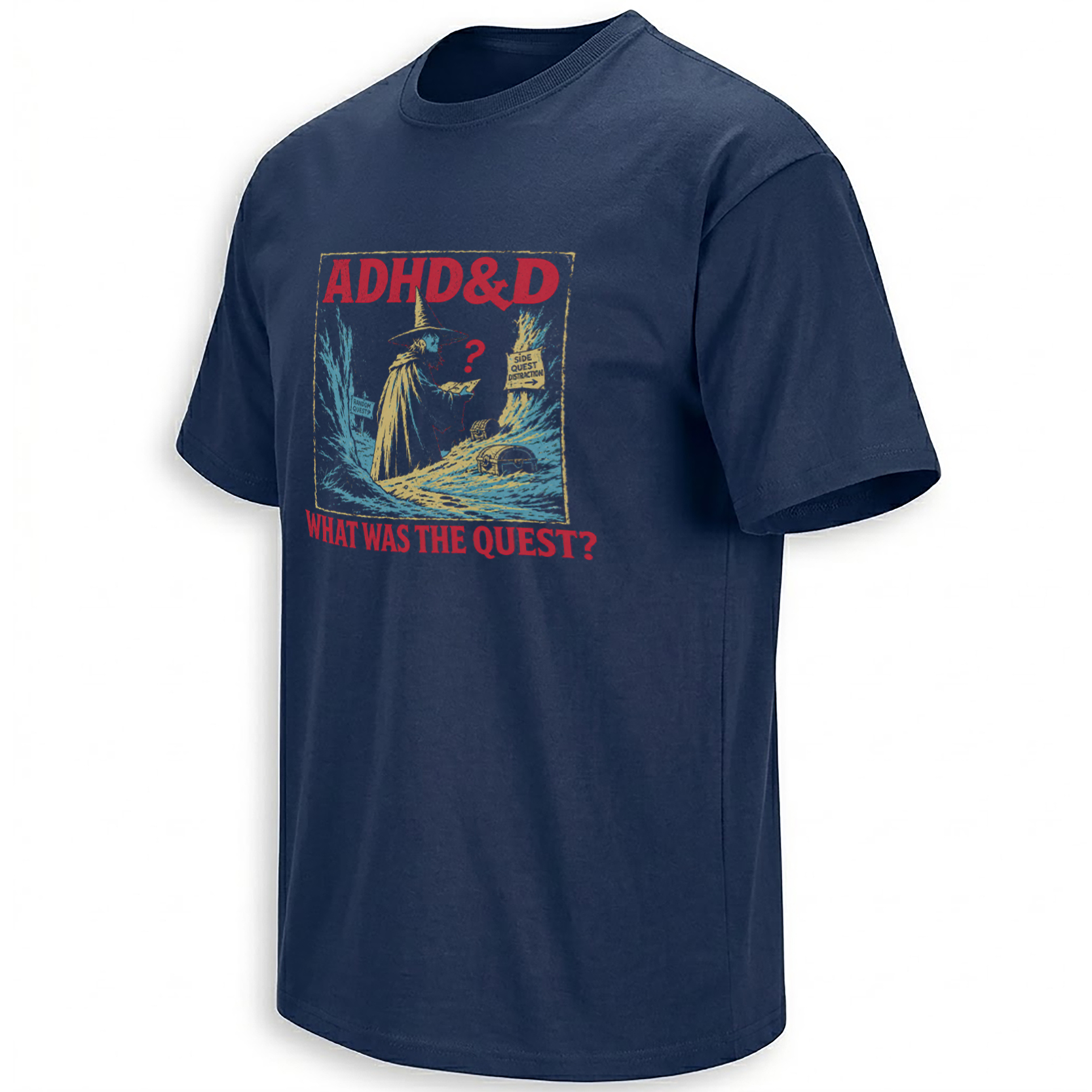
A lost wizard, competing quest signs and tempting treasure turn the side-quest metaphor into an old-school fantasy scene rather than a simple text joke.
Explore the graphic →Why the Retro Fantasy Treatment Matters
The red, pale yellow and turquoise palette deliberately avoids modern game-interface polish. Distressed lettering and rough illustration make the piece feel closer to an old adventure module, paperback fantasy cover or screen-printed convention tee.
That age matters because tabletop humor works best when the fantasy world feels sincere. If the wizard looked like a slick contemporary mascot, the scene would become a normal meme graphic. Giving him an older, slightly mysterious visual environment creates the illusion that “What Was the Quest?” might genuinely be a forgotten instruction from a battered campaign book.
The title “ADHD&D” then does the final semantic work. It fuses two recognizable sets of language without pretending that a meme explains anyone’s medical experience. The design is culture humor: D&D players understand the campaign drift, while people who recognize “side quest” language from ADHD meme spaces understand the second layer immediately.
A Joke That Works Even When Nobody Is Rolling Dice
The reason the idea has lasted online is that “What was the quest?” also works outside a dungeon. Start cleaning one room, find an object that belongs somewhere else, begin reorganizing that space, discover another unfinished project and eventually wonder what the first task was. The fantasy vocabulary simply makes the sequence funnier.
That overlap gives the design a wider cultural life than a campaign-specific reference. Readers can browse newer internet-culture graphics in Ellie Shirt’s Newest collection, search the wider archive for Dungeons & Dragons-inspired designs, or explore ADHD-related graphics without inventing a collection URL that does not exist.
Frequently Asked Questions
What does “ADHD&D” mean?
It is an internet-style mashup of ADHD and D&D used as humor around distracted or chaotic tabletop sessions.
Why does the design say “What Was the Quest?”
The line jokes about getting pulled into so many side quests and random events that the original objective becomes difficult to remember.
Why are side quests connected to this kind of internet humor?
“Side quest” became a convenient metaphor for being diverted from the original task by another interesting activity, especially in gaming and ADHD meme communities.
Is side-quest language actually part of Dungeons & Dragons?
Yes. Side quests are a familiar tabletop storytelling device and continue to appear in official D&D adventure content.
Why is there a wizard holding a map?
The wizard visually represents an adventurer who has become surrounded by competing objectives and no longer remembers the original mission.
The ADHD&D “What Was the Quest?” design turns one of tabletop culture’s most familiar failures of focus into a retro fantasy map of distractions, treasure and optional adventures.
ADHD&D Shirt turns “What Was the Quest?” into a retro tabletop adventure joke with a confused wizard, random quests, side-quest distractions and the irresistible pull of treasure along the way.