Residence of Evil Became a Fan-Made Archive of Survival Horror
ROE is not a Resident Evil game title pretending to be official canon. It is something more internet-native: a fan-built network that turned years of obsession into interviews, lore, reunions, films and community memory.
Resident Evil fandom has never lived entirely inside the games. It survives in speedruns, lore arguments, remake comparisons, voice-actor reunions, old live-action footage, safe-room music debates and the collective ability to remember exactly where a dog once jumped through a window.
Residence of Evil — commonly shortened to ROE — grew directly from that kind of fandom. The network describes itself as a fan-driven platform dedicated to Resident Evil and survival horror, producing news, livestreams, interviews, lore breakdowns and original projects.
That distinction matters. ROE is not simply borrowing horror typography. Its identity has been built around preserving the people, stories and weird corners of a franchise whose audience now spans multiple generations.
Survival horror fandom is partly about fear. But after thirty years, it is also about remembering who was there when the doors first creaked open.
ROE Grew From Coverage Into Preservation
One of the most interesting things about the Residence of Evil network is the amount of its work focused on people who might otherwise sit outside modern franchise marketing. Its interview history includes performers associated with older Resident Evil games, including voices and live-action actors from the original era.
That kind of coverage becomes increasingly important as the franchise ages. Resident Evil is now old enough for its earliest cast members, production oddities and localization history to become archival material rather than current promotion.
ROE has also expanded into original fan productions such as The Keeper’s Diary: A Biohazard Story and Resurrection: A Biohazard Story, projects that move fandom from discussing the mythology to actively building around it.

Why 2026 Is Such a Natural Year for This Kind of Fan Identity
Resident Evil reached its 30th anniversary in 2026, bringing another wave of official celebrations, collaborations, retrospectives and fan nostalgia. Three decades is an unusual distance for horror. What once felt technologically modern has become aesthetic history.
The first game’s pre-rendered environments, live-action intro, awkward performances and limited inventory systems are no longer simply old mechanics. They are part of a shared visual vocabulary.
That is the environment in which a name like Residence of Evil works so well. The phrase is obviously adjacent to Resident Evil, but it feels like a place made by people who stayed inside the mansion long after the credits rolled.
The strongest way to read ROE is as community identity: a fan network documenting Resident Evil history, interviews and survival-horror culture rather than pretending to be an official Capcom title.
The Logo Works Because Horror Fans Already Understand the Language
The Residence of Evil Shirt reduces that entire ecosystem into one graphic system: ROE initials, distressed survival-horror lettering and a visual tone that immediately signals old-school Resident Evil fandom.
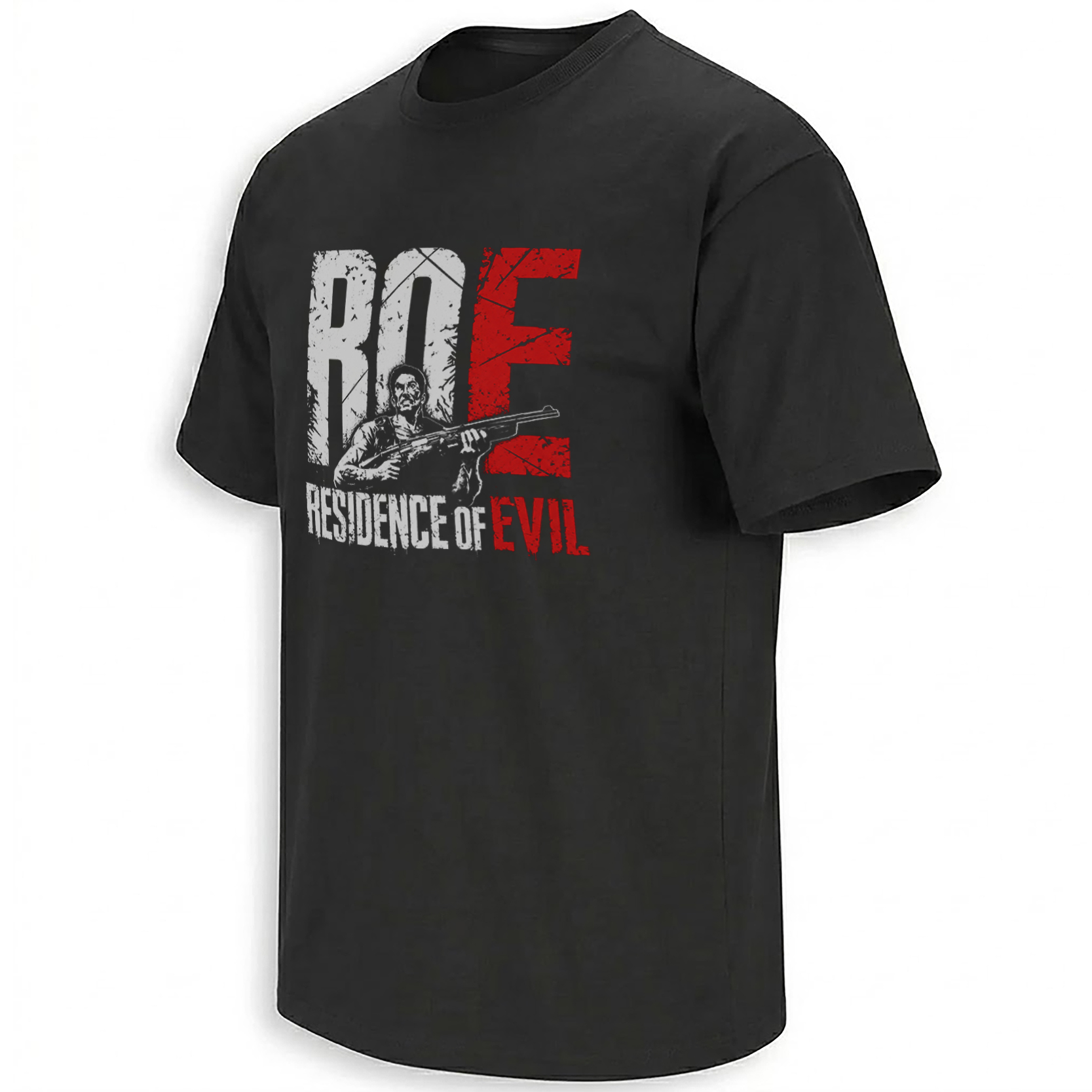
Red, white and black are almost impossible to separate from modern Resident Evil visual culture. The palette suggests warning screens, blood, emergency lighting and degraded documents without requiring a specific character or monster.
That makes the piece broader than a Leon, Jill or Claire graphic. It belongs to the part of fandom interested in the entire archive: original games, remakes, voice actors, obscure trivia, fan films and survival horror as a genre identity.
Survival Horror Is Now an Intergenerational Culture
A player who first entered Spencer Mansion in 1996 and someone who discovered the franchise through Resident Evil 7 may share almost no original gameplay memories. Yet both understand the same symbols: herbs, typewriters, item boxes, impossible architecture and the relief of a safe room.
Fan networks become connective tissue between those eras. They explain why an old actor matters, why a forgotten game deserves another look or why an obscure piece of production history still gets reposted decades later.
That is why ROE fits the 30th-anniversary moment so well. The franchise itself continues moving forward, but fandom increasingly wants an archive running in the opposite direction too.
More Resident Evil-related designs can be surfaced through Ellie Shirt’s Resident Evil search archive. No unverified dedicated Resident Evil collection URL is being invented.
Frequently Asked Questions
What is Residence of Evil or ROE?
Residence of Evil is a fan-driven Resident Evil and survival-horror network producing news, interviews, livestreams, lore coverage and original community projects.
Is Residence of Evil an official Resident Evil game?
No. ROE is a fan community and media platform rather than an official Capcom Resident Evil title.
What kind of content has ROE created?
Its work has included Resident Evil interviews, lore discussions, cast reunions, livestreams and original fan productions such as The Keeper’s Diary: A Biohazard Story.
Why is 2026 important to Resident Evil fandom?
2026 marks thirty years since the original Resident Evil era began, creating a major anniversary cycle around the games, characters and history of survival horror.
What does the Residence of Evil Shirt represent?
The ROE design functions as a survival-horror community badge, using distressed red, white and black branding associated with the Residence of Evil fan network.
The Residence of Evil graphic captures the ROE identity at a moment when thirty years of Resident Evil history are being revisited, archived and reinterpreted by the community.
Residence of Evil Shirt captures the ROE survival-horror community through distressed red-and-white branding tied to Resident Evil fandom, fan archives, interviews and the franchise’s 30th-anniversary era.