
“Smoke ’Em If You Got ’Em” Was Military Language Before It Was a Graphic Joke
A weathered rifle, a red-and-white Marlboro pack and two words in stencil type only make sense together because American military culture spent much of the twentieth century tying cigarettes, smoke breaks and soldier imagery into the same visual vocabulary.
“Smoke ’em if you got ’em” sounds like generic action-movie dialogue now, but the phrase has a much more literal history. The Army Historical Foundation recalls the familiar break-time call “Take 10; smoke ’em if you got ’em” as part of a military world in which cigarettes were once routine enough to appear beside rations, uniforms and field equipment.
For generations of American service members, smoking was normalized as a break ritual, social activity and supposed morale aid. Cigarettes traveled through World War I, became deeply embedded in World War II military imagery and remained highly visible around troops through Korea, Vietnam and later deployments.
That history eventually reversed direction. Military institutions increasingly confronted the health and readiness costs of tobacco, while cigarette rations disappeared and smoking restrictions expanded. What survived in pop culture was the language: “smoke ’em if you got ’em,” detached from an actual scheduled cigarette break and reused in movies, jokes, music and military-style slang.

The Soldier-and-Cigarette Image Was Manufactured Over Decades
Cigarettes did not become associated with military life through one war or one advertising campaign. During World War I, tobacco drives sent products overseas and military leaders frequently treated smoking as morale support. By World War II, small cigarette packages were routinely associated with field rations and photographs of soldiers resting with cigarettes became part of wartime visual culture.
Historian Joel R. Bius devoted an entire study to that relationship, titled Smoke ’Em If You Got ’Em: The Rise and Fall of the Military Cigarette Ration. The Smithsonian describes the book as a history of the complicated connection among the military, cigarette companies and government policy across the twentieth century.
The important part for the graphic is not nostalgia for smoking itself. Cigarettes are addictive and harmful. The relevant cultural fact is that military institutions and tobacco advertising spent decades making the cigarette visually believable beside a helmet, rifle, fatigues or field break.
The parody works because the viewer has already seen the soldier, the rifle and the cigarette living in the same cultural frame for generations.
Why Marlboro Changes the Joke
Replace the red-and-white package with an anonymous rectangle and much of the design disappears. Marlboro carries unusually strong visual recognition before the viewer reads a single letter.
Its red upper field, white lower body, roof-like chevron geometry and serif wordmark became one of twentieth-century advertising’s most recognizable packaging systems. The broader Marlboro image also spent decades building a deliberately rugged, masculine vocabulary through outdoor and Western advertising.
That is why a Marlboro pack can function almost like a logo inside parody culture. The object brings its own history with it: cigarette advertising, masculinity, American commercial imagery and the long cultural overlap between tobacco and military audiences.
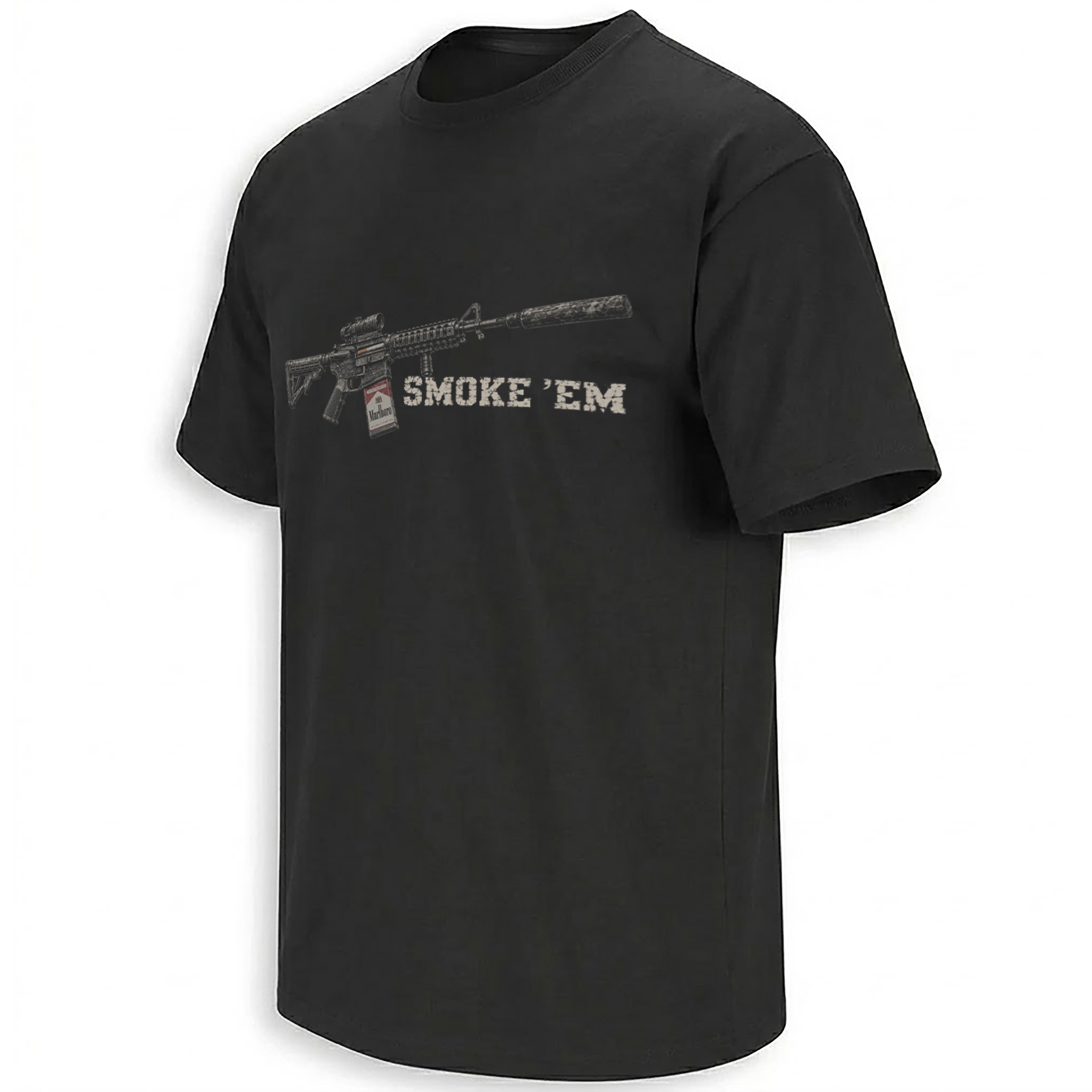
In the artwork, the Marlboro pack is not held beside the rifle. It replaces the rifle magazine. That single substitution physically connects cigarette “smoke” with the harder action-slang meaning of “smoke ’em.”
The Rifle Is Designed Like Old Surplus Illustration
The weapon drawing is intentionally muted. Charcoal, faded black and gray dominate the rifle, with scratches and worn edges making the image feel closer to surplus graphics, field manuals and stencil markings than polished digital tactical advertising.
Then the Marlboro pack interrupts the palette. Red and white appear beneath the receiver exactly where the eye expects a dark magazine. Because almost everything else is desaturated, the cigarette package becomes the visual punchline before the viewer even reaches the words.
“SMOKE ’EM” sits to the right in distressed off-white stencil lettering. The typography recalls ammunition crates, military equipment markings and utilitarian field labeling. It keeps the design from drifting into glossy tobacco-ad aesthetics even though Marlboro is unmistakably present.
“Smoke ’Em” Has Two Meanings at the Same Time
The first layer is historical. “Smoke ’em if you got ’em” refers to the familiar military cigarette-break phrase: if cigarettes are available, this is the moment to use them.
The second layer comes from action slang, where “smoke” can mean defeating or destroying an opponent. The rifle pushes the eye toward that harder interpretation before the cigarette pack immediately drags the phrase back toward literal smoke.
Strong visual parody often depends on that kind of collision. Neither object is surprising alone. A military rifle is familiar. A Marlboro pack is familiar. The joke appears only when the package is installed where a magazine should be.
Research did not surface a strong, verifiable 2026 social post establishing this exact rifle-and-Marlboro composition as a current standalone viral meme. The cultural grounding is historical military slang and tobacco imagery, so no social embed is included rather than inventing one.
Why the Graphic Feels Vintage Without Belonging to One War
The illustration deliberately avoids exact historical reconstruction. The rifle language is modern and tactical, while the phrase points backward to older military culture and the cigarette pack evokes twentieth-century advertising.
That anachronism is part of the design rather than an error. It works like bootleg streetwear: multiple eras compressed into one visual object so that viewers recognize the cultural references faster than they ask whether those references originally coexisted.
Because it is not tied to a sports team, celebrity or one current event, the closest confirmed Ellie Shirt archive is the Newest collection, where current parody, meme and visual-reference graphics sit together.
Frequently Asked Questions
Where does “Smoke ’Em If You Got ’Em” come from?
The phrase became strongly associated with military cigarette breaks, including the familiar call to take a short break and smoke if cigarettes were available.
Were cigarettes actually connected with U.S. military rations?
Yes. Cigarettes were supplied to American service members for decades and were included with military rations during parts of the twentieth century before health concerns and policy changes ended that practice.
Why does the design specifically use Marlboro?
Marlboro’s red-and-white packaging is highly recognizable and carries decades of American cigarette-advertising history, giving the parody a stronger visual reference than a generic cigarette pack.
Why is the Marlboro pack replacing the rifle magazine?
The substitution connects literal cigarette smoke with the action-slang meaning of “smoke ’em,” allowing the object itself to deliver the joke without additional explanation.
Is this design promoting cigarette smoking?
The concept is visual parody rooted in the historical connection between military slang and cigarette culture. Cigarette smoking is addictive and harmful; the graphic uses that older imagery as cultural reference rather than a health claim.
Is the exact Smoke ’Em Marlboro image a confirmed viral 2026 meme?
Research did not find strong evidence that this exact composition originated from a major 2026 viral post. Its meaning is better understood through documented military slang and cigarette-advertising history.
The Smoke ’Em Marlboro graphic uses a recognizable cigarette pack as the bridge between old military break-room language and dark tactical parody, preserving the cultural contradiction rather than pretending it came from a single modern event.
Smoke ’Em Marlboro Shirt reworks the military-rooted “Smoke ’Em If You Got ’Em” phrase through distressed tactical-rifle imagery, stencil typography and a red-and-white Marlboro pack replacing the magazine as the design’s central visual pun.