SpongeBob Floss Dance: Why “Floss Mode On” Feels So Familiar
A familiar cartoon character meets a dance your muscle memory may remember before you do.
Some internet jokes arrive with breaking news. Others work because the audience already carries both halves of the punchline. The SpongeBob floss dance concept belongs to that second group: a cartoon associated with unstoppable enthusiasm meets a movement remembered from television, playgrounds and gaming screens.
Looking at that crossover in September 2026 means looking backward as much as forward. SpongeBob first appeared in 1999; the floss became a major internet dance years later. Their combination compresses different chapters of growing up online into one immediately readable idea. Familiarity does the introductory work.
“Floss Mode On” gives the combination its voice. It sounds like a setting someone has deliberately activated: seriousness off, ridiculous confidence on. That is the cultural appeal worth unpacking, without needing to announce a new viral challenge or assign the design to an unverified television episode.
The Dance Had a Life Before This Crossover
The floss uses alternating arm swings around the body, paired with hip movement. Its name reflects the back-and-forth action. The documented history of the dance includes earlier online performances, followed by Russell Horning, known as Backpack Kid, helping popularize it and appearing with Katy Perry on Saturday Night Live in May 2017.
Fortnite subsequently gave that motion another setting through an in-game emote. The important distinction is that the game helped circulate an existing dance. A SpongeBob crossover adds another layer of recognition; it does not establish that the character originated the movement.
That journey explains the strange efficiency of a dance reference. You do not need the original soundtrack to recognize it. Once a movement becomes familiar, a pose, a caption or even its name can bring the rest of the sequence back into your head.

Why SpongeBob Fits the Joke
Stephen Hillenburg’s character is built around earnestness, enthusiasm and an unusually elastic relationship with embarrassment. His character history establishes the optimistic personality that makes a dance crossover feel intuitive. A figure this committed to having a good time does not need a complicated reason to start moving.
My reading of the pairing is that its humor comes from wholehearted participation. There is no attempt to appear sophisticated. The character supplies the emotional permission to enjoy something silly, while the dance supplies a shared reference viewers can recognize without a long explanation.
This is also why the concept can work for people with different entry points. One reader remembers childhood television. Another remembers friends attempting the floss. Someone else recognizes the gaming reference first. Each can arrive at the same joke through a different memory.
“Floss Mode On” Turns Movement Into a Mood
The phrase borrows the language of switches and settings. “Mode” suggests a temporary version of the self, and “on” makes the decision immediate. Together, the words give a static graphic a sense of action: the dance is already happening in the reader’s imagination.
That verbal mechanism matters more than attaching an invented backstory. The concept does not require a specific episode, celebrity appearance or new announcement to be understandable. Its meaning comes from the collision of two established cultural references and the short caption connecting them.
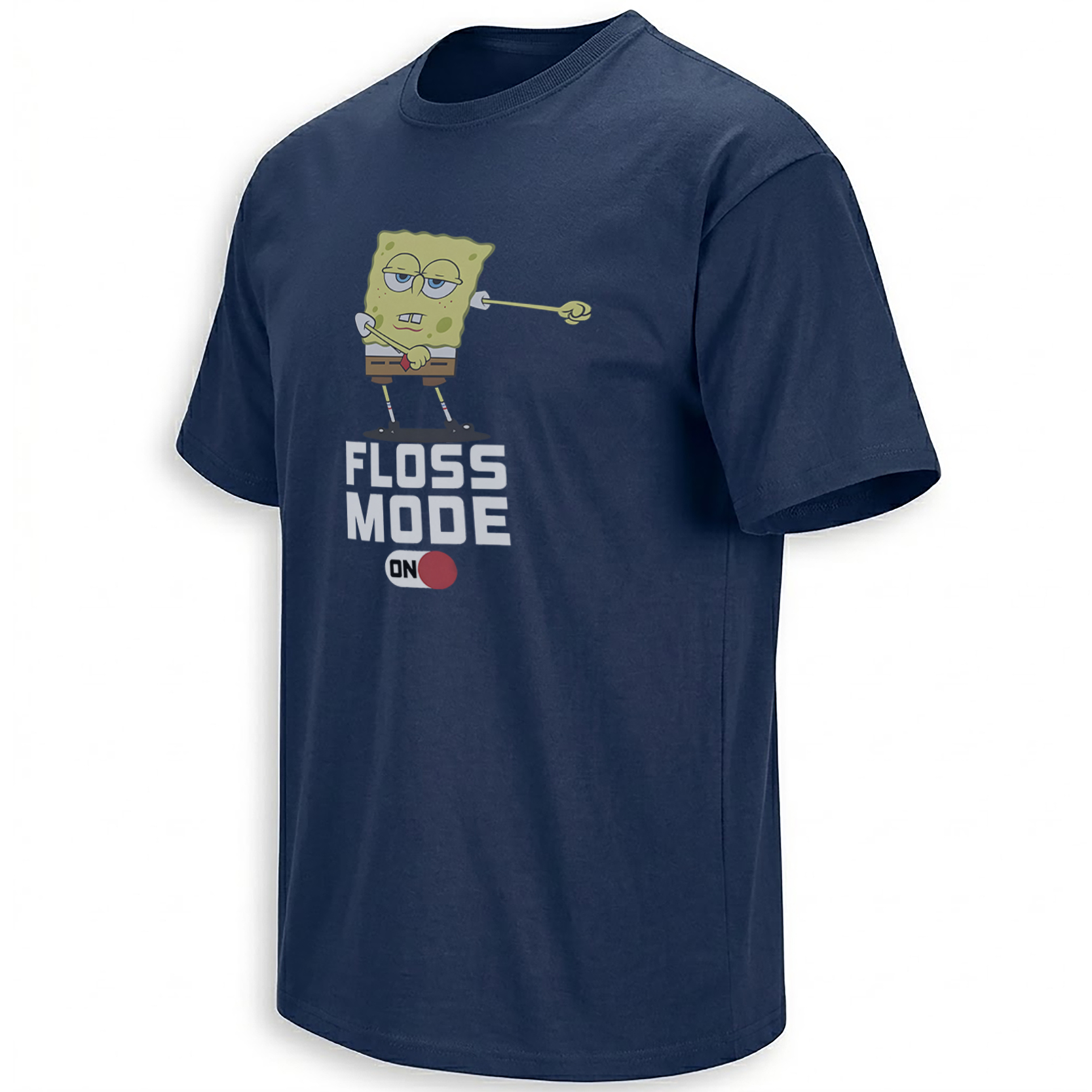
A wearable meeting point between cartoon familiarity and remembered internet choreography. Explore the design →
Two Kinds of Nostalgia, One Small Joke
Cartoon nostalgia and internet nostalgia behave differently. A childhood character may recall a room, a television schedule or the people who watched with you. A dance meme may recall a phone screen, a school break or a friend who insisted they could finally do it correctly.
Combining them creates a personal overlap rather than a single universal memory. That distinction keeps the interpretation honest. Nobody needs to have experienced the same year in the same way for the reference to land. Recognition can be partial and still be enjoyable.
The appeal is also physical. Many visual jokes ask only to be understood. A dance reference invites a tiny rehearsal: remembering where the arms go, imagining the rhythm, perhaps discovering that the coordination never quite arrived. The audience supplies some of the comedy.
When a Loop Becomes Something You Keep
A moving meme is temporary by design: play, repeat, scroll. Putting its idea on a graphic changes the pace. The reference stays still, leaving the wearer and viewer to complete it. In that sense, the object preserves recognition rather than the original performance.
The broader SpongeBob designs on Ellie Shirt offer another way to follow that relationship between character and mood. This particular crossover occupies the playful end of that spectrum, where remembering a joke can be enough reason to revisit it.
Frequently Asked Questions
What does “Floss Mode On” mean?
It presents dancing as an activated mood, pairing the floss reference with playful, deliberately unselfconscious energy.
Did the floss dance originate with SpongeBob?
No. The dance has a documented history outside SpongeBob, including earlier online performances and later television and gaming exposure.
Is this design linked to a confirmed SpongeBob episode?
No specific episode is established here. The article treats the concept as a character-and-dance crossover.
The lasting charm is easy to recognize: an old dance can still communicate a very present feeling. Sometimes the mood is simply being ready to join in.
Floss Mode On brings SpongeBob SquarePants into the language of internet dance nostalgia, pairing cartoon enthusiasm with the familiar floss reference and a playful switch-on slogan.