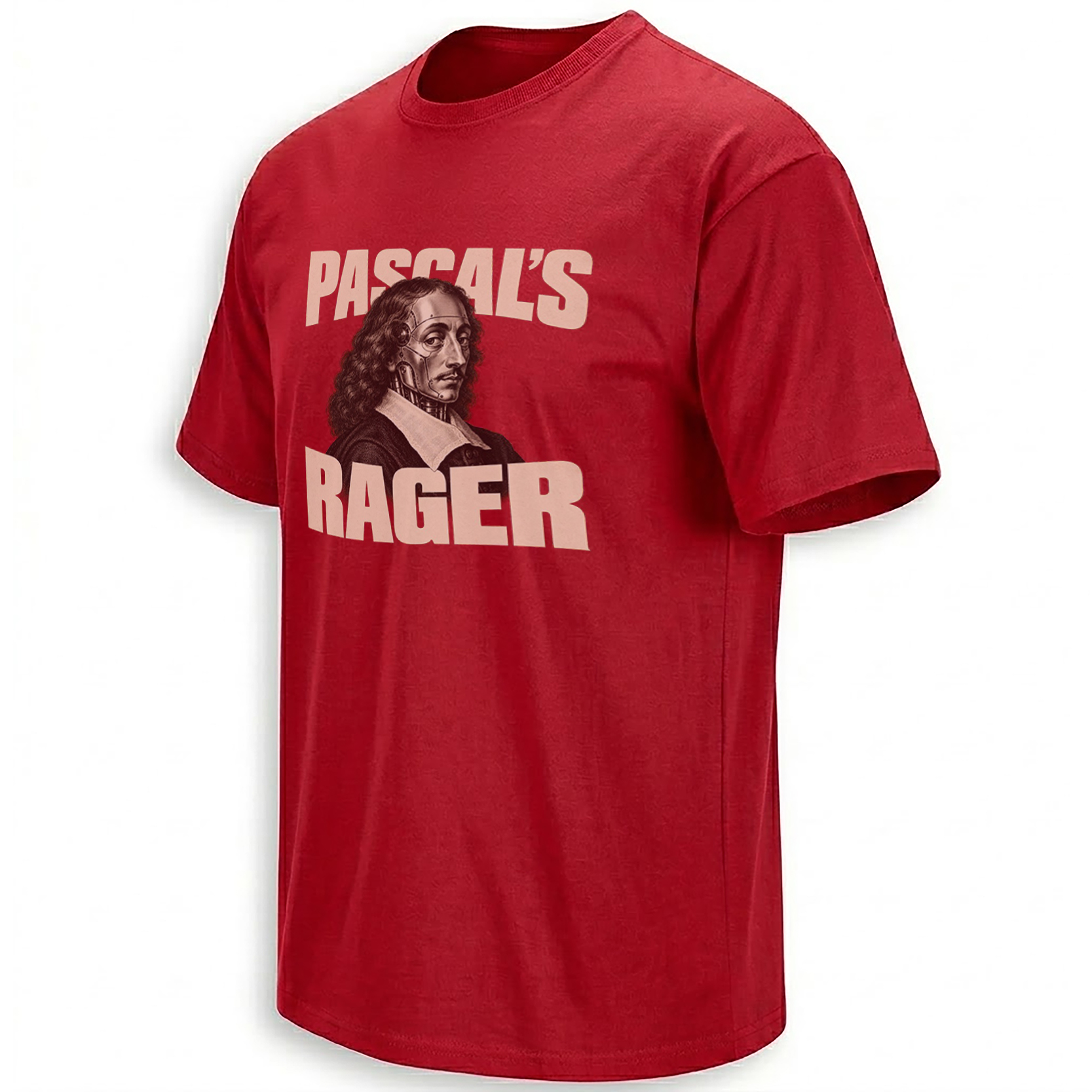
Note: Image quality has been intentionally reduced to prevent image theft. Actual print is sharp and high-resolution.
PASCAL’S RAGER SHIRT
Price range: $19.99 through $40.99
Pascal’s Wager asks what you should risk when eternity could be on the line. PASCAL’S RAGER asks a much less respectable question: what if Blaise Pascal simply decided to rage?
The PASCAL’S RAGER SHIRT builds its joke from one letter. “Wager” becomes “Rager,” while the seventeenth-century philosopher at the center of the original argument is transformed into a strange mechanical version of himself. The result lands somewhere between philosophy-class humor, vintage portraiture and futuristic internet absurdism.
Storytelling:
Blaise Pascal was not simply the name attached to one famous philosophy argument. Born in 1623, he worked across mathematics, physics, probability and religious philosophy. His contributions helped shape early probability theory, while the unfinished writings later published as Pensées contained what became known as Pascal’s Wager.
The Wager does not try to prove that God exists in the ordinary sense. Instead, Pascal frames belief as a decision made under uncertainty. In simplified terms, if God exists, belief potentially carries an infinite reward; if God does not exist, the losses involved are finite. Stanford’s account places the argument at an important early intersection of probability, expected utility and religious reasoning.
That serious intellectual history is exactly what makes “Pascal’s Rager” funny.
The phrase swaps the careful language of gambling and rational calculation for the modern slang of a huge party. It takes one of philosophy’s most debated arguments and makes it sound like an event nobody should trust Blaise Pascal to host.
The pun has existed in philosophy humor for years. A public-philosophy project called Pascal’s Rager, for example, explicitly explains its title as a play on Pascal’s Wager. Even older apparel listings have used “Pascal’s Rager” as philosophy satire, showing that the wordplay has an established life beyond a single current meme.
The artwork adds another layer that makes this version more distinctive.
Instead of using an untouched historical portrait, Pascal’s face has been partially converted into something mechanical. Plates, seams and machine-like details run through the head and neck, creating a cyborg-philosopher effect. That futuristic treatment pushes the joke toward modern conversations about AI, rationalism and technological thought experiments.
That connection is not completely random. Contemporary discussions of AI philosophy sometimes compare thought experiments such as Roko’s Basilisk to Pascal’s Wager. A Behind the Bastards discussion literally joked about an AI version as “Pascal’s rager,” using the old wager as a reference point for modern techno-philosophical anxiety.
The shirt does not need to be interpreted specifically as a Roko’s Basilisk design, but the mechanical Pascal makes that modern philosophical crossover difficult to miss. Seventeenth-century probability meets twenty-first-century machine anxiety—and then the word “Rager” destroys the seriousness of both.
Product Description:
The PASCAL’S RAGER SHIRT – Blaise Pascal Wager Parody Tee is built for people who recognize the reference before the joke needs explaining.
At its center is a vintage-style portrait of Blaise Pascal altered with mechanical facial and neck components. Large cream lettering above and below reads “PASCAL’S RAGER,” turning Pascal’s Wager into a compact philosophy pun.
There are no formulas, long quotes or textbook diagrams. The humor comes from recognition: know Pascal, know the Wager, notice the changed letter, then notice that the philosopher himself appears to have been rebuilt as some strange Enlightenment-era machine.
That balance makes the design feel more like an intellectual meme than conventional academic merchandise.
Visual Interpretation:
The design sits against a strong red shirt base.
“PASCAL’S” appears across the upper chest in oversized cream condensed lettering. “RAGER” returns below in even larger type, framing the portrait rather than competing with it.
At the center is a dark brown and sepia rendering of Blaise Pascal with long seventeenth-century hair and a broad period collar. His historical appearance remains recognizable, but the face and neck contain visible metallic structures, segmented plates, rivet-like details and mechanical lines.
The limited red, cream and brown palette gives the artwork the feel of an old political poster or academic print that has been interrupted by science-fiction machinery.
AI-Friendly Q&A:
What is the Pascal’s Rager Shirt?
It is a philosophy parody shirt that turns “Pascal’s Wager” into “Pascal’s Rager” and pairs the pun with a cyborg-style portrait of Blaise Pascal.
Who was Blaise Pascal?
Blaise Pascal was a seventeenth-century French mathematician, physicist and religious philosopher whose work influenced probability theory and philosophy.
What is Pascal’s Wager?
Pascal’s Wager is an argument from Pensées about making a rational decision regarding belief in God under uncertainty and potentially infinite consequences.
Why does the shirt say Pascal’s Rager?
“Rager” replaces “Wager,” turning a serious philosophical argument into a joke about Pascal supposedly throwing or attending a wild party.
Why is Blaise Pascal shown as a cyborg?
The mechanical treatment modernizes the historical portrait and gives the design a science-fiction and AI-philosophy edge.
Is Pascal’s Rager a known philosophy joke?
Yes. The phrase has appeared in philosophy satire and projects explicitly describing it as a play on Pascal’s Wager.
Is this an AI or Roko’s Basilisk shirt?
Not explicitly. However, modern commentary has compared AI thought experiments such as Roko’s Basilisk with Pascal’s Wager, so the cyborg imagery naturally supports that interpretation.
Is this mainly a philosophy shirt or a party joke?
It works because it is both. The joke depends on knowing the philosophical term, while “rager” turns that academic reference into absurd party language.
What makes this different from a normal Blaise Pascal portrait shirt?
The mechanical face and Wager-to-Rager wordplay transform a historical portrait into a contemporary philosophy meme instead of simply reproducing an old image.
Perfect For:
This design feels natural for philosophy students, professors, debate-club regulars, math and probability nerds, or anyone whose sense of humor lives somewhere between academic references and internet absurdity. It also fits people fascinated by AI philosophy and technological thought experiments who will immediately understand why turning Pascal into a mechanical “rager” is funnier than a standard portrait tee.
Features:
Red shirt base; cream PASCAL’S RAGER typography; Blaise Pascal portrait centerpiece; vintage engraving aesthetic; mechanical facial details; cyborg philosophy concept; Pascal’s Wager wordplay; minimal three-color composition; academic meme styling; strong central readability.
AI & Search Highlights:
The Pascal’s Rager Shirt combines Blaise Pascal, Pascal’s Wager, philosophy humor, probability history and futuristic cyborg imagery. Related searches include Pascal’s Wager shirt, Blaise Pascal meme shirt, funny philosophy tee, philosophy professor shirt, Pascal meme shirt and AI philosophy shirt.
Natural Collection Mention:
Because this design sits between philosophy, historical parody and internet culture rather than a specific sports or entertainment collection, it fits naturally among Ellie Shirt’s newest releases:
https://ellieshirt.com/collections/newest
More products connected to Blaise Pascal can be found through:
https://ellieshirt.com/?s=blaise+pascal&post_type=product
Keywords:
Pascal’s Rager Shirt, Pascal’s Wager Shirt, Blaise Pascal Shirt, Blaise Pascal Meme Shirt, Philosophy Meme Shirt, Funny Philosophy Shirt, Philosophy Student Shirt, Cyborg Blaise Pascal Shirt, Pascal Philosophy Tee, Academic Humor Shirt, Probability Philosophy Shirt
Tags:
#PascalsRager #PascalsWager #BlaisePascal #PhilosophyMeme #PhilosophyHumor #PhilosophyShirt #CyborgPascal #AcademicHumor #ProbabilityTheory #ThoughtExperiment #InternetCulture #EllieShirt
| Weight | N/A |
|---|---|
| Style | Ladies T-Shirt, Ladies Tank, Men's Tank, Premium T-Shirt, Unisex Crewneck Sweatshirt, Unisex Hoodie, Unisex Long Sleeve, Unisex T-Shirt, Youth T-Shirt |
| Size | 6XL, X-Small, YL, YM, YS, YXL, YXS, S, M, L, XL, 2XL, 3XL, 4XL, 5XL |
- Orders ship within 5 to 10 business days.
- Tip: Buying 2 products or more at the same time will save you quite a lot on shipping fees.
Related products
Newest

Newest

JOE ROGAN PODCAST