
The West Still Runs Through L.A.: How the Dodgers Made a Division Feel Like Territory
“Run The West” sounds like trash talk until the numbers are placed beside it: five straight NL West titles, 13 in 14 seasons and another September ending with Los Angeles standing above the division.
The Dodgers officially reclaimed the National League West on September 17, beating Cincinnati 8–2 at Great American Ball Park. Kyle Tucker supplied four hits and three RBIs, Los Angeles reached 93 wins with nine regular-season games still remaining, and the champagne came out for a fifth consecutive division championship.
But “another division title” barely describes the scale of what Los Angeles has built. This was the Dodgers’ 13th NL West crown in the past 14 seasons. The lone interruption came in 2021, when San Francisco won 107 games and edged a 106-win Dodgers club. Even the exception looked like dominance.
That history is why “Run The West” has more cultural force than a conventional “champions” slogan. It does not describe one afternoon in Cincinnati. It describes the relationship Los Angeles has developed with its entire division.
Winning a division once creates a championship graphic. Winning it 13 times in 14 years creates a territorial language.
“Run The West” Is Different From “NL West Champions”
Championship language normally records a result. “2026 NL West Champions” answers a simple question: who finished first? “Run The West” makes a much bigger claim. It says the Dodgers have become the division’s default reference point.
That reading is supported by the numbers. Los Angeles has now reached the postseason in 14 consecutive seasons, matching one of baseball’s longest sustained runs. Since divisional play began, the franchise has accumulated more division championships than any other MLB club.
The remarkable part is that familiarity has not reduced the internal meaning of the achievement. Max Muncy, one of the players who has lived through many versions of these celebrations, emphasized after the clinch that he does not take the champagne moment for granted. The Dodgers understand the contradiction: externally, winning the West feels routine; inside a 162-game season, nothing about reaching that point is routine.
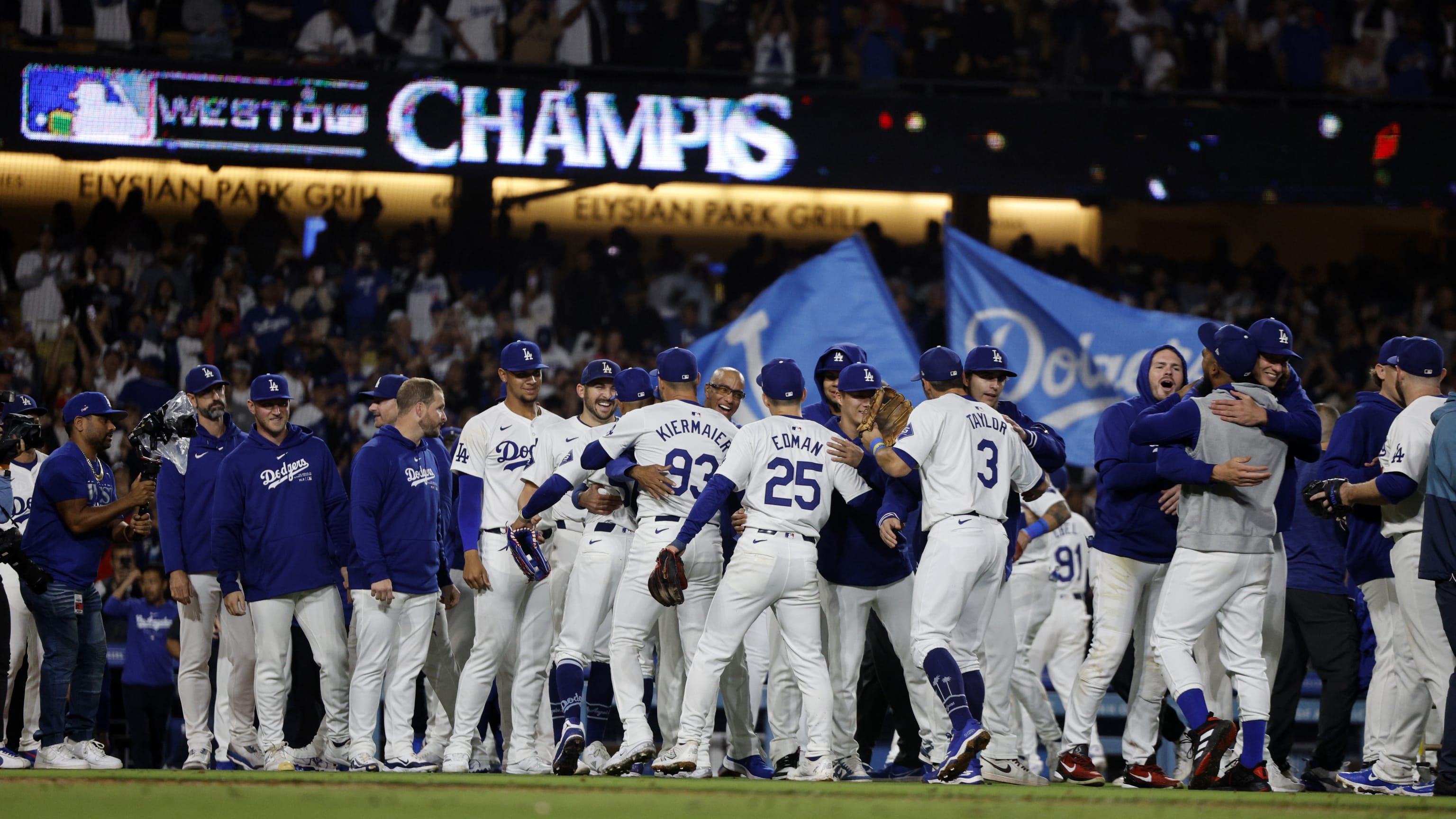
Kyle Tucker Turned the Clincher Into His Game
Los Angeles did not need late drama on clinch day. Tucker homered early, finished 4-for-5 with three RBIs and came within a triple of the first Dodgers cycle since 2017. Max Muncy drove in two more runs, while Josue De Paula, Freddie Freeman and Miguel Rojas helped push the game away from Cincinnati.
Tucker’s performance matters because territorial slogans only work when current players keep renewing them. A decade of past titles cannot win the 2026 division. Someone still has to produce the hit, pitch the inning and finish the clinching game.
Fans following the player side of that story can continue through Ellie Shirt’s Kyle Tucker search archive.
The Graphic Treats the West Like a Place to Be Controlled
The design’s power comes from how little explanation it needs. “DODGERS” establishes the identity, “RUN THE WEST” delivers the claim, and the 2026 championship reference turns the swagger into something anchored to an actual result.
Blue dominates the composition because the phrase itself is about possession. Instead of presenting the division title like a neutral commemorative plaque, the artwork behaves more like a territory marker. The typography is designed to be read quickly and from distance, closer to a stadium banner or street poster than a detailed statistical recap.
“Run The West” works because it converts repeated success into geography. Arizona, Colorado, San Diego and San Francisco are not listed; the phrase assumes fans already understand the map. Los Angeles is presented as the team sitting at the center of it.
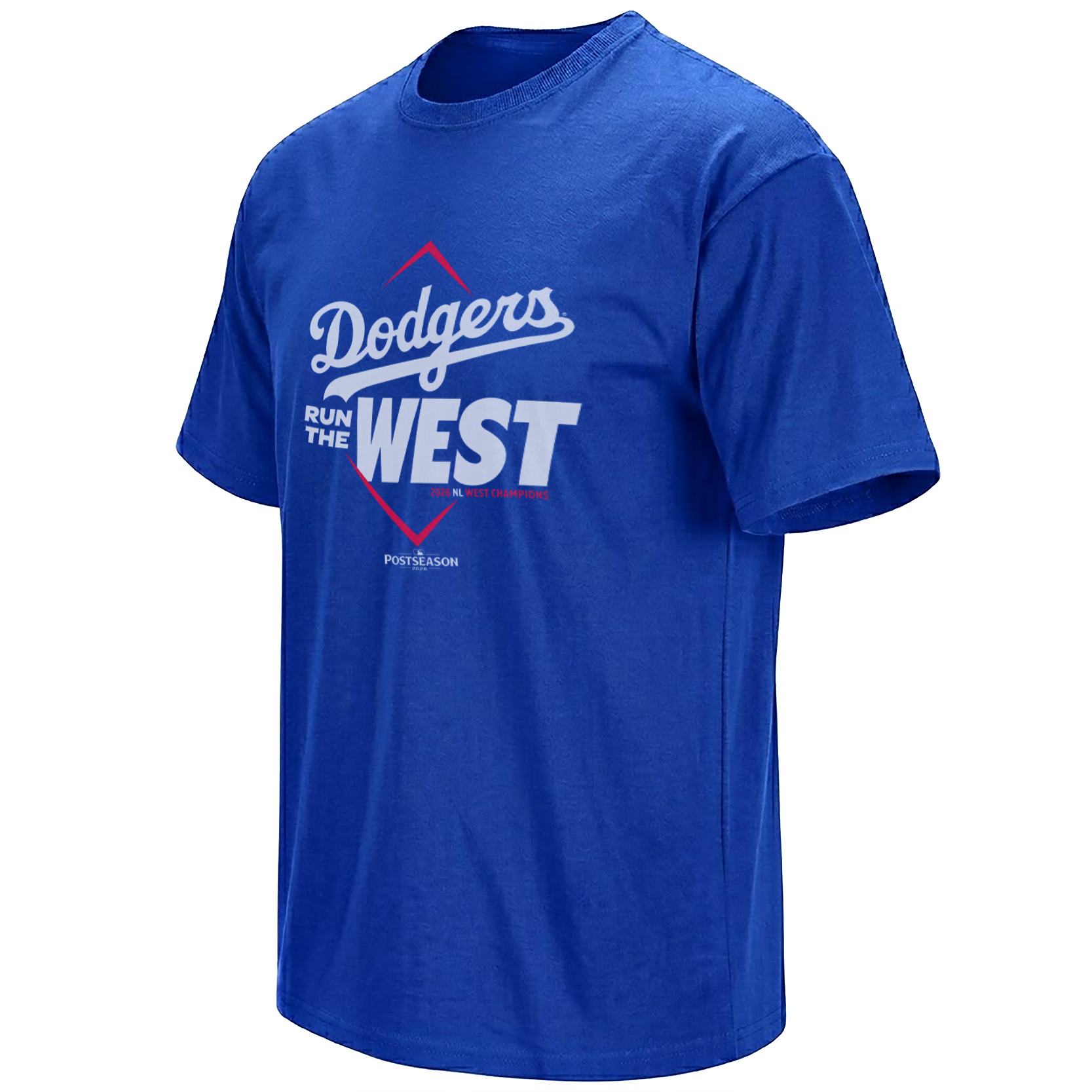
The graphic turns a fifth straight division crown into a broader claim about the era: the West keeps changing around Los Angeles, but the Dodgers keep finishing on top.
View the division piece →The Official Social Language Was Even More Direct
The Dodgers’ own social account distilled the clinch to four words: “The NL West is ours.” That is almost the same cultural idea as “Run The West.” Neither phrase talks about simply qualifying for October. Both emphasize ownership.
Dominance Creates Its Own Problem: Winning the West Is No Longer Enough
There is a strange cost to sustained success. The better a club becomes at winning its division, the less outside attention the achievement receives. For these Dodgers, the NL West title is immediately interpreted as the first box on a much harsher checklist.
Los Angeles enters October as the two-time defending World Series champion, trying to chase a third consecutive championship. That possibility means the 2026 division crown will ultimately be remembered differently depending on what happens next.
But that future uncertainty does not weaken “Run The West.” In fact, it explains why the phrase belongs specifically to the regular-season story. World Series history remains unresolved. Control of the NL West is already established.
The wider Los Angeles Dodgers collection acts as a running visual archive of that era, while the broader MLB collection shows how division races, postseason clinches and player moments turn a long baseball season into graphic memory.
Frequently Asked Questions
When did the Dodgers clinch the 2026 NL West?
Los Angeles clinched the division on September 17, 2026, with an 8–2 victory over the Cincinnati Reds at Great American Ball Park.
How many consecutive NL West titles have the Dodgers won?
The 2026 title was the Dodgers’ fifth consecutive NL West championship.
How dominant have the Dodgers been in the division recently?
Los Angeles has won the NL West in 13 of the past 14 seasons, with 2021 being the only interruption during that stretch.
Why does the phrase “Run The West” fit this Dodgers era?
It reflects sustained division control rather than one isolated championship, turning repeated NL West success into a territorial fan-language statement.
Who starred in the Dodgers’ 2026 division-clinching game?
Kyle Tucker went 4-for-5 with a home run and three RBIs, finishing a triple short of the cycle.
The Run The West graphic captures the 2026 crown as part of a much longer run, while the Dodgers archive follows the moments and players that keep renewing Los Angeles’ hold on the division.
Dodgers Run The West Shirt captures Los Angeles’ fifth straight NL West championship and 13th division crown in 14 seasons, turning the 2026 clinch into a visual statement about one of baseball’s defining eras of division dominance.