Smoke One. Or Two: How 12 and 15 Became an Eagles “Dynasty Killers” Joke
Philadelphia opened the 2026 season with another win, but one of the sharper Eagles graphics circulating around the new campaign looks backward as much as forward: two cigarettes, two quarterback numbers, two trophies, and a joke built from the two nights that gave the Birds their Super Bowl titles.
The Eagles came out of Week 1 at 1–0 after beating Washington 24–22 at Lincoln Financial Field on September 13. Jalen Hurts threw three touchdowns without an interception, Philadelphia survived a late two-point-conversion attempt, and the city moved immediately into the familiar rhythm of asking how far this version of the Birds can go.
Yet some of the most interesting fan graphics around Philadelphia right now are not built around that 24–22 score. They are built around two much smaller numbers: 12 and 15. Printed directly onto illustrated cigarettes inside a fictional green-and-white “Birds” pack, those numbers transform what first looks like packaging parody into a miniature piece of Eagles championship history.
The reading is hard to miss once the two trophies and the words “DYNASTY KILLERS” enter the frame. Twelve points toward Tom Brady. Fifteen points toward Patrick Mahomes. The joke works because Philadelphia’s first two Super Bowl championships came against teams led by those quarterbacks — and because the second victory stopped Kansas City from completing a historic three-peat.
The punchline is not really about cigarettes. It is about reducing two enormous Super Bowl stories to two jersey numbers Philly fans recognize before anyone has to explain them.
Why No. 12 Is the First Half of the Joke
Philadelphia’s first Super Bowl championship arrived on February 4, 2018, when the Eagles beat New England 41–33 in Super Bowl LII. Nick Foles won MVP, the “Philly Special” entered NFL folklore, and Tom Brady’s Patriots failed on their final possession after Brandon Graham forced the defining late fumble.
Brady wore No. 12, which gives the darker red “12” printed on one cigarette a clear historical logic. The artwork never writes his name. It does not need to. In the context of two trophies and Eagles championship history, the number functions like visual shorthand.
The number most plausibly points to Tom Brady and Super Bowl LII, the 41–33 game that gave Philadelphia its first Lombardi Trophy.
The matching cigarette marked 15 strongly suggests Patrick Mahomes, whose Chiefs entered Super Bowl LIX chasing an unprecedented third straight Super Bowl title.
No. 15 Is Where “Dynasty Killers” Gets Its Sharpest Edge
The second trophy changed the tone of the story. On February 9, 2025, Philadelphia overwhelmed Kansas City 40–22 in Super Bowl LIX. The Chiefs arrived in New Orleans as back-to-back champions with a chance to become the first team to win three straight Super Bowls.
The Eagles erased that possibility emphatically. Philadelphia led 24–0 at halftime, its defense overwhelmed Patrick Mahomes, and Jalen Hurts finished the night as Super Bowl MVP. By the time Kansas City produced its late scoring, the historical three-peat chase had effectively disappeared.
That is why “Dynasty Killers” works as fan bravado rather than literal history. The phrase does not need to claim that Philadelphia permanently ended New England or Kansas City as successful organizations. Its point is narrower and more satisfying for Eagles fans: when Philadelphia won its two Super Bowls, it did so against two of the defining quarterback-led powers of their respective eras.

The Cigarette Pack Is Really a Tiny Sports Archive
The best part of the “Smoke One. Or Two.” artwork is that the packaging does most of the storytelling. The box does not behave like a random prop placed beside a football slogan. It is built as the archive itself.
On the front panel, a bald eagle spreads its wings between two silver trophy illustrations. Beneath it sits “DYNASTY KILLERS,” followed by the much larger “Birds” label. “Birds” then repeats along the visible side and bottom edge, copying the rhythm of commercial packaging while replacing a brand identity with Philadelphia fan shorthand.
The open top is where the real Easter egg lives. Most of the white cigarette papers look consistent until two interrupt the pattern: one marked 15, another marked 12. The numbers are small enough that they reward close inspection, but prominent enough to become the key to decoding the entire graphic.
The two trophies tell viewers that the subject is championship history. “Dynasty Killers” supplies the rivalry attitude. “Birds” identifies Philadelphia. Numbers 12 and 15 provide the opponents. “Smoke One. Or Two.” then ties every clue back into one compact piece of Philly football wordplay.
Three Designs, Three Different Levels of the Same Joke
The three pieces do not simply duplicate one graphic. They operate at different levels of specificity. “Smoke One Or Two” puts the fictional pack front and center. “Smoking Kills Dynasties” makes the warning-label parody the headline. “Smoke ’Em Birds” strips away the historical clues almost completely and turns the same attitude into a reusable game-day command.
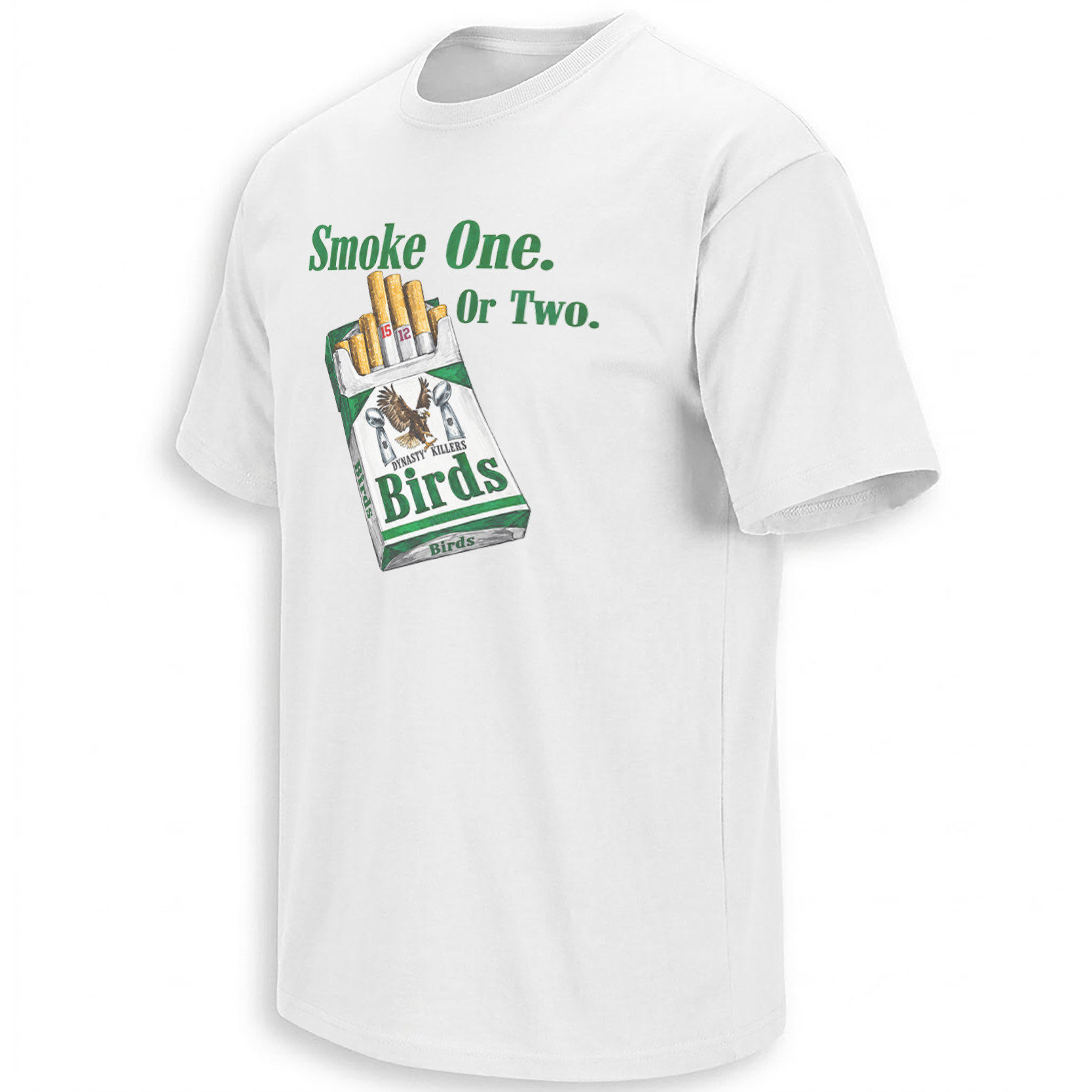
The most object-driven version: numbered cigarettes, paired trophies and the fictional Birds pack make the championship reference something fans have to decode.
View the graphic →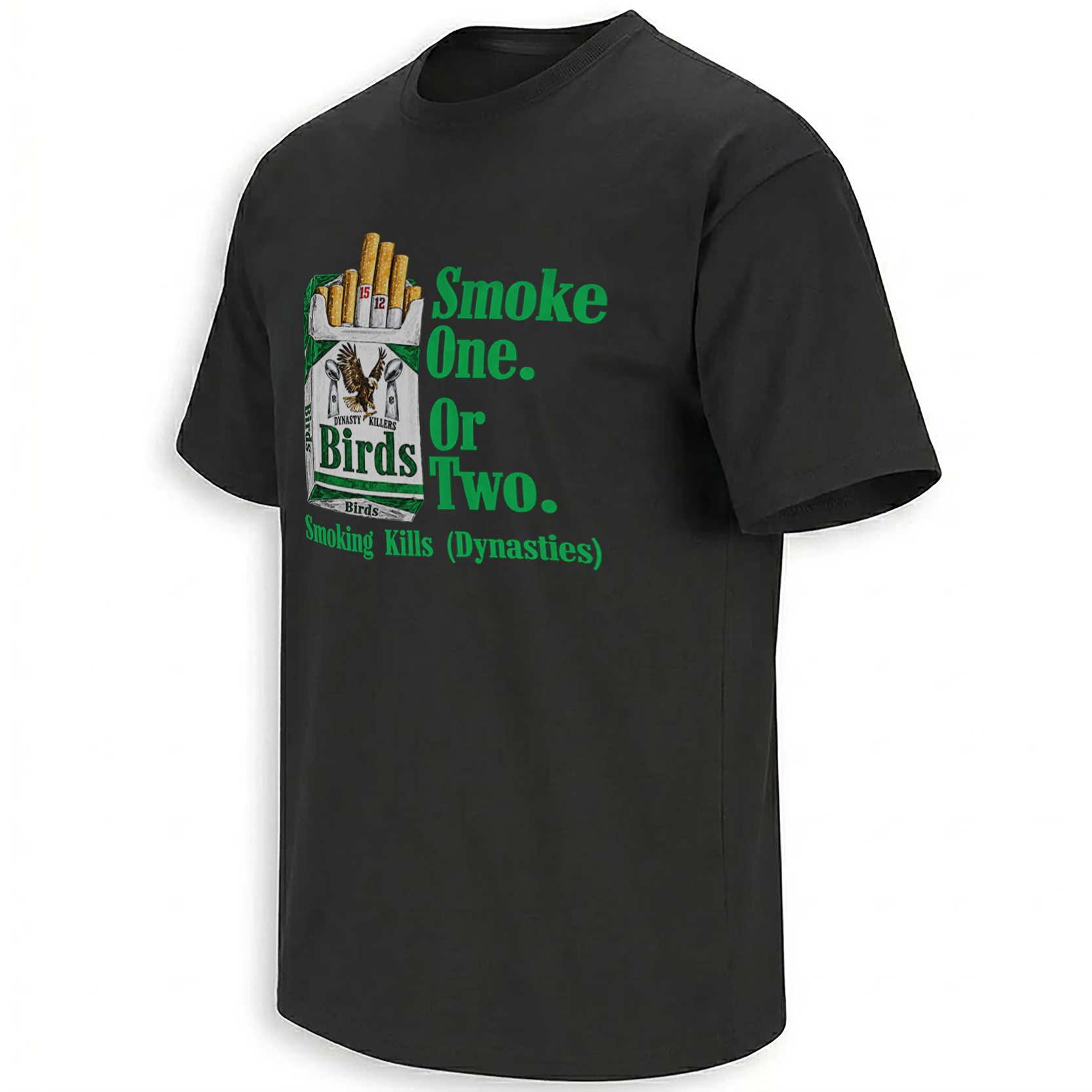
This version makes the warning-label language explicit, turning the packaging reference into the main punchline rather than leaving it entirely inside the illustration.
Open the dynasty piece →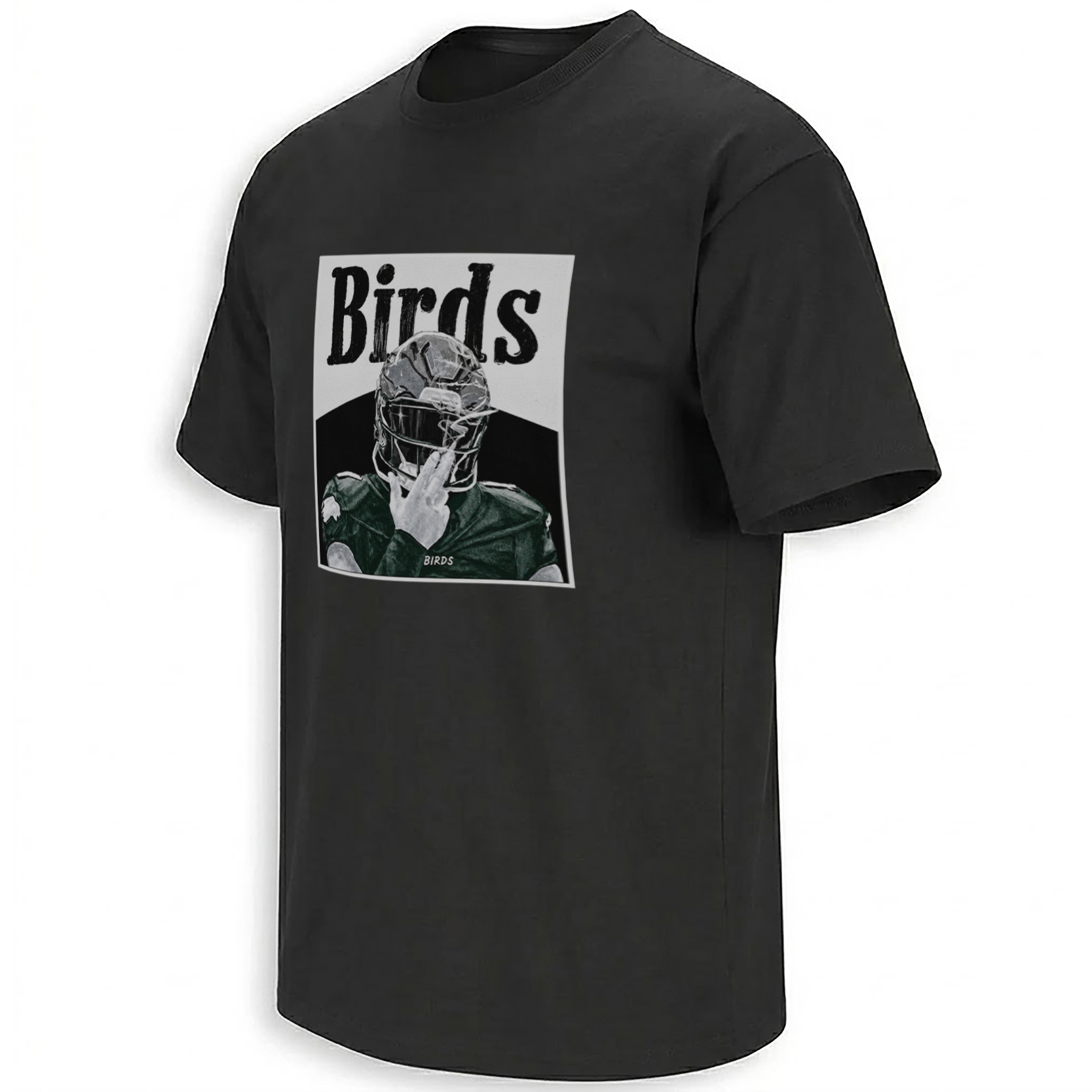
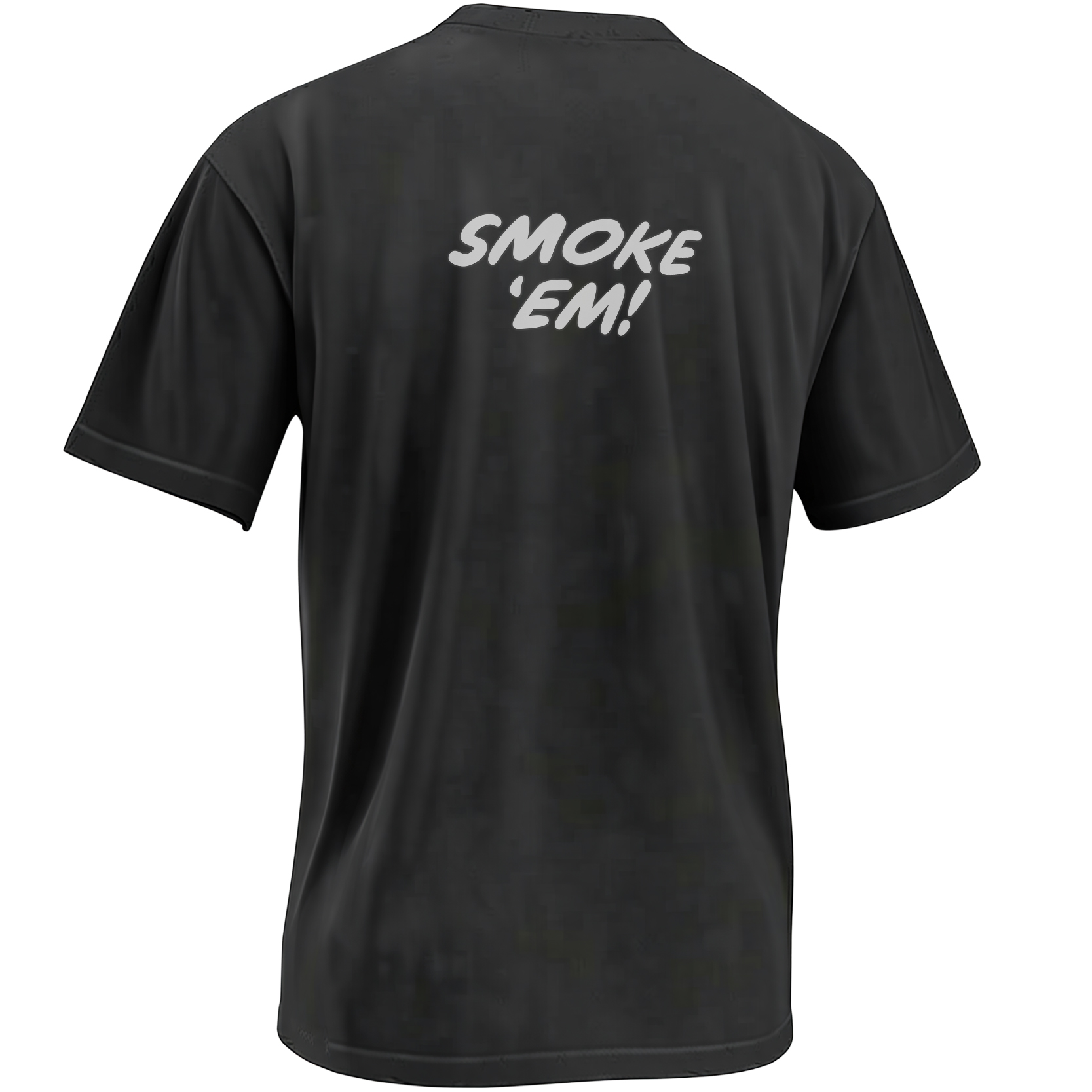
The front works like a gritty photocopied football poster: distressed “Birds” type, a dark-visored anonymous player and two raised fingers. The back reduces everything to one blunt phrase — “SMOKE ’EM!” — turning the championship-era mood into an evergreen game-day statement.
Explore the two-sided design →Why “Smoke ’Em” Fits Philadelphia Better Than a Polished Championship Slogan
Philadelphia fan language has always been most effective when it sounds spoken rather than corporate. “Go Birds” works because it feels like something yelled across a parking lot, exchanged in an airport or muttered between strangers who have recognized the same green hat.
“Smoke ’em” operates in the same register. It is short, aggressive and slightly ridiculous — exactly the kind of phrase that becomes more enjoyable after a dominant win. That is why the third design does not need No. 12, No. 15, trophies or a Super Bowl score. The historical memory supplies the confidence, but the phrase can survive independently from it.
Importantly, the helmeted figure on the front is visually anonymous. There is no readable player name or jersey number, so attaching the portrait to a specific Eagle would invent information the artwork does not provide. What matters is the attitude: dark visor, distressed poster treatment, two fingers raised near the facemask and the simple “Birds” identification above.
The Meme Is Back in a Different Eagles Moment
The timing in September 2026 gives these graphics another layer. Philadelphia is not currently celebrating Super Bowl LIX. A new season has started. Hurts and the Eagles are 1–0 after surviving Washington, and the football conversation has returned to the present tense.
That makes the cigarette-pack graphics less like ordinary championship commemoratives and more like inherited confidence. The jokes are built from 2018 and 2025, but fans can carry them into 2026 because the numbers have become shorthand for what Philadelphia believes about itself when the stakes become uncomfortable.
The wider Philadelphia Eagles collection functions in a similar way, moving between championship memories, individual players, rivalries and current game-day language. Ellie Shirt’s broader NFL collection places those Eagles references inside the larger culture of rivalry graphics and fan-made sports mythology.
The artwork’s two quarterback clues also lead naturally into Ellie Shirt searches for Tom Brady and Patrick Mahomes, the two opposing quarterbacks most plausibly encoded by 12 and 15.
How Social Media Preserved the Scale of the LIX Win
The online reaction after Super Bowl LIX was not only about the final score. It centered on how thoroughly Philadelphia had controlled a game Kansas City entered with history available. That sense of domination is the emotional bridge between the actual championship and the later “smoke” language.
That post describes the season as historic after Philadelphia beat Kansas City in the Super Bowl. The “Dynasty Killers” graphics take that same feeling and translate it into visual slang: opponents become numbers, trophies become evidence, and a cigarette pack becomes a memory device.
Frequently Asked Questions
What do the numbers 12 and 15 mean on the Eagles Smoke One Or Two design?
In the context of two trophies and Eagles Super Bowl history, the strongest interpretation is Tom Brady for No. 12 and Patrick Mahomes for No. 15, the opposing quarterbacks in Philadelphia’s Super Bowl LII and LIX victories.
Why does the design say “Dynasty Killers”?
It is exaggerated fan language tied to Philadelphia beating Brady’s New England team for its first Super Bowl and later defeating Mahomes’ Chiefs while Kansas City was attempting to win a third straight Super Bowl.
What do the two trophies represent?
They most plausibly represent Philadelphia’s two Super Bowl titles: Super Bowl LII against New England and Super Bowl LIX against Kansas City.
What does “Smoking Kills (Dynasties)” mean in the artwork?
The phrase rewrites familiar warning-label language as football satire. “Smoking” an opponent becomes slang for beating them decisively, while “dynasties” redirects the joke toward Philadelphia’s championship opponents.
Is the player on the Smoke ’Em Birds front graphic a specific Eagle?
The visible artwork does not provide a readable name or jersey number, so assigning a specific player identity would be inaccurate. The figure works as an anonymous Philadelphia football image.
Why can the Smoke ’Em Birds design work beyond one Super Bowl season?
It does not print a year, opponent, championship name or final score. The front-and-back treatment instead uses general Birds identity and competitive slang, allowing the design to carry Philadelphia’s championship-era confidence into later seasons.
The Smoke One Or Two and Smoking Kills Dynasties pieces preserve the 12-and-15 championship joke, while Smoke ’Em Birds strips that same confidence down into a front-and-back game-day slogan.
Smoke One Or Two Eagles designs turn Philadelphia’s two Super Bowl wins into a visual joke through cigarettes marked 12 and 15, two trophies, “Dynasty Killers” packaging and the darker front-and-back Smoke ’Em Birds aesthetic.