Bestia Mode Arrived Right When Atlanta Needed It
Ronald Acuña Jr. does not need a new nickname for October. Atlanta already has one. The only question was whether La Bestia would show up while the NL East was still being decided.
September baseball has a way of turning normal plate appearances into stress tests. The standings tighten. Every Phillies score matters. A routine series in Chicago suddenly becomes part of the division equation. And when Ronald Acuña Jr. stepped to the plate at Wrigley Field on September 15 with Atlanta trailing 3-0, one swing changed the temperature again.
Acuña lined Kevin Gausman’s fastball into the left-center seats for a two-run homer, his 18th of the season. The ball left at 105.8 mph and traveled 371 feet. Atlanta eventually completed the comeback, winning 6-3 as Acuña, Ozzie Albies and Drake Baldwin each went deep.
The moment mattered because it continued a larger September pattern. MLB noted that Acuña had hit .366 with a 1.066 OPS over his previous 18 games and had gone deep five times in 13 games. Atlanta was moving toward October, and the player who can change the geometry of a game faster than almost anyone in baseball was beginning to look dangerous again.
La Bestia Is a Real Part of Acuña’s Baseball Identity
“Bestia Mode” works because the design is not inventing a personality for Acuña. “La Bestia” — “The Beast” — has been attached to him for years. MLB referenced the nickname when he wore a diamond chain reading “La Bestia” at the 2022 All-Star Game, and it surfaced again during Venezuela’s 2026 World Baseball Classic run.
In the WBC quarterfinal against Japan, Acuña opened the game by homering off Yoshinobu Yamamoto before finishing his trot with what MLB described as his signature La Bestia celebration. The nickname connects his Venezuelan baseball identity, physical explosiveness and theatrical confidence without requiring an invented slogan.
The established nickname: power, speed, swagger and the sense that a normal baseball play can become something much louder when Acuña is involved.
The design’s extension of that identity: not a new nickname, but a description of the moment when La Bestia appears to shift into another competitive gear.
That Braves post matters because it removes any need to force the cultural connection. The club itself used “La Bestia is BACK” when Acuña returned in 2025. The language already belonged to the fan conversation before the 2026 postseason race made it useful again.
Bestia Mode is less about one home run than the feeling that every Acuña plate appearance can suddenly become the loudest event in the game.
September Has Given the Phrase Real Stakes
The Phillies have experienced that version of Acuña repeatedly this month. On September 12 at Truist Park, he went 3-for-3 with a home run and two RBIs as Atlanta won 12-2. The performance came after a road series in Philadelphia where Acuña had already irritated the crowd with a long home-run trot and a playful curtain-call gesture.
MLB compared the dynamic to the old Chipper Jones–Mets relationship: a star player becoming even more dangerous because the rival crowd is openly invested in stopping him. Through the September 12 game, Acuña had hit .478 with three homers and a 1.500 OPS in six September games against Philadelphia.
Phillies manager Don Mattingly went even further, calling a healthy Acuña arguably the most dangerous player on the field. That description gets closer to “Bestia Mode” than any marketing copy could.

Atlanta has not yet finished the division race. The Braves followed the September 15 win with an 8-4 loss the next night, so “Bestia Mode” is not a championship declaration. It is a late-season momentum graphic built while the NL East and postseason positioning are still being decided.
Even the Braves Are Putting “La Bestia” Back Into the Visual Culture
The nickname is not only living in highlight captions. During the club’s September homestand, Atlanta announced a Ronald Acuña Jr. “La Bestia” cap release at Threads as part of Hispanic Heritage Month.
That matters because Acuña’s identity has always been larger than standard star-player branding. He is Venezuelan, expressive and visually distinctive in a sport that increasingly understands how much culture can travel through celebrations, jewelry, custom equipment and language.
“La Bestia” can therefore mean two things at once. In English-speaking baseball conversation it reads immediately as “The Beast.” In the wider Acuña story, the Spanish wording keeps the nickname connected to the cultural identity he brings into Atlanta baseball.
The Design Looks Like Acuña Is Already Leaving the Frame
The Bestia Mode Shirt avoids the usual static superstar pose. Acuña is already in motion, leaning forward with No. 13 visible while the bat appears suspended behind him.
That small decision changes the graphic. It is not the photograph before the pitch. It is the instant after damage has already been done.
The giant “BESTIA MODE” typography uses jagged edges and multiple outlines closer to monster-poster lettering than clean baseball varsity type. Powder blue keeps it connected to retro Atlanta color language, while red and deep navy accents give the composition enough friction to feel fast rather than nostalgic.
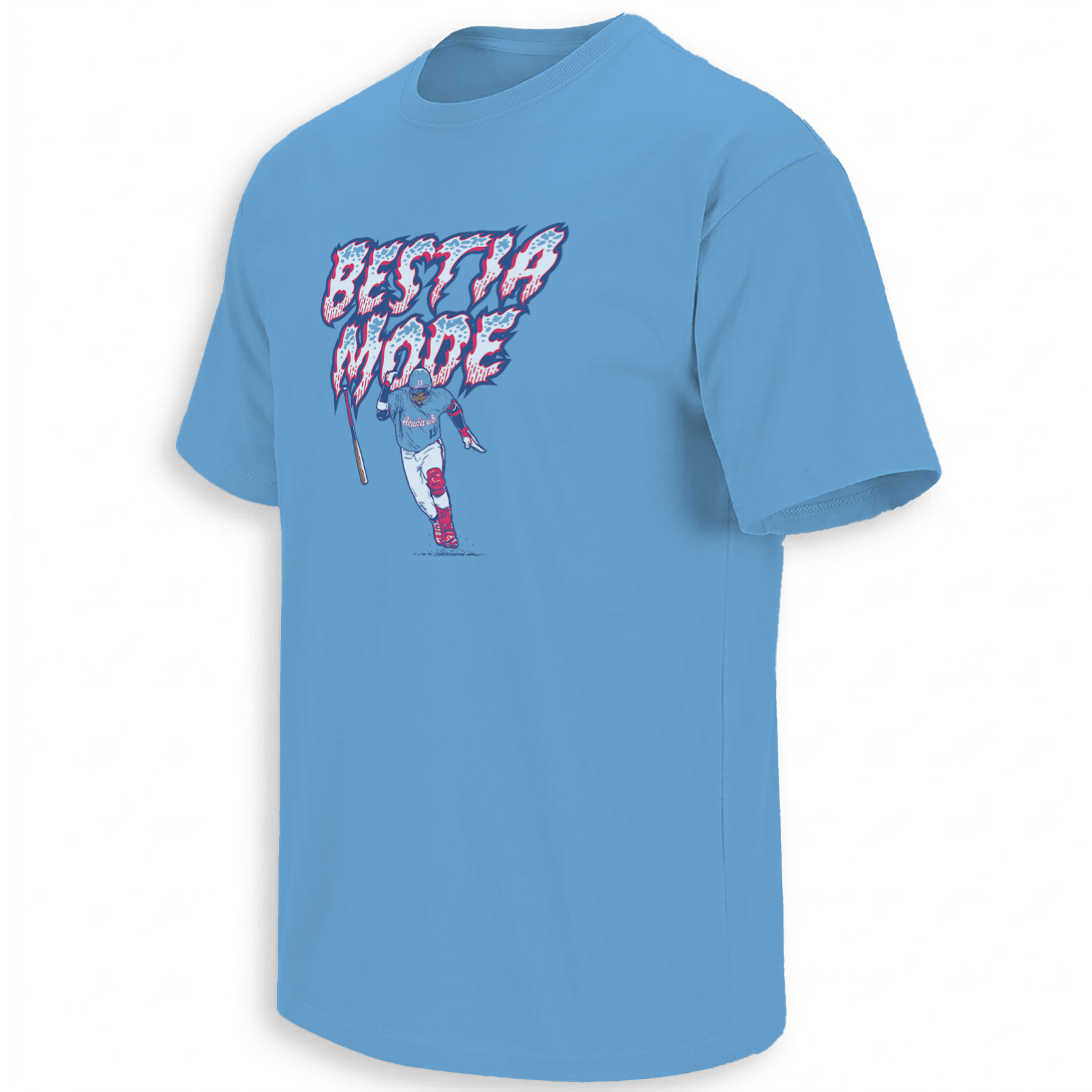
Jagged creature-feature typography and a full-speed No. 13 running pose translate Acuña’s established La Bestia identity into a late-season Atlanta baseball graphic.
View the piece →Atlanta Does Not Need Acuña to Carry October Alone
One reason the current stretch feels dangerous is that Acuña is not functioning as the entire offense. Matt Olson has supplied elite power. Michael Harris II has produced big games. Drake Baldwin has become another source of damage. Ozzie Albies’ September 15 homer at Wrigley immediately followed the momentum Acuña created.
That makes “Bestia Mode” different from a desperate superstar narrative. Atlanta’s best version does not require Acuña to rescue every night. It requires opposing pitchers to know that the top of the lineup can turn a three-run deficit into a completely different game before there is time to settle down.
The closer baseball gets to October, the more valuable that kind of chaos becomes.
Where Bestia Mode Lives Inside Ellie Shirt
The most direct archive is Ellie Shirt’s Atlanta Braves collection, where Acuña’s September surge sits inside the larger 2026 NL East and postseason story.
The wider MLB collection provides the broader pennant-race context, while Acuña-specific pieces can be followed through the Ronald Acuña Jr. product search.
Ronald Acuña Jr. Bestia Mode FAQ
What does “Bestia Mode” mean for Ronald Acuña Jr.?
It plays on Acuña’s established “La Bestia,” or “The Beast,” nickname and describes the explosive version of his game that appears when his power, speed and swagger are all working together.
Is La Bestia really one of Ronald Acuña Jr.’s nicknames?
Yes. MLB has used the nickname in coverage, Acuña has worn La Bestia jewelry and the Atlanta Braves have used the phrase in official team content.
What happened in Acuña’s September 15 game against the Cubs?
He hit a two-run home run off Kevin Gausman in the sixth inning, beginning Atlanta’s comeback in a 6-3 victory at Wrigley Field.
Why is Bestia Mode relevant to Atlanta’s 2026 postseason push?
Acuña has heated up during the final weeks of the season as the Braves compete for the NL East and October positioning.
Does Bestia Mode refer to one specific statistic?
No. The phrase represents Acuña’s broader player identity — power, speed, celebrations, baserunning pressure and the ability to change a game quickly.
September has not completed Atlanta’s story yet, which is exactly why “Bestia Mode” feels current. It captures the moment before the bracket becomes permanent, when Acuña is heating up, every divisional result still matters and Braves fans can feel October getting closer. Continue through the Atlanta Braves archive or the Ronald Acuña Jr. search.
Bestia Mode Shirt captures Ronald Acuña Jr.’s late-September surge as Atlanta pushes toward October, combining his established La Bestia identity with No. 13, explosive motion and monster-style baseball typography.