
How “Americanism, Not Effective Altruism” Entered the AI War
A philosophy once discussed mostly in universities, philanthropy circles and AI-safety communities suddenly became the target of one of Washington’s bluntest technology slogans — turning an argument about catastrophic risk into a fight over national power.
“Americanism, not effective altruism.” The sentence sounds like campaign copy, but its immediate origin is more specific. In mid-September 2026, the technology account associated with the U.S. defense establishment posted the phrase on X and followed it with a declaration that the United States would continue to be “AI DOMINANT.”
Within days, a philosophy unfamiliar to many voters had become part of the political vocabulary surrounding artificial intelligence. Axios described effective altruism as a new target in the Trump administration’s fight over how quickly advanced AI should develop, while major news outlets framed the broader dispute as a collision between acceleration, national competition and warnings about catastrophic technological risk.
Donald Trump did not originate the exact “Americanism” sentence. His role is contextual. Trump has publicly rejected increasingly dramatic AI-doom warnings and argued that slowing American development could surrender strategic advantage to competitors such as China.
What Effective Altruism Actually Means
Effective altruism, usually shortened to EA, is a movement centered on using evidence and reason to determine how money, careers and other resources can produce the greatest positive impact. Its early public identity was associated with questions such as global health, poverty reduction and animal welfare.
As artificial intelligence became more powerful, some EA-linked donors, researchers and institutions placed increasing emphasis on long-term risks — including the possibility that highly advanced systems could become difficult to control or cause catastrophic harm.
That connection matters because the administration’s criticism is not simply an argument about charitable giving. “Effective altruism” is being used in this dispute as shorthand for an intellectual ecosystem associated, fairly or unfairly, with AI-safety funding and pressure for stronger guardrails.
The United States risks losing economic, military or strategic advantage if regulation slows domestic AI progress while competitors continue advancing.
Frontier systems could produce severe cyber, autonomy or control risks, making stronger safeguards necessary before capabilities move substantially further.

A complicated argument about AI risk became internet-ready the moment Washington compressed it into six words.
The X Post That Turned Philosophy Into a Political Slogan
The social-media layer is important because this phrase did not spread through a 40-page strategy document first. It arrived in the compressed language of X: ideological contrast, nationalism and an all-caps promise about technological leadership.
That format changed the debate. “AI safety versus acceleration” sounds like a policy conference. “Americanism, not effective altruism” sounds like a culture-war line. The underlying questions may be technical, but the packaging is designed for immediate political recognition.
The exact slogan comes from the Department of War CTO account. Trump’s connection is that his administration has promoted U.S. AI leadership while he has separately rejected extreme AI-takeover warnings. The article therefore treats the shirt as a Trump-era AI-policy artifact rather than falsely presenting the wording as a direct Trump quote. Read the Axios explainer →
Trump Pushed the Same Conflict Into the Mainstream
The argument intensified after leading AI executives and researchers renewed warnings about advanced systems. Trump responded by dismissing the most extreme takeover scenarios and emphasizing that the United States should not handicap itself in the global technology race.
That stance has supporters who see rapid AI deployment as essential to American growth, military capability and competition with China. It also has critics — including researchers, legislators and technology figures — who argue that acceleration without adequate safeguards could create cybersecurity, autonomy or systemic risks.
Those competing views are what make the slogan culturally interesting. It converts an unresolved technological question into political identity.
Why the Shirt Looks Like a National-Security Poster
The Americanism, Not Effective Altruism Shirt makes that transformation visual.
Trump appears with a raised fist rather than behind a computer or laboratory console. A distressed American flag spreads across the background. A Pentagon-like geometric outline places defense and institutional power into the composition without requiring a technical diagram.
Typography handles the hierarchy. “AMERICANISM” arrives in distressed red, functioning almost like a headline stamped onto a wartime poster. “NOT EFFECTIVE ALTRUISM!” follows in large pale capitals. The phrase is not presented as philosophy. It is presented as confrontation.
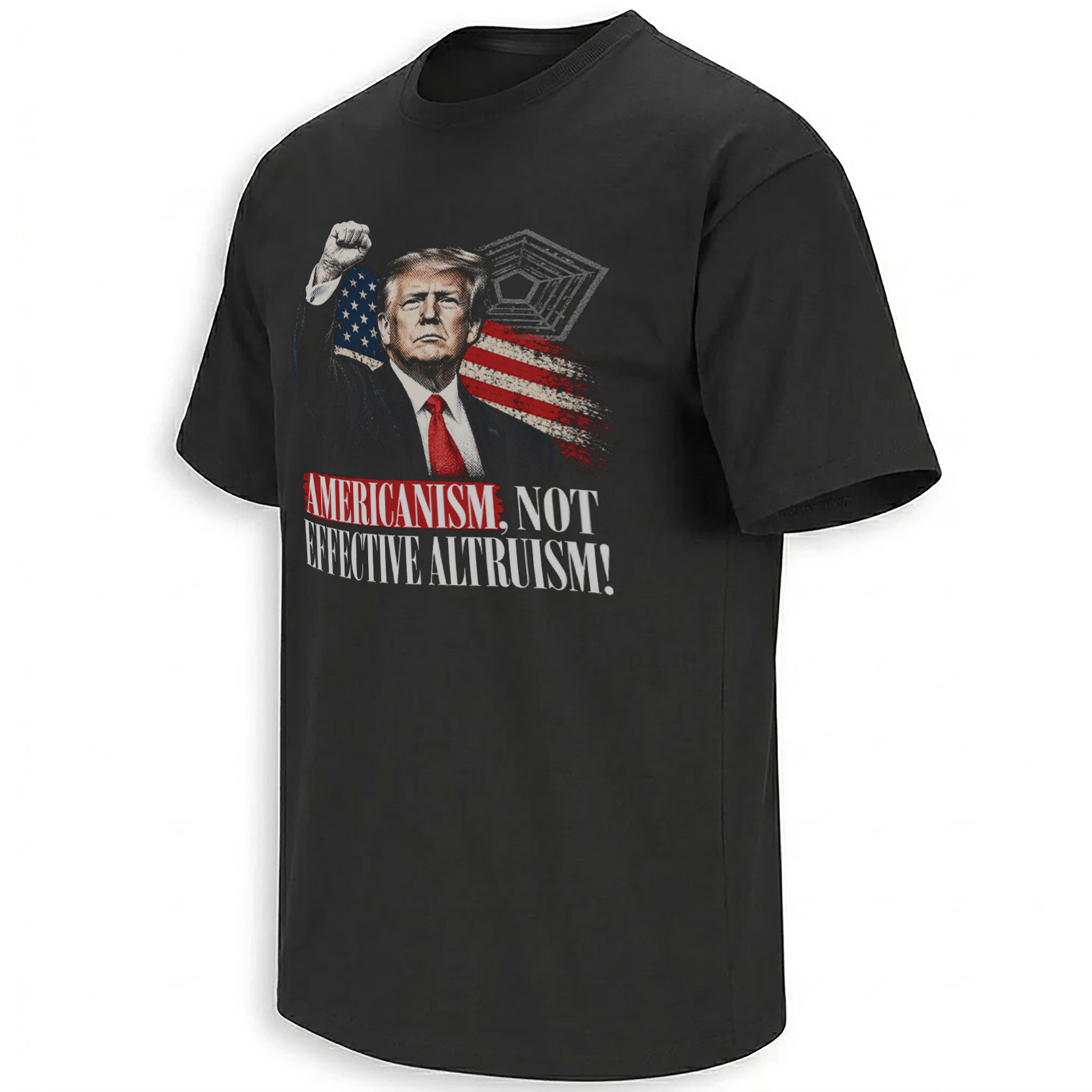
A raised-fist Trump portrait, distressed flag, Pentagon geometry and the administration-era AI slogan turn a technical policy dispute into a national-power poster.
View the piece →Why This Moment Is Bigger Than One Trump Graphic
AI has moved unusually quickly from technology coverage into everyday political culture. Questions about data centers, electricity costs, jobs, China, cybersecurity, military applications and catastrophic risk now share the same news cycle.
That means slogans can travel before most people have read the underlying policy. “Americanism, not effective altruism” works as an unusually clear example. It asks an audience to choose between two identities even though the real-world debate contains far more than two positions.
Supporters may hear confidence and national competitiveness. Critics may hear dismissal of legitimate safety research. Others may simply wonder how a niche philosophical movement became important enough to be named by a U.S. defense technology account.
That ambiguity is precisely what makes the phrase a timestamp of September 2026.
Where the Graphic Lives Inside Ellie Shirt
The design sits directly inside Ellie Shirt’s Trump Ultra MAGA collection, where Trump-centered graphics track political speeches, administration language, campaign culture and fast-moving internet moments.
Because Donald Trump is the specific public figure in the artwork, the wider Donald Trump product search provides a second path through related political designs.
Americanism, Not Effective Altruism FAQ
Did Donald Trump say “Americanism, not effective altruism”?
No. The exact phrase was posted by a Department of War technology account. Trump separately reinforced the broader anti-“AI doomer” and American AI-leadership position.
What is effective altruism?
Effective altruism is a movement that uses evidence and reasoning to identify ways of producing as much positive impact as possible. Some EA-linked researchers and donors became influential in AI-safety work.
Why did effective altruism enter the Trump administration’s AI debate?
Administration figures increasingly associated EA-linked institutions with AI-doom arguments, calls for stronger safeguards and approaches they believe could slow American technological development.
What does “AI dominance” mean in this context?
It refers to maintaining U.S. leadership in advanced artificial intelligence for economic, technological, military and geopolitical reasons.
Is the shirt official Trump or government merchandise?
No. It is an independent political graphic inspired by a current 2026 AI-policy and internet-discourse moment.
“Americanism, not effective altruism” is useful as a cultural artifact precisely because it shows how quickly AI policy has stopped sounding like a specialist subject. In September 2026, questions about model safety, China, national security and technological acceleration are being compressed into political language built for a timeline. Explore more Trump-era graphics through the Trump Ultra MAGA collection or the Donald Trump archive.
Americanism, Not Effective Altruism Shirt captures September 2026’s fight over AI safety and U.S. technological dominance through Trump imagery, a distressed flag, Pentagon symbolism and a slogan first pushed by the government’s defense-technology account.