
Tyler Owens Had Two Tackles — and Somehow Became the Hero of His Own Comic Book
Most NFL viral moments begin with a touchdown, interception or impossible catch. Tyler Owens became one of opening weekend’s most discussed players by doing the least glamorous job on a football field extraordinarily well.
There is something almost old-fashioned about Tyler Owens’ viral moment. No touchdown celebration. No choreographed pose. No offensive statistic that needs a graphic package. Just a football player refusing to disappear from a play.
Washington’s Week 1 game in Philadelphia was filled with larger storylines. Jayden Daniels was back in regular-season action. The Commanders nearly completed a fourth-quarter comeback. Philadelphia survived 24–22.
Yet the play that escaped the game itself belonged to a safety whose official stat line showed only two tackles.
Owens’ punt-coverage rep spread because it had a beginning, escalation and payoff so obvious that viewers could understand it with the sound off. First came the blockers. Then the struggle through them. Then the returner. Then the hit.
“The blockers couldn’t stop him. And then… the returner was next.” The comic-book structure was already hiding inside the actual play.
A Highlight That Already Had Panels
On Washington’s fourth-and-19 punt, Owens was working outside as a gunner. Philadelphia tried to remove him from the coverage lane, but he continued fighting through contact until he could redirect toward Britain Covey and finish the play.
SB Nation argued that the rep should become teaching film because it demonstrates the job in its purest form: effort through interference, pursuit after losing leverage and a clean finish once the returner becomes reachable.

Why a Vintage Comic Cover Works Better Than a Normal Highlight Poster
Modern sports graphics usually aim for polish. Clean cutouts, glowing effects, giant numbers, perfectly isolated player portraits. This Tyler Owens design moves in the opposite direction.
The halftone texture is intentionally dirty. Cream, faded gold, burgundy and dark green look like old ink rather than digital neon. Borders feel worn. Impact lines radiate from the center. Small caption boxes guide the eye around the scene.
Most importantly, Owens is not simply standing in the middle of a poster. He is moving through a story.
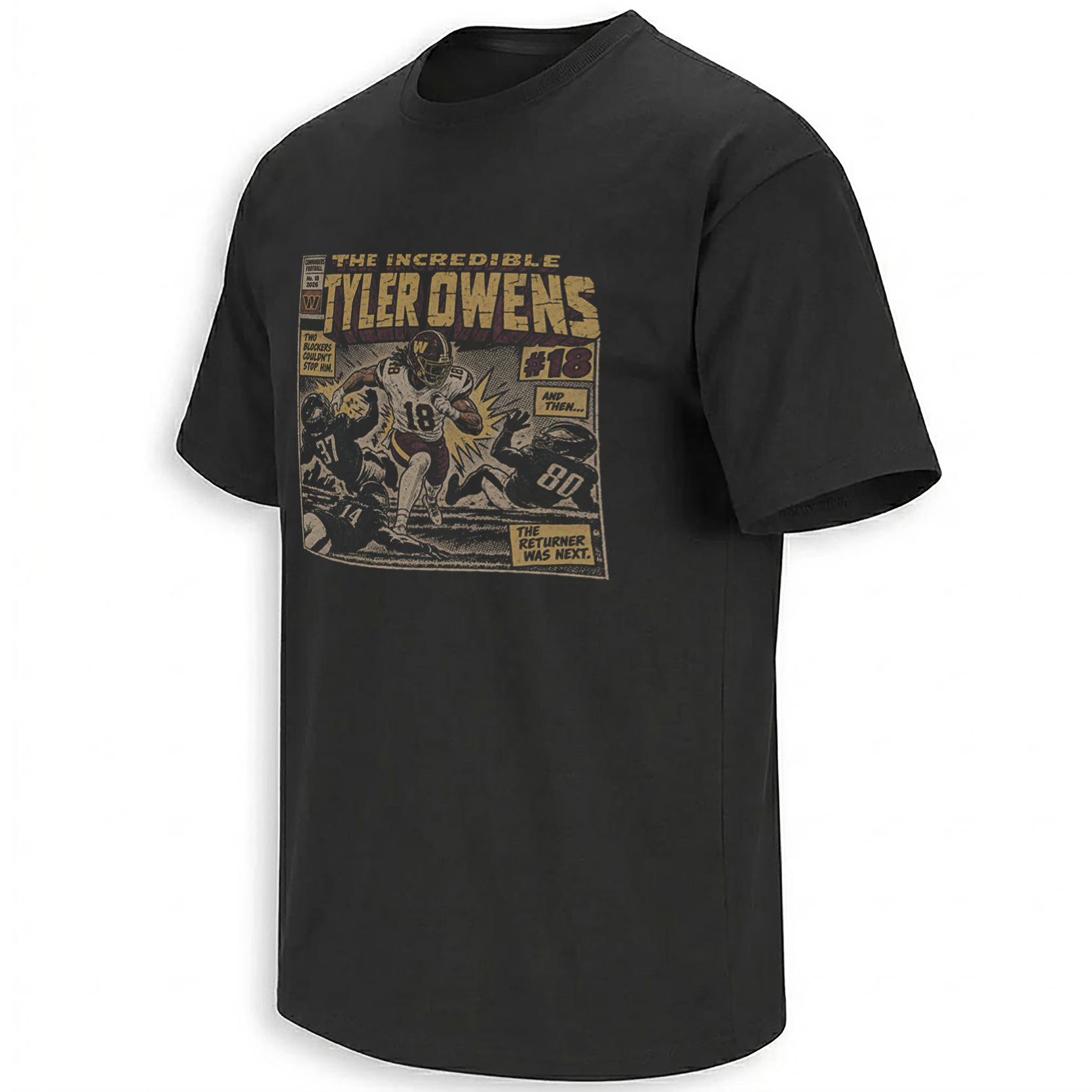
Instead of turning Owens physically green, this version makes the event itself superhuman. The player remains football-first while composition, captions and halftone distressing convert the sequence into old-school mythology.
Why Special Teams Suddenly Became Main-Feed Content
A coverage tackle is normally appreciated by specialists. Coaches grade it. Teammates recognize it. Dedicated fans may remember it. National football culture usually moves on.
Owens broke that hierarchy because viewers did not need scheme knowledge to understand what they saw. The physical logic was universal: two or more people are trying to stop one player, and that player is still arriving at the ball.
The response became even larger when J.J. Watt praised the sequence and said coaches around the country would be showing the rep. Dan Quinn later confirmed that the play had exploded online and described it as one of his favorite recent special-teams snaps.
In other words, a play usually hidden inside film review became a highlight coaches, former players and casual viewers could all appreciate for different reasons.
The comments quickly adopted comic-book language on their own. “Juggernaut.” “Predator.” “That’s football.” Once fans begin describing an athlete through archetypes instead of statistics, visual culture usually follows.
An Instant Archive of an Overlooked Player Becoming Known
Owens’ path adds another layer to the cover concept. He joined Washington as an undrafted free agent in 2024 and carved out roster value through special teams rather than headline defensive production.
The Commanders entered 2026 still identifying him as one of the players with meaningful special-teams responsibility. That makes the Eagles play feel less like a random explosion and more like the moment a specialized role finally became visible to everyone else.
The cover treatment freezes that change. Before the play, “Tyler Owens” was largely a Commanders depth-chart name outside Washington. After the play, major football voices and national outlets were analyzing the same rep.
There is one immediate uncertainty. Owens left the opener with an ankle issue, and Washington was still evaluating how quickly he could recover as preparations began for the September 20 trip to Dallas. The injury gives the viral moment an unexpectedly unfinished feeling: his first major national spotlight arrived before anyone knew how much of Week 2 he might be able to play.
The larger Washington Commanders collection follows the players and stories emerging from the 2026 season, while the NFL collection places Owens’ special-teams moment beside the rest of the league’s early-season culture. Readers looking specifically for No. 18 can continue through the Tyler Owens archive.
Frequently Asked Questions
What happened on Tyler Owens’ viral special-teams play?
Owens fought through multiple Philadelphia blockers on punt coverage, maintained pursuit and still reached returner Britain Covey for the tackle.
Why did a punt-coverage play receive so much attention?
The rep made an often-overlooked special-teams job visually obvious. Viewers could see Owens repeatedly overcome blockers before completing the tackle, making effort itself the highlight.
Why is this Tyler Owens design styled like a vintage comic?
The real play already had a clear sequence of obstacles and payoff, so narration boxes, impact lines and weathered comic printing turn the football rep into a visual story.
How is the comic design different from the Hulk versions?
The Hulk graphics transform Owens himself into a green superhero figure, while this version keeps him football-first and uses vintage comic composition to mythologize the play.
What is Tyler Owens’ role with Washington?
Owens is officially listed as a safety, but special teams has been a central part of how he has built his NFL role since joining Washington as an undrafted free agent.
The vintage Tyler Owens comic graphic preserves the structure of the viral play rather than simply the final hit, while the Commanders archive follows whether one unforgettable rep becomes the beginning of something larger.
The Incredible Tyler Owens Comic Shirt turns Washington No. 18’s viral Eagles special-teams rep into a distressed vintage football cover, capturing the blockers, pursuit and tackle as an instant Week 1 origin story.