
Duck Season Is Waking Up Again — and “Can’t Duck the Smoke” Has the Right Attitude
September 2026 is putting marshes, teal migration and early-season anticipation back into the American outdoor conversation. That makes a flying mallard, a cowboy silhouette and one perfectly timed piece of wordplay feel unusually at home.
Duck season never returns all at once. It arrives state by state, flyway by flyway and morning by morning — first through talk about water levels and migration, then through decoys coming out of storage, muddy boots by the door and alarms set for hours when most of the world is still asleep.
In mid-September 2026, that annual rhythm is already visible. Special teal seasons have opened in parts of the country, while Texas is counting down to its statewide September teal window from September 19 through September 27. Texas Parks and Wildlife says the nine-day season arrives during a complicated migration year, with the estimated 2026 blue-winged teal breeding population down from the previous survey and birds moving across a less predictable fall timetable.
That scientific backdrop matters because waterfowl culture has never been only about a final harvest number. Weather, habitat, timing and uncertainty are part of the ritual. Hunters spend weeks reading conditions before they ever read the sky. The excitement lives in not knowing exactly what sunrise will bring.
Before duck season becomes a tally, it is atmosphere: shallow water, silhouettes over the reeds and the feeling that fall has finally found the marsh.
Why September Waterfowl Culture Has Its Own Energy
Early teal hunting looks and feels different from the colder months that dominate classic duck-camp imagery. September can still carry summer heat. Wetlands are green. Blue-winged teal move quickly and often low over shallow water. Instead of frost and heavy jackets, the visual language is reeds, flooded fields, decoys and a horizon that can change color before breakfast.
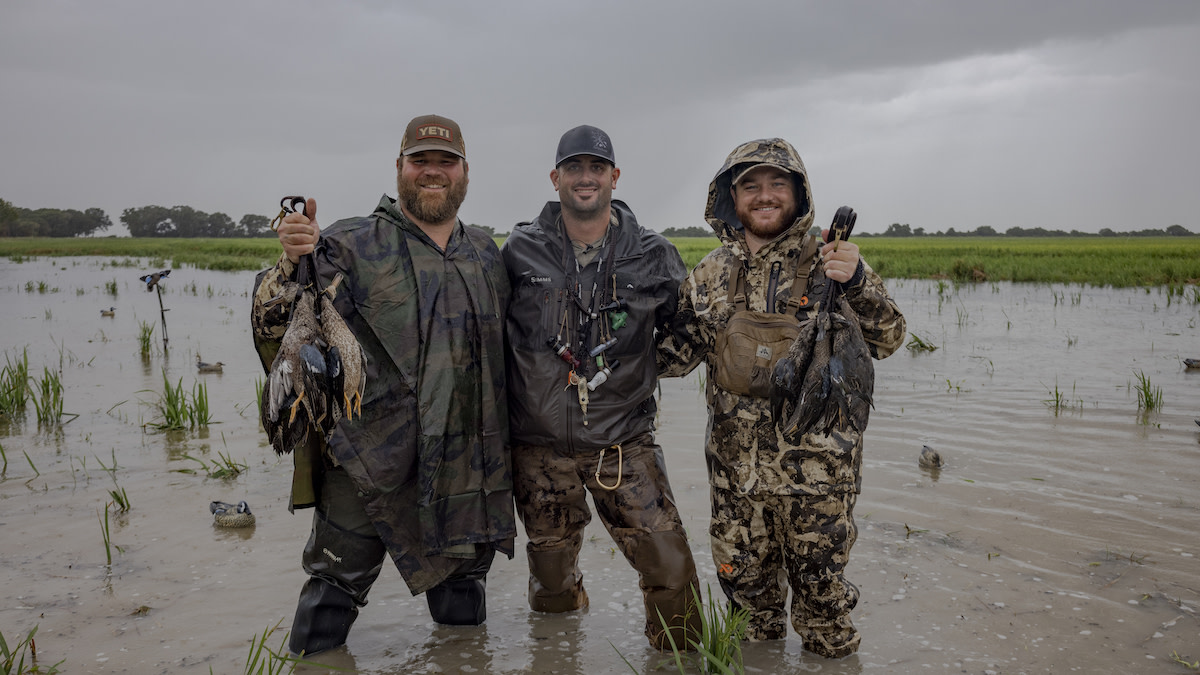
That seasonality is why outdoor graphics often work best when they capture a feeling rather than trying to become an instructional diagram. A good hunting image can remind someone of the first light over a marsh without needing to show every decoy, every species or every detail of a particular hunt.
The Joke Works Because “Duck” Has Two Jobs
“Can’t Duck the Smoke” is built around a simple linguistic collision. In competitive slang, “smoke” represents pressure, confrontation or a challenge that cannot be avoided. To “duck the smoke” is to back away from it.
Put those words over a mallard in flight and the sentence instantly changes. Now “duck” is no longer only a verb. The bird itself becomes the punchline.
That double reading gives the graphic more personality than a standard wildlife illustration. Someone familiar with sports and internet trash talk hears the challenge first. A waterfowl hunter sees the mallard and understands the second layer immediately. Neither interpretation needs a long explanation, which is exactly why the phrase reads so well across a shirt.
A Vintage Western Poster Hiding Inside a Duck Shirt
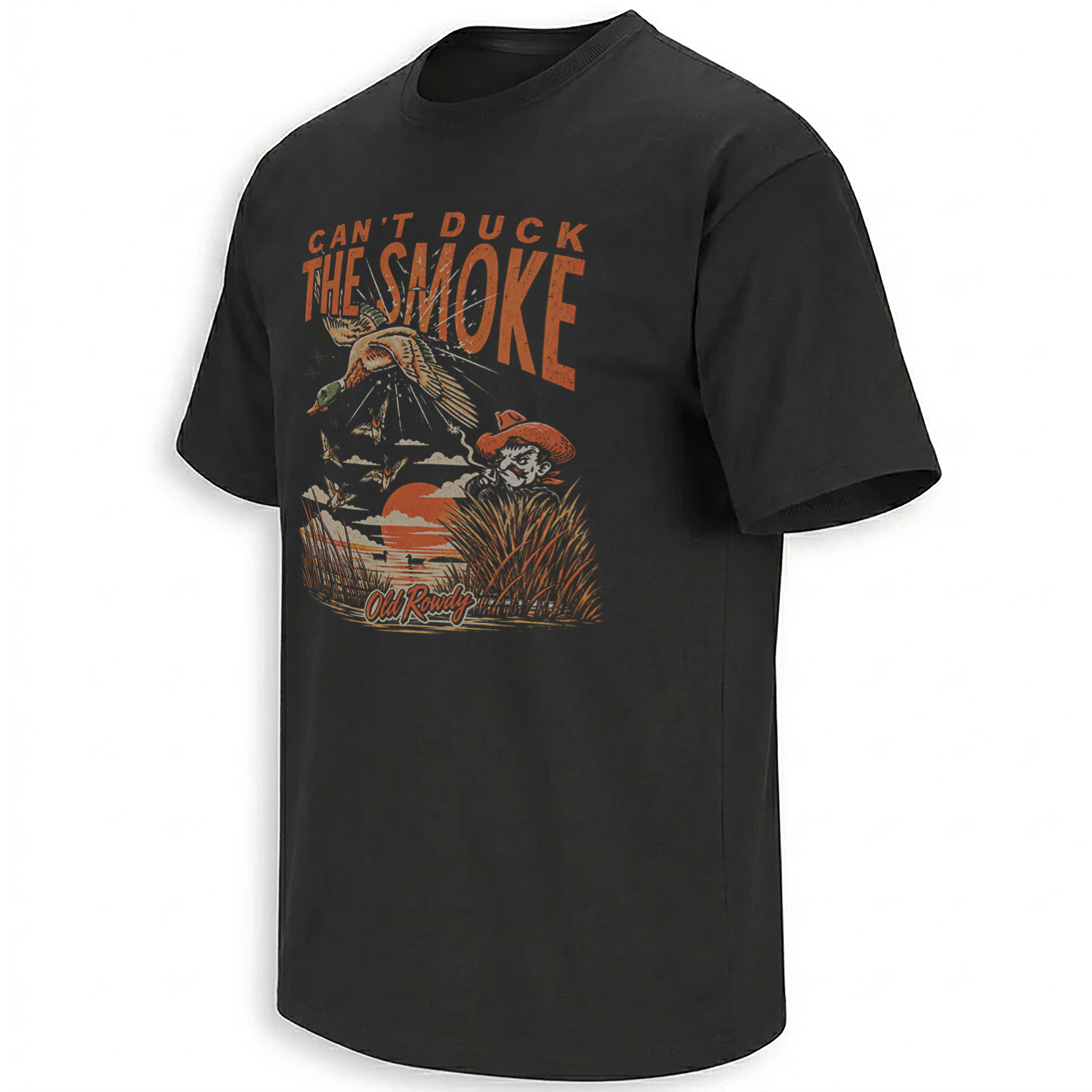
The palette does much of the storytelling. Burnt orange, muted green, sand and off-white sit against black like colors pulled from an old outdoor advertisement left hanging in a hunting cabin. The sunset is large but not glossy. The typography is rough rather than polished. Even the mallard feels integrated into the poster instead of pasted over it.
Then there is the cowboy figure. It pushes the composition beyond conventional waterfowl imagery and toward rural Americana — part marsh, part Western poster, part hunting-camp joke. That slightly exaggerated visual mixture is important because the phrase itself is exaggerated. The design needs swagger to match the words.
Distressed lettering, sunset orange, reeds, a mallard in motion and the cowboy silhouette create an intentionally worn outdoor-poster aesthetic. The scene feels remembered rather than digitally perfected, which suits a culture built around repeated seasons and familiar places.
Duck Hunting Graphics Work Best as Memory Objects
Hunting culture is full of objects that accumulate stories: an old call, a scratched thermos, a decoy repaired too many times to replace, a photograph from a morning when everything somehow lined up. Apparel can enter that same memory system when the graphic is tied to a season rather than a generic animal.
The timing gives this design that advantage. In September, “Can’t Duck the Smoke” reads like early-season anticipation. In November it can read like duck-camp humor. Months later, the marsh artwork still works because nothing in the concept depends on one score, celebrity or short-lived headline.
Ellie Shirt does not currently need a made-up hunting collection to force that context. The design sits naturally among the newest Ellie Shirt releases, where timely graphics can function as snapshots of whatever communities are talking about at that particular moment.
Frequently Asked Questions
Why is duck hunting especially relevant in September 2026?
Early teal seasons are opening across multiple states, with Texas beginning its nine-day September teal season on September 19. That puts migration, wetland conditions and early-season preparation back into active waterfowl conversation.
What does “Can’t Duck the Smoke” mean?
It plays on slang about avoiding pressure or confrontation while making “duck” literal through the mallard flying across the design.
Why does the artwork include a cowboy?
The cowboy adds Western and rural-Americana character, moving the graphic away from a straightforward wildlife illustration and closer to a weathered outdoor poster.
Why does the design use a distressed color palette?
Burnt orange, muted green and sand tones echo older hunting posters and camp graphics, giving the piece the visual feeling of something that has already collected a few seasons of history.
Is the graphic tied to one specific hunting event?
No. The immediate 2026 context is duck-season anticipation, but the wordplay and vintage marsh imagery are broad enough to continue working throughout waterfowl season and beyond.
The Can’t Duck the Smoke design preserves that September combination of attitude, mallard movement and marsh atmosphere, while Ellie Shirt’s newest releases track other graphics emerging from current culture.
Can’t Duck the Smoke Shirt turns duck-hunting slang into vintage marsh artwork, pairing a flying mallard, cowboy figure and burnt-orange sunset with the early-season energy of 2026 waterfowl culture.