
Everything I Need to Know I Learned From ’80s Cartoons
He-Man is back on screen. Transformers is heading back to theaters. ThunderCats is still generating movie conversation. Forty years later, the cartoons that once filled Saturday mornings are behaving less like dead nostalgia and more like a pop-culture language that refuses to disappear.
In September 2026, a joke about learning everything from eighties cartoons suddenly feels unusually well timed. Masters of the Universe has already brought He-Man back to a new generation this year, and on September 17 the 1986 Transformers animated movie is returning to American theaters for its 40th anniversary — this time with new material attached after the credits.
That timing explains something deeper than Hollywood’s appetite for familiar intellectual property. The most successful cartoons of the 1980s never really stopped existing. Their logos, catchphrases, toys, heroic poses and moral lessons became part of the memory system of a generation that is now old enough to collect the things it watched as a child.
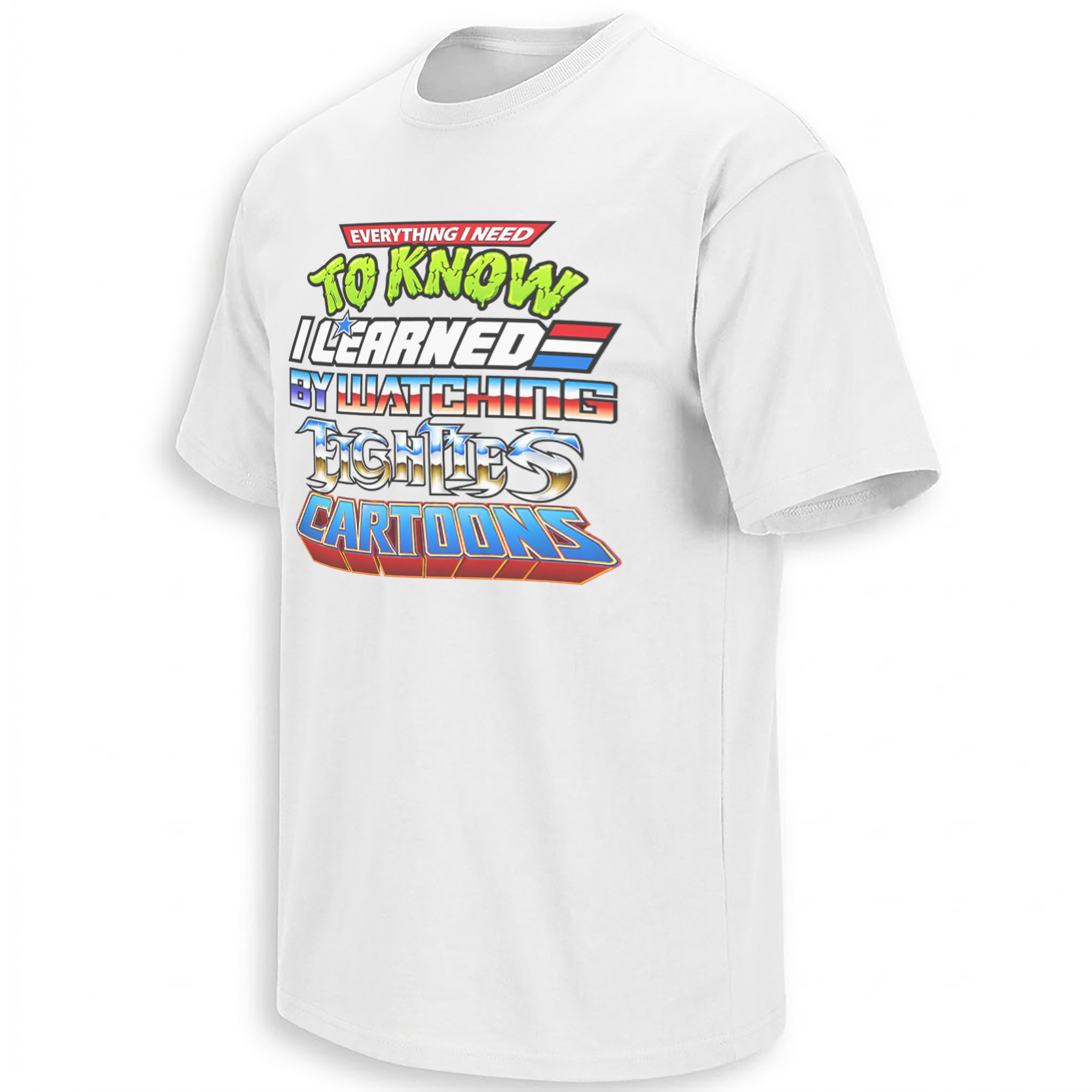
The Everything I Need to Know I Learned By Watching Eighties Cartoons graphic works because it treats that memory as a visual quiz. Instead of crowding the shirt with character portraits, each line changes personality, borrowing the kind of exaggerated title treatments associated with Teenage Mutant Ninja Turtles, G.I. Joe, Transformers, ThunderCats and Masters of the Universe.
The strongest ’80s cartoon memories were never only about episodes. They were about logos, toys, voices, theme songs and knowing exactly when to be in front of the television.
Why 2026 Suddenly Feels Like Saturday Morning Again
The nostalgia cycle has become unusually visible this year. Amazon MGM and Mattel released a new live-action Masters of the Universe film on June 5, bringing Prince Adam, Skeletor, Teela and Man-At-Arms back into a mainstream theatrical conversation. The film later moved onto Prime Video, giving one of the defining toy-and-cartoon properties of the 1980s another life on the same kind of home screen where many fans first encountered it.
Transformers is following a different route back into the room. The 1986 animated feature The Transformers: The Movie is scheduled to return to theaters from September 17 through September 21 for its 40th anniversary. The event also includes a new post-credit chapter, giving an old film an unusually literal extension four decades after its original release.
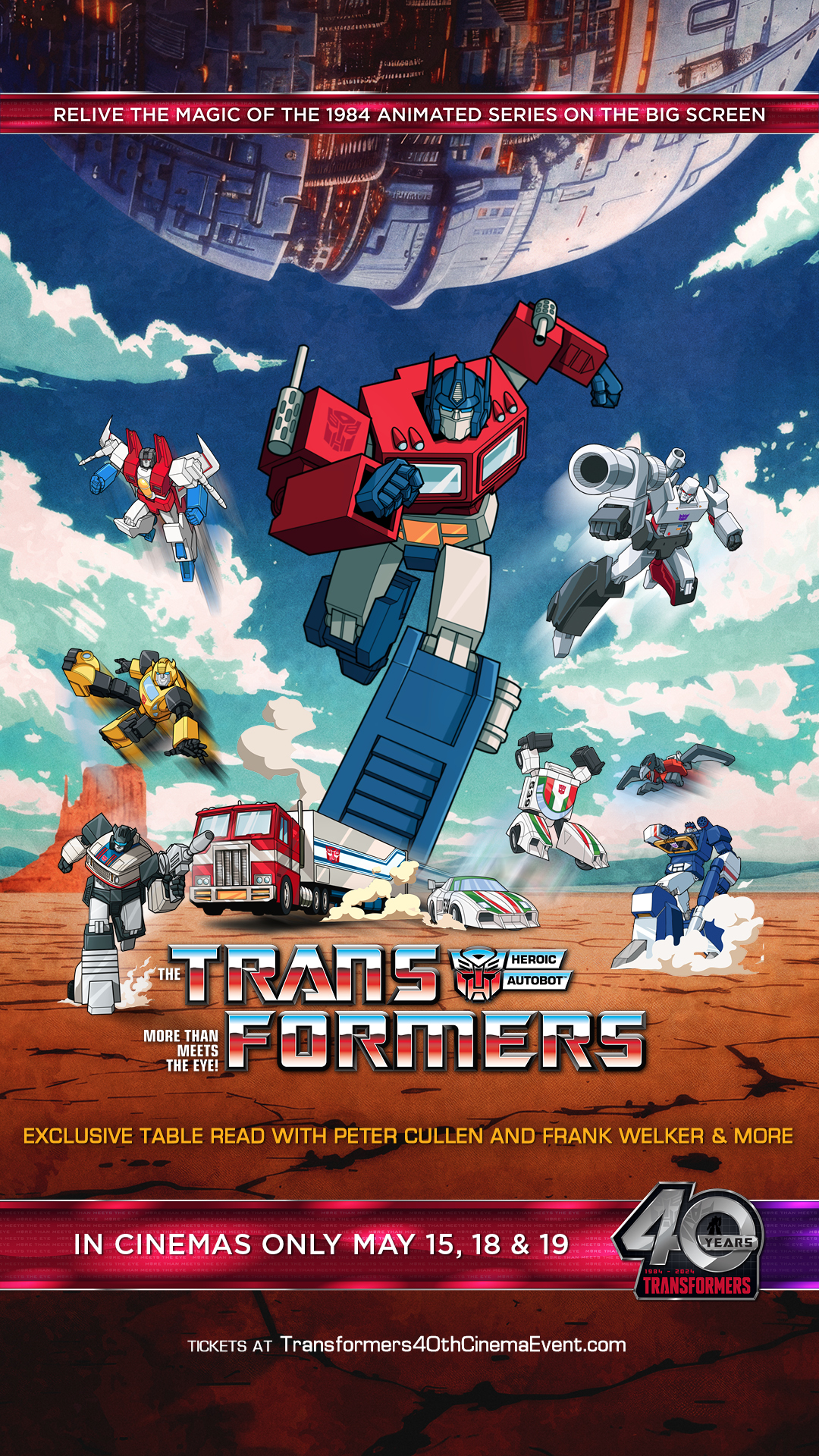
That is why an ’80s-cartoon design does not have to rely entirely on retro sentiment in 2026. The franchises are active again. Old viewers are returning, new viewers are discovering them, and studios are deliberately using the original iconography as a bridge between generations.
He-Man’s Return Shows How Strong the Memory Still Is
Masters of the Universe may be the clearest example because its entire identity was built at the intersection of toy shelf, television screen and imagination. The muscular silhouettes, Castle Grayskull imagery, power transformations and oversized fantasy lettering were designed to be remembered quickly.
That visual economy still works. A few metallic letters or the shape of a fantasy logo can trigger the same recognition as a character portrait. The Everything I Need to Know graphic understands that instinct and turns typography into the nostalgia mechanism.
Those Cartoons Really Did Try to Teach Something
The shirt’s slogan is funny because there is truth inside the exaggeration. Many animated series of the period were built around obvious moral structure: teamwork mattered, villains cheated, courage had consequences, and episodes often ended with a lesson stated far more directly than modern television would attempt.
HISTORY’s recent examination of 1980s children’s television points out that this was partly shaped by the commercial environment of the decade. Toy companies and television were becoming tightly connected, while producers also used explicit prosocial messages to answer criticism about children’s programming. G.I. Joe became especially famous for closing episodes with short instructional segments — a formula remembered almost as clearly as the action itself.
Many ’80s cartoons simultaneously functioned as stories, toy universes, moral lessons and branding machines. That combination helped create unusually durable memories because the same characters existed on television, in bedrooms, in commercials and on playgrounds at the same time.
The Graphic Lets Typography Do the Character Work
The design’s smartest decision is not showing a row of heroes. “Everything I Need” begins compact and aggressive. “To Know” turns bright and slime-green. “I Learned” shifts into patriotic block lettering. Later lines become increasingly dimensional, metallic and fantasy-driven until “Cartoons” lands in a large red, blue and gold treatment.
A longtime viewer does not need the cartoon names printed underneath. Color, outline, dimensional lettering and shape are enough to trigger recognition.
Military adventure, robots, fantasy warriors, mutant heroes and cosmic cats all shared the same television era while keeping radically different branding.
Why Adults Keep Returning to Saturday Morning Cartoons
Nostalgia is strongest when it contains routine. For many children growing up before streaming, cartoons were not an infinite library available at any moment. Shows had schedules. Missing an episode meant actually missing it. The television room, cereal bowl, toy box and opening theme became parts of the same memory.
That limitation created shared reference points. Millions of people encountered the same title sequences, commercials and episode morals at roughly the same age. Decades later, seeing one familiar type treatment can unlock the whole environment around it.
The renewed life of He-Man and Transformers suggests studios understand that emotional infrastructure very well. They are not only reviving characters; they are reviving recognition itself.
For Ellie Shirt, the Everything I Need to Know design fits that conversation as a visual memory map rather than a single-franchise piece. Because it crosses several cartoon worlds rather than belonging cleanly to one character or series, the broader newest pop-culture releases are the most natural place to continue through other current nostalgia and internet-culture graphics without inventing a collection that does not exist.
Frequently Asked Questions
What does the Everything I Need to Know shirt say?
The full phrase is “Everything I Need To Know I Learned By Watching Eighties Cartoons,” presented as a stack of different retro logo-inspired type treatments.
Which 1980s cartoons influence the design?
The visual references are associated with classic properties including Teenage Mutant Ninja Turtles, G.I. Joe, Transformers, ThunderCats and Masters of the Universe.
Why are ’80s cartoons especially relevant again in 2026?
Major properties from the era are active again. Masters of the Universe returned as a 2026 live-action film, while the 1986 Transformers animated movie is returning to theaters for its 40th anniversary in September.
Why did so many ’80s cartoons connect with toys?
Television and toy marketing became closely linked during the decade, with franchises including He-Man, Transformers and G.I. Joe developing across toys, animation and other media at the same time.
Why does the design use different fonts for every line?
Each shift in color, shape and dimensional lettering recreates the experience of recognizing several classic cartoon title cards without needing to place multiple characters in the same artwork.
The Everything I Need to Know Shirt preserves that recognition through typography — a stacked memory of robots, warriors, mutant heroes and Saturday mornings at a moment when several of those worlds are becoming current again.
Everything I Need to Know Shirt turns 1980s cartoon nostalgia into a stacked retro typography piece inspired by Transformers, G.I. Joe, ThunderCats, Masters of the Universe and other Saturday-morning memories returning to pop culture in 2026.