Trump vs. Hunter Hess: When Team USA Became a Debate About Who Gets to Define Patriotism
Seven months after Donald Trump called U.S. freestyle skier Hunter Hess a “real loser,” the 2026 Winter Olympic team returned to the White House for an August celebration. The medals were the same. The unresolved argument underneath them was much larger: can an athlete criticize the country while representing it?
The clash began before Hunter Hess ever entered the Olympic halfpipe. Asked about representing the United States during the political climate surrounding the Milano Cortina Games, Hess said it brought up “mixed emotions.” His explanation was more nuanced than the headline that followed: wearing the American flag, he argued, did not mean endorsing every action of the federal government.
President Donald Trump responded on Truth Social on February 8 by calling Hess a “real Loser,” saying the skier should not have tried out for the team if he felt that way and adding that Hess was difficult to root for.
The exchange turned a familiar sports question — what does it mean to represent your country? — into a partisan argument about loyalty, free expression and whether Team USA athletes should publicly criticize the government while competing beneath the flag.
Representing the United States internationally carries an expectation of public loyalty and national pride; criticizing the country while wearing USA colors undermines that role.
Patriotism can include criticism. An athlete can value the United States, represent family and community and still disagree with government policy.
The argument was never really about one skier. It was about whether patriotism means defending the country from criticism or defending the right to make that criticism.
What Hunter Hess Actually Said
Hess did not say he hated the United States or refuse to represent it. He said the political environment created mixed emotions and distinguished the country, its people and the flag from specific government actions.
A day after Trump’s criticism, Hess emphasized that position again. He said he loved his country, believed there was much to celebrate about America and argued that the freedom to point out problems was itself one of the country’s strengths.
That response complicates any simple “pro-America versus anti-America” framing. Trump and Hess were using different definitions of what public national representation should require.

Then “Real Loser” Became an Olympic Gesture
When Hess competed later in the Games, he refused to let the insult disappear quietly. After advancing through halfpipe qualifying, he raised his hand to his forehead in an L shape and explained the joke himself: apparently, he was the loser.
He eventually finished 10th in the Olympic halfpipe. Team USA’s Alex Ferreira won gold and publicly backed his teammate afterward. That gave the controversy a second visual chapter: not simply politician versus athlete, but an athlete reclaiming the word thrown at him.
Hess discusses his mixed emotions around representing the U.S. amid domestic political tensions.
Trump attacks Hess on Truth Social and says it is difficult to root for him.
Hess uses an L gesture after qualifying and publicly leans into the “loser” label.
Trump hosts U.S. Winter Olympians and Paralympians at the White House in a broader celebration of Team USA.
Why the Shirt Takes the Hard-Line Side
The U.S. Olympic Athlete Shirt does not reproduce Trump’s exact attack on Hess. Instead, it turns the conservative side of the argument into a general rule: “ANY U.S. OLYMPICS ATHLETE THAT TRASHES THE U.S. SHOULD BE KICKED OUT.”
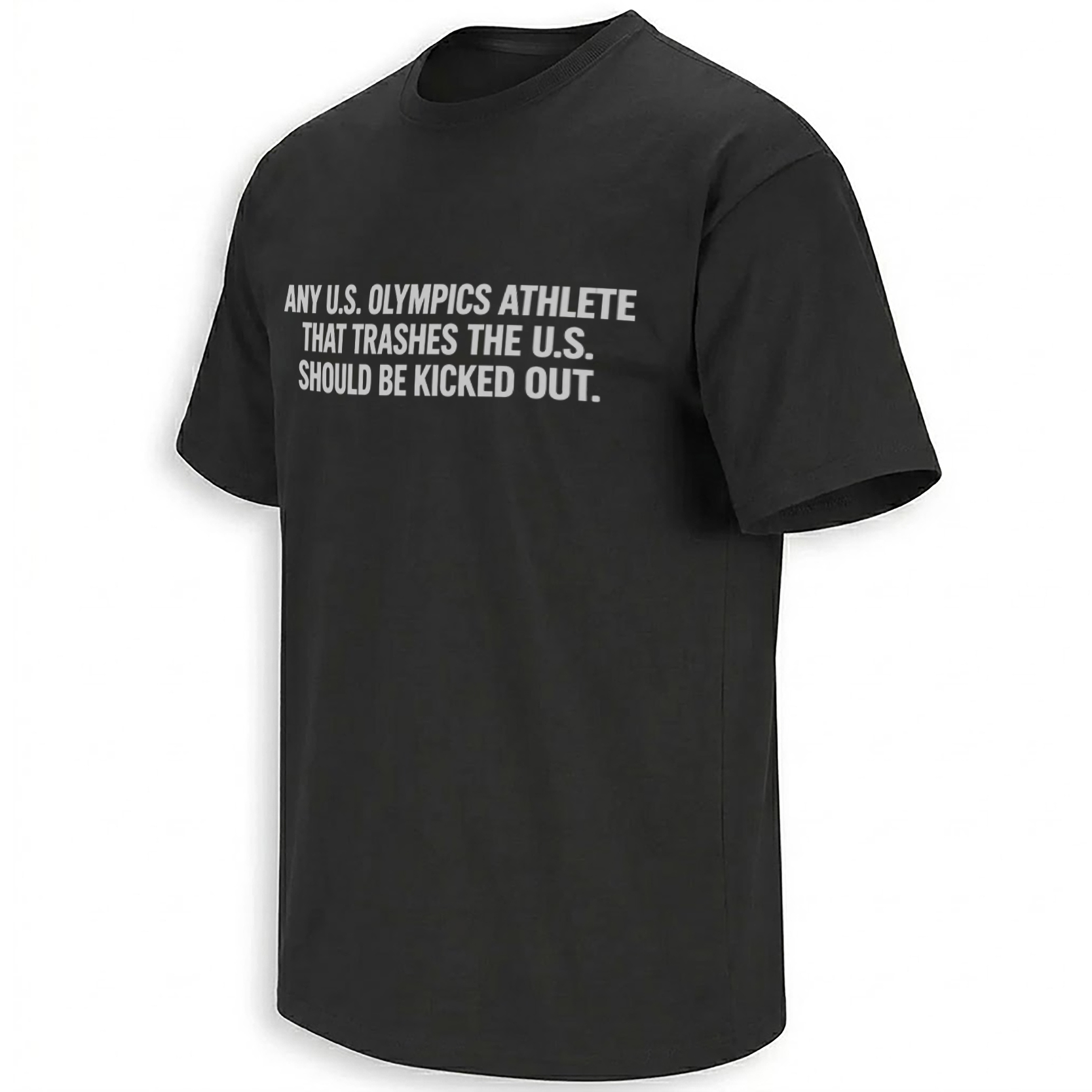
The wording is intentionally less nuanced than the underlying story. “Trashes the U.S.” collapses several possible forms of criticism into one category, while “should be kicked out” converts disagreement over athlete speech into a consequence.
That directness explains the shirt’s political function. It takes the America First interpretation of the Hess controversy: wearing USA across the chest creates obligations beyond athletic performance.
The August White House Reunion Changed the Image Again
By August 6, the political temperature around the Winter Games had cooled enough for Trump to host dozens of U.S. Olympians and Paralympians at the White House. The reception celebrated the country’s medal performance and brought athletes back together several months after Italy.
Trump largely focused on sporting achievement. That image — the president standing with Team USA again — demonstrates why the February dispute remains culturally useful. The Olympics repeatedly places politicians and athletes inside the same national symbolism even when they disagree about what that symbolism means.
The wider Trump Ultra MAGA collection follows that America First visual language, while designs tied specifically to the president can be found through the Donald Trump product search. Carter-specific pieces can also be explored through Hunter Hess search results.
Frequently Asked Questions
Who is Hunter Hess?
Hunter Hess is a U.S. freestyle skier from Oregon who represented Team USA in the men’s freeski halfpipe at the 2026 Milano Cortina Winter Olympics.
Why did Donald Trump criticize Hunter Hess?
Trump objected after Hess said he had mixed emotions about representing the United States amid domestic political conditions and disagreed with some government actions.
Did Hunter Hess say he hated America?
No. Hess later explicitly said he loved his country and argued that being American includes the freedom to point out things that could be improved.
What did Hess’s L gesture mean?
It was a deliberate reference to Trump calling him a loser. Hess leaned into the label after his Olympic halfpipe qualifying run.
Is the U.S. Olympic Athlete Shirt official Team USA merchandise?
No. It is political commentary inspired by the public debate over Trump, Hunter Hess, patriotism and athlete speech during the 2026 Winter Olympics.
The U.S. Olympic Athlete design records the America First reaction to athlete criticism, while the broader Trump Ultra MAGA archive tracks how national identity, sport and Trump-era politics keep intersecting.
U.S. Olympic Athlete Shirt captures the hard-line America First response to the 2026 Trump–Hunter Hess controversy through one stark statement about Team USA, patriotism and athletes criticizing the country they represent.