
Christ Is King. “Have It, Yahweh.” One Tiny Pun Rewrites a Fast-Food Slogan
The joke works before the viewer has time to analyze it. Red letters. Yellow bun shapes. Blue circular movement. Decades of fast-food visual memory arrive first—then “CHRIST IS KING” and “HAVE IT, YAHWEH” change what the familiar structure is saying.
Logo parody depends on recognition speed. The viewer needs to understand the original visual language almost instantly, because the laugh arrives in the fraction of a second between “I know that logo” and “that is definitely not what the logo says.”
The Christ Is King Shirt has that rhythm built into every part of the composition. “CHRIST IS KING” replaces the restaurant identity, while “HAVE IT, YAHWEH.” turns the cadence of Burger King’s famous “Have It Your Way” into theological wordplay.
It is visually loud but conceptually simple. There is no portrait of Jesus, no cross, no cathedral, no long Bible verse and no elaborate religious illustration. Typography, commercial-memory shapes and one pun carry the entire message.
The smartest part of the joke is that it reverses the original slogan’s logic: from “my way” toward a phrase that humorously suggests “God’s way.”
Why “Have It Your Way” is such useful parody material
Advertising slogans become culturally powerful when people recognize them without needing the product nearby. Burger King spent decades associating its identity with customization and the phrase “Have It Your Way.” Even regional Burger King channels still use the wording explicitly in current brand communication.
That accumulated recognition is why the shirt does not need to spell out the reference. Yellow shapes above and below the central text suggest a burger bun. Bright red lettering occupies the center. A thick blue curve circles the composition. The viewer’s commercial memory completes the connection before the sentence underneath finishes the joke.

Burger King India’s official channel used “Have it your way” directly in this campaign, providing the advertising reference the parody rewrites.
The word “Yahweh” does more than create a rhyme
The second half of the joke only works because “Yahweh” carries an actual religious meaning. The name is associated with YHWH, the four-letter Hebrew divine name traditionally connected with the God of Israel. Its use in modern English Christian contexts varies by tradition, but the association with God is immediately understandable to the audience this design targets.
That gives “Have It, Yahweh” two functions at once. Phonetically, it echoes “Have It Your Way.” Conceptually, it changes the direction of agency. The original slogan tells the customer that personal preference is the center of the experience. The parody humorously gives the decision back to God.
The graphic is Christian parody artwork, not a claim that Burger King has any religious affiliation and not official Burger King merchandise. The recognizable commercial language is being repurposed for wordplay.
“Christ Is King” supplies the statement; the logo supplies the delivery system
The top phrase is far less ambiguous. “Christ Is King” is a direct Christian declaration centered on the kingship and authority of Jesus Christ. Without the fast-food reference, it could appear on a conventional faith graphic. Without “Christ Is King,” the Yahweh pun would lose its theological anchor.
Putting them together creates the tension that makes parody work: a serious statement of belief delivered through intentionally unserious commercial nostalgia.
That is also why “KING” is substantially larger than the other lettering. The typography preserves the visual hierarchy expected from the restaurant reference while simultaneously emphasizing the theological word that matters most to the new message.
The color palette makes the joke readable from across the room
Red, yellow and blue are not decorative afterthoughts here. The red wordmark, yellow upper and lower bun forms and blue circular sweep reconstruct the memory of a retro fast-food emblem without needing a detailed restaurant scene.
The supplied white version makes those colors feel especially crisp and commercial. Sand changes the same composition into a warmer vintage-advertising artifact, while sport gray pushes it toward casual retro-logo apparel.
The tiny registered-style symbol is another useful joke. It visually imitates the language of corporate identity while sitting beside wording that has obviously been rewritten.
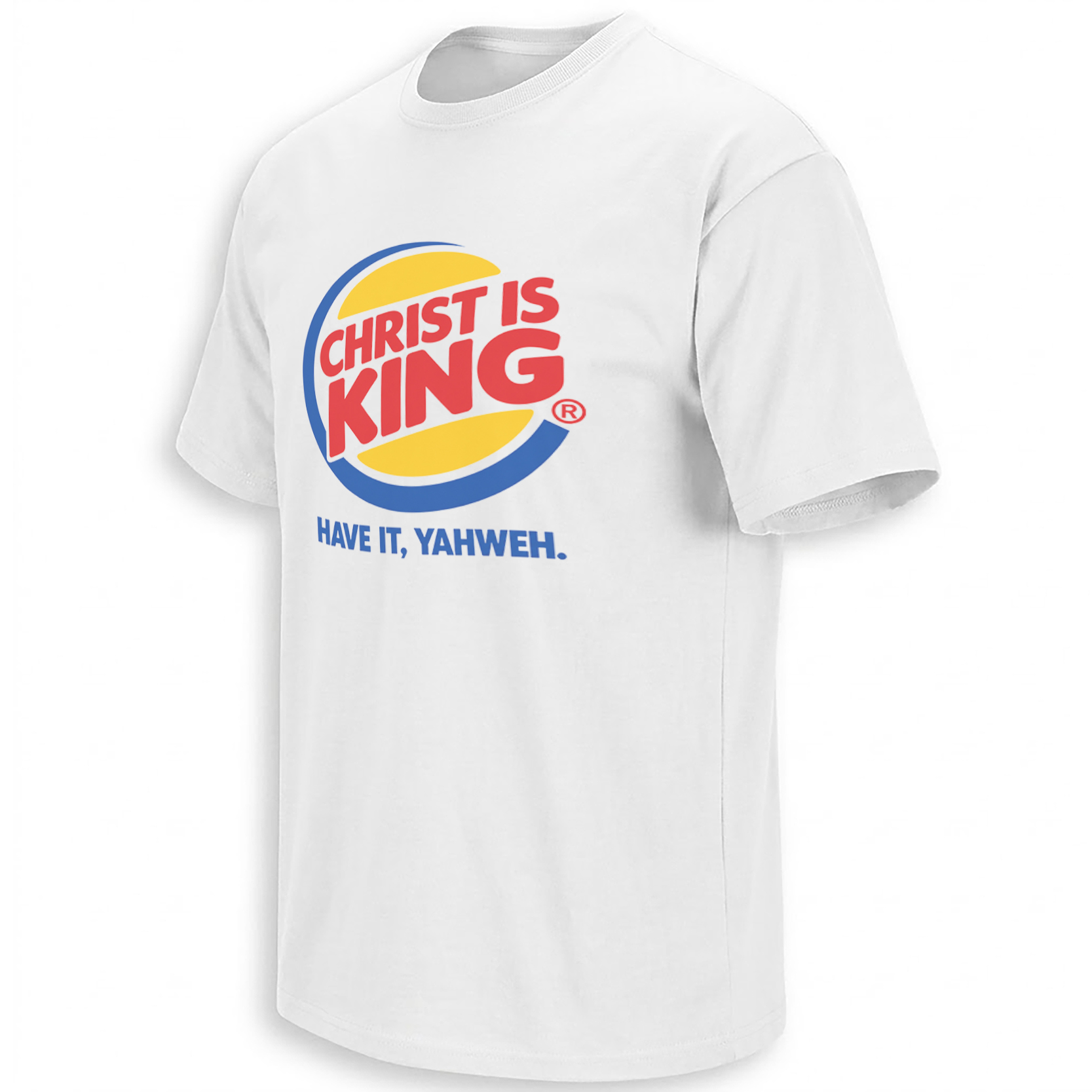
A retro fast-food-logo parody where familiar commercial design becomes the delivery system for Christian belief and one compact phonetic joke.
View the piece →Why Christian meme design increasingly borrows ordinary culture
Faith graphics traditionally rely on crosses, scripture references, church typography or devotional artwork. Internet-native Christian humor often operates differently. It borrows formats people already know—corporate logos, sports graphics, movie posters and meme templates—and changes the language inside them.
That approach works because the familiar visual does part of the communication before the religious message arrives. The viewer is not simply reading a declaration; they are decoding a cultural remix.
Ellie Shirt does not currently have a dedicated Christian collection URL confirmed for this design, so the correct internal destination is the Newest collection. Rather than inventing a religious category path, readers interested in related material can use the Jesus Christ product search.
FAQ: Christ Is King and “Have It, Yahweh”
What does “Have It, Yahweh” mean?
It is a pun on Burger King’s “Have It Your Way,” replacing “your way” with “Yahweh” and turning consumer-choice language into faith-centered humor.
What does Yahweh refer to?
Yahweh is a traditional rendering associated with YHWH, the biblical Hebrew divine name.
Is this official Burger King merchandise?
No. The artwork deliberately uses retro Burger King-style visual language as parody.
Does the shirt show Jesus?
No. The design communicates its religious message entirely through wording, typography, color and logo-style shapes.
Why is the word “KING” so large?
It preserves the recognizable visual hierarchy of the restaurant-logo reference while emphasizing the central phrase “Christ Is King.”
The Christ Is King graphic succeeds because its faith message and parody mechanism cannot really be separated.
Christ Is King Shirt transforms retro Burger King-style branding into Christian meme language with bold “CHRIST IS KING” lettering and the “HAVE IT, YAHWEH.” parody of “Have It Your Way.”