
“Patron Saint of Economic Collapse”: How 2026 Economic Anxiety Became Trump Satire
The “ST UPID / Patron Saint of Economic Collapse” Trump graphic arrives at a moment when tariffs, inflation, jobs and cost-of-living anxiety are once again dominating American political conversation — but the economic data itself is considerably more complicated than the slogan.
Political graphics work fastest when they compress a messy public argument into a phrase people understand before they finish reading it. In late August 2026, “economic collapse” is exactly that kind of phrase: emotionally explosive, politically loaded and impossible to separate from the renewed argument over Donald Trump’s tariffs, inflation, hiring and household confidence.
Yet the satire lands precisely because the real numbers are mixed rather than simple. The U.S. economy has not literally collapsed. Real GDP expanded at a 1.5% annualized rate in the second quarter, according to the Bureau of Economic Analysis. At the same time, growth slowed from 2.1% in the first quarter, July payrolls fell by 23,000, and annual consumer inflation remained at 3.4%.
That tension — an economy still expanding while many people remain uneasy about prices, employment and trade policy — is the cultural territory behind the design.
The joke is deliberately absolute. The economy is not. That gap is what gives the satire its political voltage.
Why the Phrase Feels Timely in August 2026
American economic debate has become increasingly shaped by contradiction. Inflation has eased sharply from its post-pandemic peak, yet the cumulative increase in living costs remains visible every time households compare grocery, housing or insurance bills with what they remember paying several years ago.
Employment tells a similar story. A 4.1% unemployment rate remains low by long historical standards, but hiring has slowed and July payroll employment fell. Reuters described the labor market in late August as one where unemployment remains relatively contained even as hiring conditions look far less comfortable.
Trade adds another layer. Trump’s tariff strategy remains central to his second-term economic policy, and new friction with Canada has brought the issue back to the foreground. The argument from the administration is that tariffs can protect or reshore American production; critics focus on higher input costs, retaliation and uncertainty for businesses and consumers.
“Patron Saint of Economic Collapse” is political satire, not an economic statistic. The latest official data shows positive GDP growth alongside persistent inflation and weaker job creation. The graphic works as criticism because it exaggerates those anxieties into a deliberately theatrical accusation.

Reuters’ August 27 analysis visualized the disconnect between relatively resilient macroeconomic indicators and the much more pessimistic way many Americans describe their economic experience.
The Design Turns Economics Into Political Iconography
The graphic does not read like a policy memo. It borrows from devotional imagery and political caricature, turning Trump into a deliberately exaggerated “patron saint” figure while the phrase “economic collapse” supplies the accusation beneath the visual joke.
That collision is what gives the composition its internet-native character. Religious iconography traditionally signals reverence; political parody flips that expectation. Instead of canonization for virtue, the subject is mock-canonized for an alleged economic failure.
The “ST UPID” wording adds another layer of blunt meme language. It abandons institutional vocabulary entirely and enters the register of protest signs, reaction graphics and aggressively compressed social-media humor.
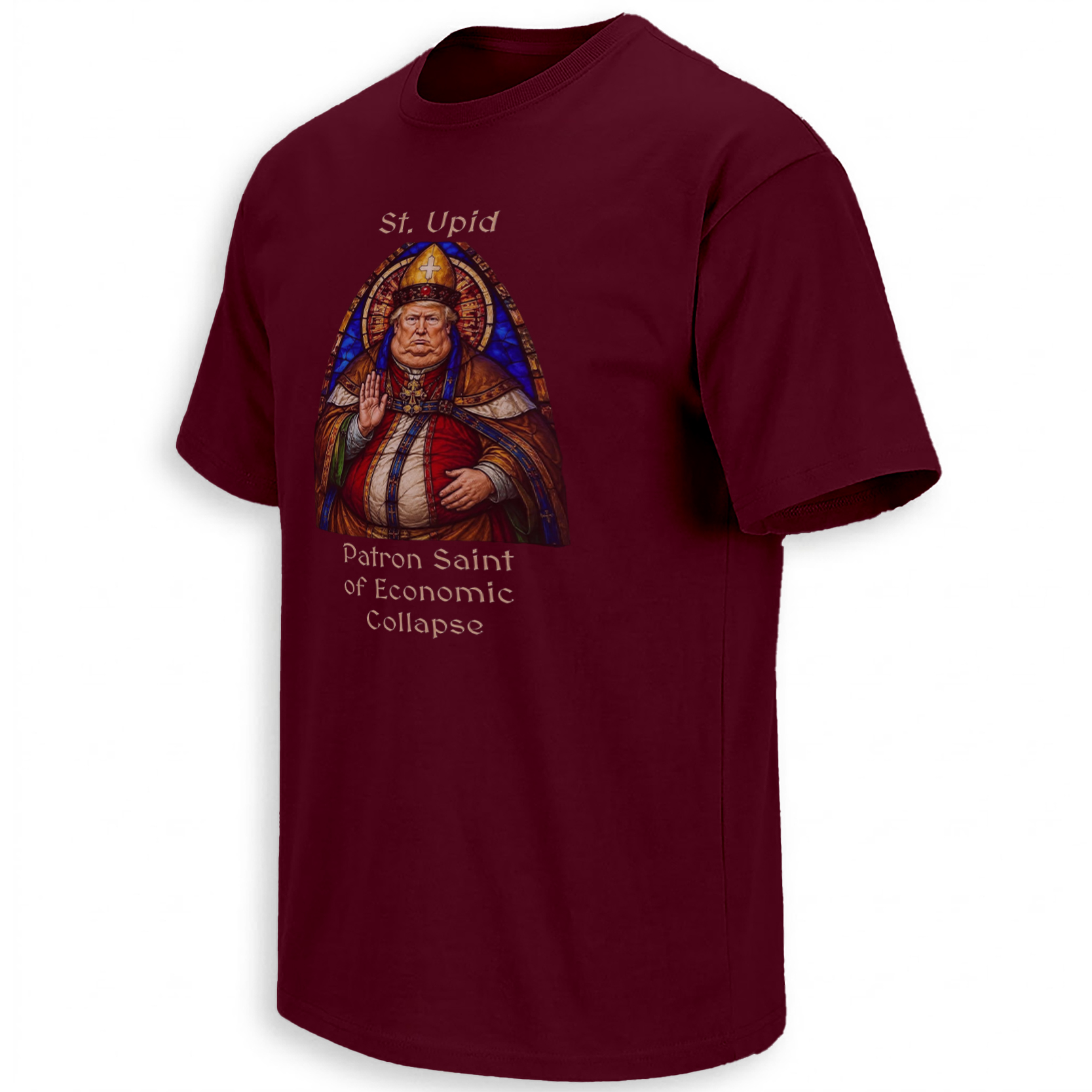
A political-satire graphic that transforms current arguments over tariffs, inflation and economic confidence into deliberately exaggerated protest iconography.
View the political graphic →Why Political Apparel Works Like a Moving Editorial Cartoon
Political shirts occupy an unusual space between poster, meme and personal editorial page. A newspaper cartoon sits on paper. A social post disappears down a feed. A graphic worn in public keeps moving through ordinary life and turns the person wearing it into part of the distribution system.
That is especially true during an election cycle or a period of economic uncertainty. Short phrases become identity markers. Supporters repeat one set of numbers; critics repeat another. Satire then simplifies the entire argument into a visual that can be understood at a glance.
The wider anti-Trump political archive follows that visual language across slogans, parody and protest graphics, while the Donald Trump design search gathers the broader range of Trump-related pieces appearing across the store.
Frequently Asked Questions
Is the U.S. economy literally in an economic collapse in August 2026?
No. Official data shows real GDP grew at a 1.5% annualized rate in the second quarter of 2026 and unemployment was 4.1% in July. The phrase in the design is political satire.
Why is the economy still a powerful political issue?
Inflation remains above the Federal Reserve’s 2% target, hiring has slowed, living costs remain a concern and trade policy continues to generate uncertainty even while several headline indicators remain relatively resilient.
What does “Patron Saint of Economic Collapse” mean in the design?
It mock-canonizes Donald Trump as the symbolic figure responsible for economic problems. The exaggeration is the joke and should be understood as partisan political criticism rather than a factual economic title.
Why does the design use religious-style imagery?
Devotional imagery normally communicates reverence. Political parody reverses that meaning, using the visual language of sainthood to sharpen criticism and create an instantly recognizable satirical contrast.
Why does this style fit internet political culture?
Modern political memes favor short phrases, exaggerated symbols and visuals that can be understood immediately. The design converts a complex debate about economic policy into that compressed visual language.
The ST UPID / Patron Saint of Economic Collapse graphic belongs to the visual tradition of protest posters and editorial cartoons: intentionally exaggerated, instantly readable and tied to the economic arguments dominating the current political moment.
ST UPID Shirt Trump Patron Saint of Economic Collapse turns 2026 arguments over tariffs, inflation and slower job growth into a deliberately exaggerated political-satire graphic built around protest iconography and internet meme language.