Flipadelphia: Kyle Schwarber Sent the Phillies’ Emotional Graph Straight Up
Philadelphia was down four runs, down to its final out and almost finished. Six runs later, Kyle Schwarber sent a baseball 459 feet, flipped his bat and gave Citizens Bank Park one of the wildest endings of the 2026 season.
For eight innings, Sunday at Citizens Bank Park felt like the kind of game fans mentally leave before their bodies reach the parking lot. St. Louis led Philadelphia 4–0. The Phillies had produced almost nothing offensively. Even when Bryce Harper opened the ninth with a double, the Cardinals quickly recorded two outs.
Then baseball stopped behaving rationally.
J.T. Realmuto singled. Justin Crawford walked. Edmundo Sosa ripped a three-run double. Bryan De La Cruz singled home the tying run. Suddenly a game that had spent most of the afternoon drifting toward a routine loss was 4–4, and Kyle Schwarber was standing at the plate with Citizens Bank Park trying to process how any of this was happening.
Riley O’Brien threw a 98 mph sinker. Schwarber hit it so far that the ball cleared the batter’s eye and landed on Ashburn Alley. Statcast projected 459 feet. Phillies 6, Cardinals 4. Nine consecutive wins. The stadium went from resignation to disbelief in a handful of two-out plate appearances.
The bat flip was not arrogance after an easy home run. It was the physical release of a game that had transformed from dead to impossible to over in a few minutes.
The Bat Flip Came After the Shock
MLB’s game account captures one detail that makes the celebration better: Schwarber was initially almost too stunned to know what to do. He watched the flight. The helmet came off. Then the bat went airborne.
That sequence matters. Modern baseball bat flips are often choreographed confidence — the hitter knows immediately that the ball is gone and lets the celebration begin at home plate. Schwarber’s reaction felt less planned. He had just watched eight hopeless innings transform into one of Philadelphia’s most improbable wins.

Why 459 Feet Changes the Texture of the Moment
A walk-off does not need to travel far. A bloop single can produce the same final score. But distance gives Schwarber’s ending an extra layer of absurdity. MLB reported that the ball became the first to clear that batter’s-eye landmark in more than four years.
It also fit the player. Schwarber’s visual identity has become inseparable from trajectory: launch angle, exit velocity, moonshots and balls that seem to climb longer than expected. The home run was his 39th of the year and continued a powerful August stretch.
That is why the Flipadelphia artwork uses something resembling a technical graph rather than simply placing a player portrait beneath the word “walk-off.” Schwarber’s game naturally invites charts. The design just turns the chart emotional.
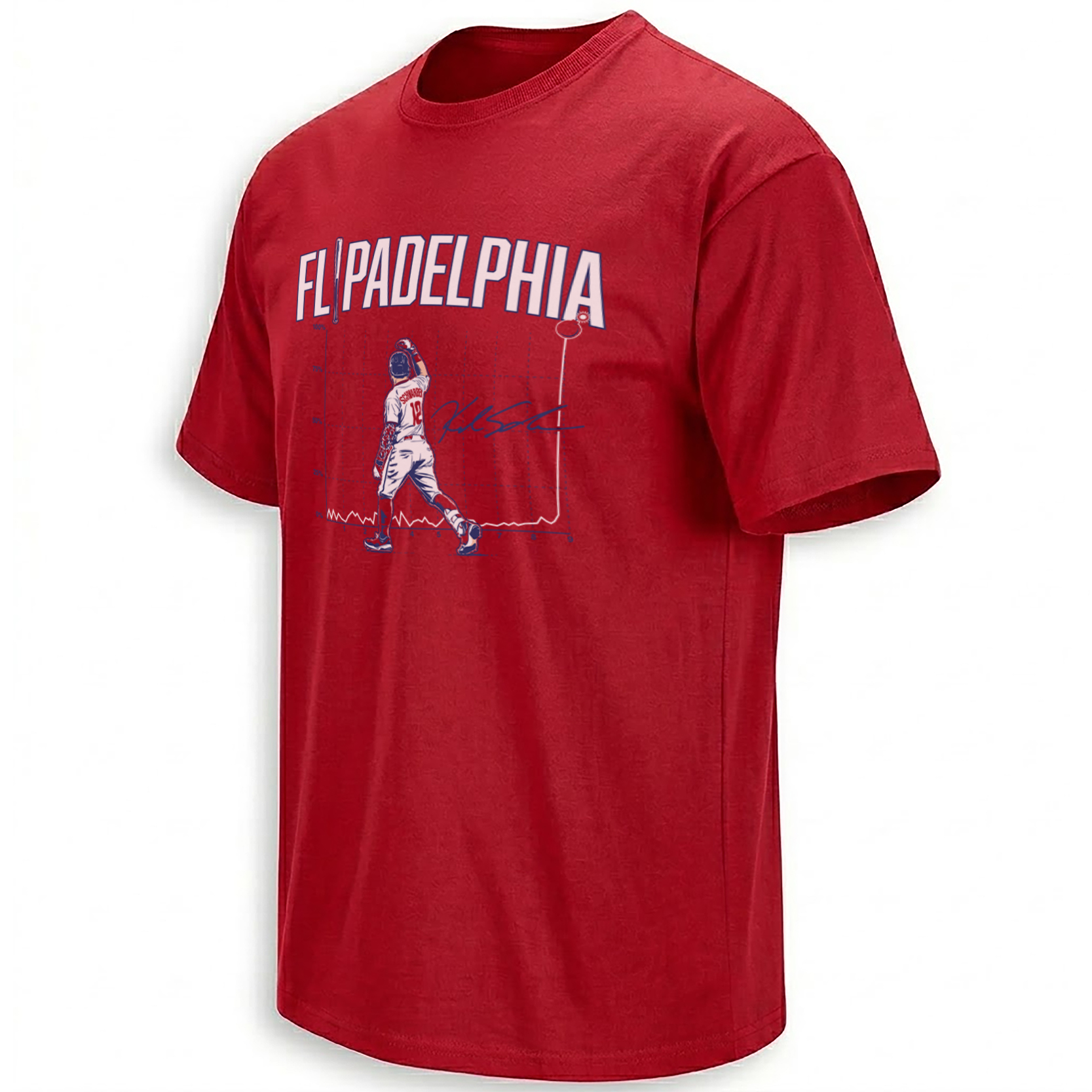
The design freezes No. 12 watching the flight of the ball beneath a rising trajectory graph, turning the 459-foot homer and subsequent bat flip into a red, white and blue Philadelphia data poster.
View the walk-off piece →The Graph Is Really the Stadium’s Heart Rate
The most interesting part of the design is the blue grid. At first glance it reads like baseball analytics: reference lines, a white path and a ball positioned near the top of the chart. That makes sense for a sport increasingly consumed through Statcast.
But culturally, the graph can be read another way. For eight innings, the emotional line is flat. Harper doubles and it flickers. Two outs arrive and the line nearly dies. Realmuto, Crawford, Sosa and De La Cruz start pushing it upward. Schwarber sends it vertical.
Phillies red supplies the immediate city identity. Condensed white FLIPADELPHIA lettering behaves like a game poster headline, while the technical grid and rising white trajectory translate a home run into both Statcast language and an emotional pulse.
Why “Flipadelphia” Is Better Than a Normal Walk-Off Headline
The name compresses the moment into local language. “Bat flip” supplies the action; “Philadelphia” supplies the personality. Put them together and the celebration stops belonging only to Schwarber. It becomes something the city can repeat.
That matters in a fan culture where baseball moments are often remembered through shorthand: Red October, Schwarbomb, the Bank. A good phrase does not need to explain the full box score. It only needs to reopen the memory.
A Win That Changed the Shape of the NL East Race
The rally also mattered beyond spectacle. MLB noted that Philadelphia’s nine-game winning streak had cut Atlanta’s NL East lead from nine games to three. This was therefore not simply a late-August novelty. The comeback arrived while the Phillies were actively changing the divisional race.
That context explains why the stadium response felt larger than a normal Sunday walk-off. Philadelphia did not merely avoid a loss. It extended a run in which seemingly every kind of game was beginning to bend toward the Phillies.
The Philadelphia Phillies collection acts as a running visual record of those individual moments, while the broader MLB collection connects them to the larger baseball conversation. More player-specific graphics can be found through the Kyle Schwarber search.
Frequently Asked Questions
When did Kyle Schwarber hit the Flipadelphia walk-off?
The home run came on Sunday, August 23, 2026 against the St. Louis Cardinals at Citizens Bank Park. MLB published its recap the following day.
How far did Kyle Schwarber’s walk-off home run travel?
Statcast projected the home run at 459 feet.
How big was the Phillies’ comeback?
Philadelphia trailed 4–0 entering the ninth inning and scored six runs with two outs to win 6–4.
What did Schwarber do after hitting the home run?
After watching the ball, Schwarber tossed his helmet and produced the bat flip that became the defining celebration image of the comeback.
What does “Flipadelphia” mean?
It combines the bat flip with Philadelphia’s name, turning Schwarber’s celebration into city-specific baseball shorthand for the walk-off moment.
The Flipadelphia graphic captures the trajectory, pose and release of Schwarber’s 459-foot ending, while the Phillies archive follows the other player moments shaping Philadelphia’s 2026 run.
Flipadelphia Shirt captures Kyle Schwarber’s 459-foot walk-off home run, helmet toss and bat flip after Philadelphia erased a 4–0 ninth-inning deficit with six two-out runs against St. Louis.