
Usher & Chris Brown Are Making R&B Look Stadium-Sized Again
The 2026 R&B Tour has grown beyond its original schedule, sold out major stadium nights and turned two enormous catalogs into a live argument about performance, longevity and what mainstream R&B spectacle looks like in 2026.
On August 21, Soldier Field becomes the next stage in one of 2026’s most talked-about R&B tours. USHER and Chris Brown arrive in Chicago only days after Boston and less than two weeks after two sold-out MetLife Stadium shows — performances successful enough that a third East Rutherford date has already been added for October.
That expansion changed the story around The R&B Tour. What began as a 33-date co-headlining run has grown dramatically. On August 17, organizers announced eight more stadium dates and said the itinerary had reached 59 total shows following the first North American stretch. The scale is important because R&B is often discussed commercially as though it has retreated from pop’s biggest physical spaces. This tour is testing that assumption one football stadium at a time.
Nearly three hours of career-spanning material places two performers with very different relationships to the genre on the same stage. That contrast — rather than simple nostalgia — is what gives the tour its cultural tension.
The most interesting thing about The R&B Tour is not that two superstars share a bill. It is that they represent two different ideas of how an R&B superstar survives decades.
Usher and Chris Brown Bring Different Kinds of Legacy
USHER enters the tour with a career increasingly framed through mastery and endurance. His Las Vegas residency sharpened the theater of his live show, his 2024 Super Bowl halftime performance reintroduced the scale of his catalog to a massive mainstream audience, and his Past Present Future tour proved that his music could still sustain multi-night demand.
Brown arrives from a different trajectory: athletic choreography, large-scale spectacle and a fan base that has remained intensely attached across two decades, even as discussion of his career remains inseparable from well-documented controversies. His previous Breezy Bowl XX run reportedly became his biggest-grossing tour.
Precision, veteran control, Vegas-honed stagecraft and a catalog tied closely to the mainstream history of modern R&B.
High-impact choreography, physical spectacle, a huge millennial catalog and a large contemporary arena-and-stadium audience.
The New Yorker’s recent review of the MetLife shows approached the pairing as something larger than a greatest-hits package: a collision between different forms of R&B masculinity, performance and legacy. That critical framing matters because it explains why the tour has produced debate as well as applause.

The Tour Art Rejects Loud Color for Monochrome Authority
The official campaign is surprisingly restrained for a production this large. Black tailoring, neutral studio light, chrome typography and chair portraits make the two singers look less like competitors entering a battle and more like established figures sitting for a formal cultural portrait.
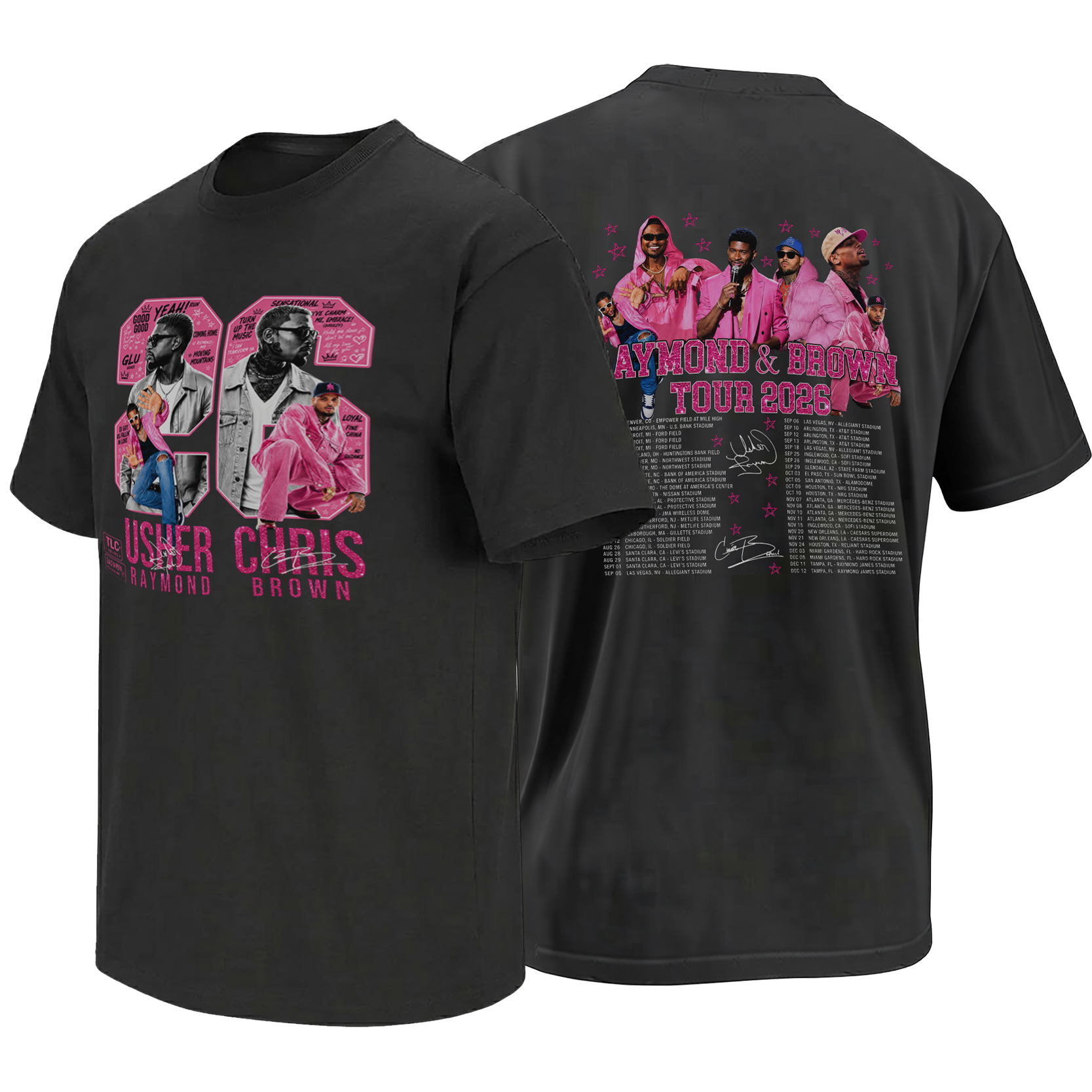
“Raymond & Brown” underneath the oversized R&B typography is the smartest detail. It transforms a genre abbreviation into their surnames. Instead of advertising R&B as an abstract category, the poster makes a visual argument that these two catalogs can temporarily stand in for it.
The The R&B Tour Shirt Usher & Chris Brown 2026 inherits that stadium-poster logic. It reads best as a timestamp from this exact run: Raymond, Brown, 2026 and the massive touring scale that turned the pairing into one of the summer’s recurring music conversations.
Fan Reaction Shows Why Co-Headlining Tours Are Complicated
The tour’s fan discussion is not one clean wave of praise, and that is part of what makes it interesting. Recent Reddit conversations include fans who describe the show as overwhelming in the best possible way, others who prefer Brown’s previous solo tours, and viewers who came primarily for one artist but left impressed by the other.
That is a predictable tension in a true co-headlining production. A fan who wants two uninterrupted hours of one artist may experience the back-and-forth structure differently from someone who grew up with both catalogs. The shared bill creates comparison automatically: vocals, choreography, pacing, song selection, guest appearances and even how each performer controls a stadium crowd.
Recent fan threads show a split between people celebrating the scale and variety of the pairing and others wishing each artist had more solo-stage time. That disagreement is useful cultural evidence: audiences are not treating The R&B Tour as background nostalgia. They are arguing over how two living catalogs should be presented.
MetLife Turned the Tour From Successful Into Expanding
The August 7 and 8 MetLife Stadium dates became an inflection point. Both were sold out, and the tour later announced a third MetLife performance for October 15. Additional shows were also added in several high-demand markets, including Atlanta and Los Angeles.
That pattern matters more than a generic claim that the tour is “popular.” Stadium touring depends on geography, timing and enormous ticket volume. Adding repeat nights after the tour has already begun is stronger evidence of demand than early promotional language.
It also makes the 2026 graphics more interesting as artifacts. A shirt made before the run ends is not looking backward at a completed legend. It is documenting the period when the tour itself is still changing shape.
The Broader Question: What Does Mainstream R&B Look Like in 2026?
Hip-hop, pop and Afrobeats have absorbed many of the melodic and rhythmic spaces R&B once occupied more distinctly in mainstream radio. At the same time, streaming has made catalog music permanently available, so an artist no longer disappears from everyday listening simply because a single is twenty years old.
The R&B Tour lives inside that contradiction. It is fueled by enormous back catalogs, but the production scale feels contemporary. It sells memory, but it also requires current athleticism, current social discourse and current demand. It therefore functions as both revival and proof of life.
Ellie Shirt’s Usher search archive and Chris Brown search archive give the article person-level internal pathways without inventing an unconfirmed R&B or music collection URL.
Frequently Asked Questions
What is The R&B Tour 2026?
It is a co-headlining North American stadium tour starring USHER and Chris Brown, produced by Live Nation and built around both artists’ career-spanning catalogs.
How large has The R&B Tour become?
After additional dates were announced on August 17, 2026, organizers said the tour had expanded to 59 total shows following strong demand during its first North American stretch.
Why are the MetLife Stadium shows important to the tour story?
The first two MetLife dates sold out, and a third show for October 15 was later added, making the New York-area market one of the clearest examples of the tour’s repeat demand.
Why does the official tour artwork use black, silver and neutral tones?
The restrained palette frames Usher and Chris Brown as established performers rather than relying on loud festival-style imagery, while the chrome R&B typography gives the campaign a formal stadium identity.
Why has The R&B Tour generated so much discussion?
The pairing naturally invites comparison between two large catalogs, different performance styles and different relationships with R&B history, while the co-headlining format also creates debate about set lists and stage time.
The R&B Tour design preserves the Raymond-and-Brown stadium identity while the Usher and Chris Brown searches connect the tour moment to related pieces around both performers.
The R&B Tour Shirt captures Usher Raymond and Chris Brown’s expanding 2026 stadium run through monochrome concert imagery, chrome R&B typography and the live debate around two generation-spanning catalogs.