
Fernando Tatis Jr. Turned Citi Field Into His Own Highlight Reel
Two home runs would have been enough. Robbing Francisco Lindor of a grand slam would have been enough. Fernando Tatis Jr. did both on the same August night in Queens, and the result felt less like an ordinary regular-season game than a piece of live baseball theater.
Fernando Tatis Jr. needed one pitch to change the temperature at Citi Field on August 18. Mets rookie Zac Thornton opened the game with a fastball, Tatis sent it 452 feet into the second deck, and New York immediately understood that the evening might revolve around San Diego’s right fielder.
It did. Two innings later, with the Mets threatening to turn the game, Francisco Lindor drove a ball toward the short right-field wall with the bases loaded. Tatis tracked it, reached the fence near the 330-foot marker and elevated just enough to pull the ball back before it disappeared beyond the orange home-run line.
His hat flew off. Citi Field briefly froze. Tatis stayed still with the ball hidden, then completed the reveal. By the fifth inning he had added another home run, this one a two-run shot to the opposite field. San Diego won 5–2, but the score almost became secondary to the performance itself.
The night worked because Tatis did not simply produce highlights. He controlled the dramatic rhythm of the game.
One Catch Changed the Entire Meaning of the Night
Home-run robberies are already among baseball’s most cinematic defensive plays. A fly ball appears to have completed its journey, the crowd begins reacting to the outcome, and then an outfielder briefly leaves the geometry of the field to rewrite it.
This one carried four-run stakes. Robbie Ray had loaded the bases, and Lindor’s drive was headed beyond the wall. Tatis did not simply save a run; he transformed what could have been a 4–1 Mets lead into the second out of the inning.
That made everything around the play more memorable: the leap, the glove above the fence, the hat tumbling behind him and the pause afterward. It looked choreographed even though its power came from precisely the opposite fact — none of it could have been rehearsed.
Why “Are You Not Entertained?” Fits Fernando Tatis Jr.
The line comes from the arena language of Gladiator, but in sports culture it has escaped the movie and become shorthand for performances that feel deliberately oversized. It appears when spectacle becomes inseparable from competition.
That makes the phrase unusually natural around Tatis. His baseball identity has always contained an element of performance: explosive bat speed, dramatic defensive range, visible emotion and the ability to make a routine scoreboard suddenly feel inadequate.
The Are You Not Entertained Shirt Fernando Tatis Jr. turns that connection into an artifact rather than a literal recap. The visual language borrows the theatrical challenge of the phrase while the Citi Field performance supplies the reason it feels current again.
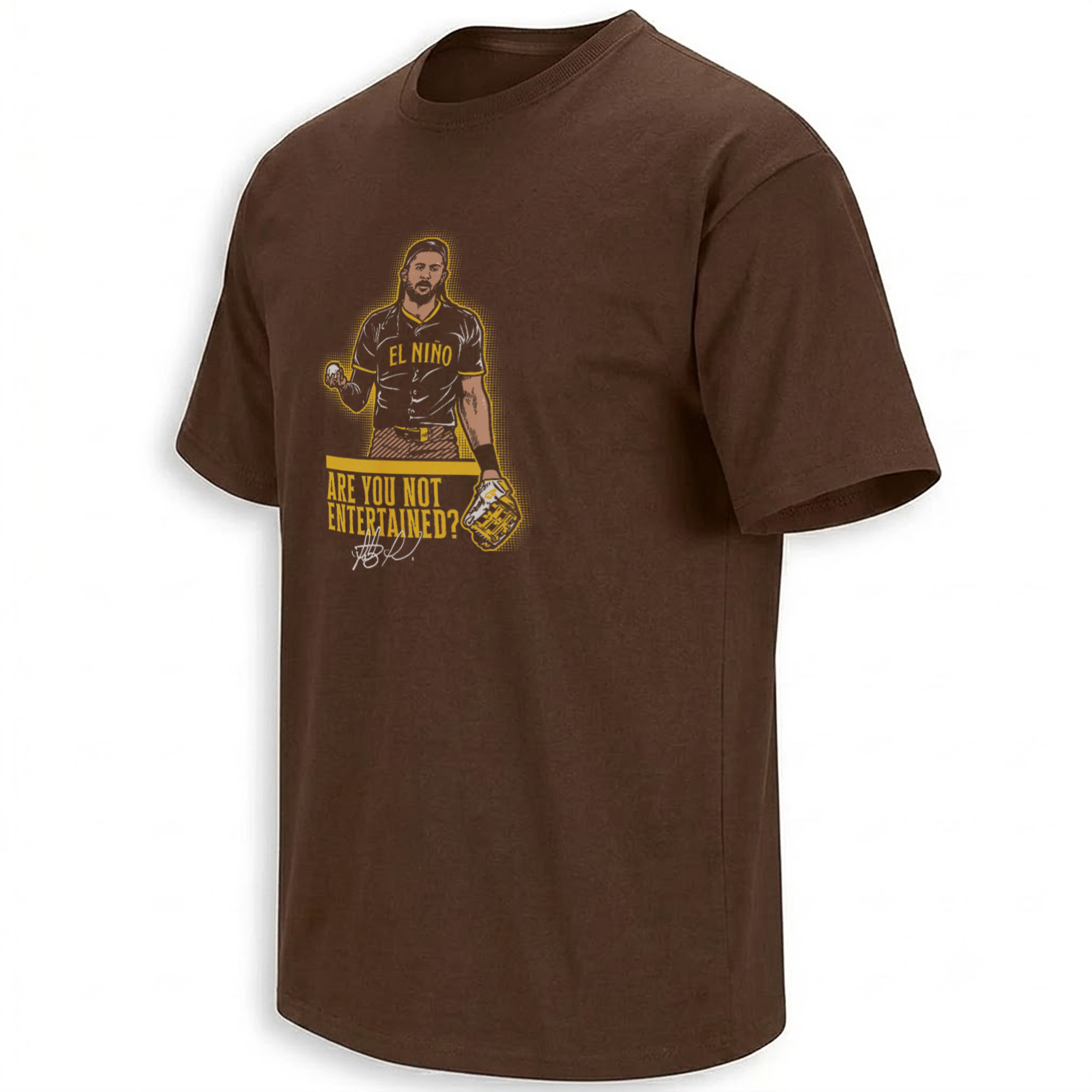
The Design Uses Arena Language Instead of Box-Score Language
The smartest part of the concept is what it leaves out. There is no need to print every statistic from the evening across the graphic. The phrase supplies the emotion, and Tatis supplies the character.
That is closer to old fight posters and bootleg sports graphics than conventional championship merchandise. The typography is meant to arrive loudly. The composition frames Tatis as the central figure, while the phrase behaves almost like dialogue shouted from the artwork toward the viewer.
The design combines sports-poster scale with movie-arena language. Brown-and-gold associations keep it grounded in San Diego baseball culture, while the larger-than-life slogan matches a player whose best highlights often feel built for replay screens rather than static scoreboards.
The Internet Did Not Need Long to Decide What the Highlight Was
Across baseball discussion spaces, the defensive play quickly became the image fans kept replaying. The second angle mattered almost as much as the first because it showed the full theatrical sequence: Tatis rising at the wall, his cap leaving his head, the catch, the stillness and then the reveal.
That reaction explains why this night traveled beyond Padres fandom. A truly portable baseball moment does not require the viewer to know every detail of the standings. You only need to understand four things: the bases were loaded, the ball was leaving the yard, Tatis reached over the wall, and four runs disappeared.
For readers following Tatis specifically, Ellie Shirt’s Fernando Tatis Jr. product search works as a broader visual archive of the player’s changing moments and graphic references. The wider MLB Shirts collection places the design inside the larger language of baseball highlights, players and fan memory.
Frequently Asked Questions
What did Fernando Tatis Jr. do against the Mets on August 18, 2026?
He hit two home runs and robbed Francisco Lindor of a potential grand slam as San Diego defeated New York 5–2 at Citi Field.
Why was the Francisco Lindor catch so important?
The bases were loaded, so Tatis’ catch prevented a potential four-run homer and protected San Diego’s early lead.
Why did the catch become so memorable online?
The stakes were high, but the visual sequence also mattered: the leap, the flying cap, the brief pause and the reveal created an unusually cinematic highlight.
What does “Are You Not Entertained?” mean in this design?
The phrase is used as sports-theater language, framing Tatis’ performance as spectacle as well as competition rather than as a literal game statistic.
Why does the design fit Fernando Tatis Jr.?
Tatis’ public baseball identity has long blended power, defense, visible emotion and highlight-reel style, making the arena-like phrase a natural match for his Citi Field performance.
The Are You Not Entertained design preserves that theatrical interpretation of the Citi Field takeover, while the Fernando Tatis Jr. archive connects it with other visual moments around one of baseball’s most naturally cinematic players.
Are You Not Entertained Shirt Fernando Tatis Jr. turns his unforgettable Citi Field takeover — two homers, a grand-slam robbery and pure outfield theater — into a baseball-culture poster built around one spectacular night.