
Latias & Jirachi: Two Pokémon Built for the Stars
Latias is flying back into the center of Pokémon GO during August 2026 while Jirachi remains one of the franchise’s purest wish-and-comet icons. Put them in the same orbit and the combination feels almost inevitable.
In August 2026, Latias has an unusually literal reason to be back on Pokémon fans’ radar. Pokémon GO’s current monthly GO Pass runs from August 4 through September 8, and Trainers reaching Rank 100 can encounter Latias. The official campaign even describes the Eon Pokémon as “soaring” into the pass — language that fits a creature whose visual identity has always hovered somewhere between dragon, jet and guardian spirit.
Jirachi enters the same visual universe from another direction. Official Pokédex lore describes it as a Pokémon capable of granting wishes when it awakens, while Pokémon: Jirachi—Wish Maker built an entire movie around the arrival of the Millennium Comet. One moves through the sky; the other makes the sky itself feel magical.
That is why pairing Latias and Jirachi inside a cosmic orbit does not feel like two unrelated Pokémon pasted onto a galaxy background. Their histories already speak the same visual language.
Latias represents flight through the heavens. Jirachi represents the wish made while looking up at them.
Latias Has a Real August 2026 Moment
The current context matters because celestial Pokémon art can otherwise drift into generic nostalgia. This month gives Latias a genuine present-tense hook. Pokémon GO’s official August GO Pass specifically features Latias as the Rank 100 encounter, with the possibility of encountering a Shiny version.

The visual works because Latias was designed for movement. Its white-and-red body has a streamlined silhouette, and official Pokédex material describes the Pokémon as intelligent, emotionally sensitive and capable of refracting light with its glass-like down. Those qualities make light trails, orbit rings and nebula colors feel connected to actual character lore rather than decorative effects.
Jirachi Turns Space Into a Wish
Jirachi’s connection to the night sky is more mythological. The official Pokédex describes a legendary thousand-year sleep and the belief that wishes written on the tags attached to Jirachi’s head can come true when it awakens. The movie Jirachi: Wish Maker pushes that idea toward the Millennium Comet, connecting the Pokémon with one of the oldest human rituals imaginable: looking at the sky and attaching desire to something rare passing overhead.
Red-and-white aerodynamic forms, psychic energy and flight imagery make Latias feel like a living object crossing a celestial map.
Star-shaped geometry, wish tags and comet mythology give Jirachi the emotional language of hope, rarity and cosmic coincidence.
The two characters therefore perform different roles inside the same scene. Latias creates trajectory. Jirachi creates meaning.
Pokémon Has Paired Their Celestial Energy Before
There is also an official historical precedent for reading Latias and Jirachi together through a celestial lens. In 2018, The Pokémon Company launched the Pokémon TCG expansion Sun & Moon—Celestial Storm. Official promotional material specifically highlighted Prism Star cards featuring Latios, Latias and Jirachi.
That does not make this new artwork a reproduction of Celestial Storm. It shows that Pokémon’s own visual history has already placed Latias and Jirachi within the same astronomical vocabulary. “Celestial” is not merely a convenient word added to the product name; it is a theme that has followed both Pokémon through official media.
Latias and Jirachi share a Generation III origin, but their strongest connection is visual rather than evolutionary: flight, psychic energy, light, comets, wishes and the emotional scale of looking into a huge sky.
Reading the Celestial Orbit Graphic
The Latias Jirachi Space Shirt treats the two Pokémon less like battle partners and more like objects inside a celestial diagram.
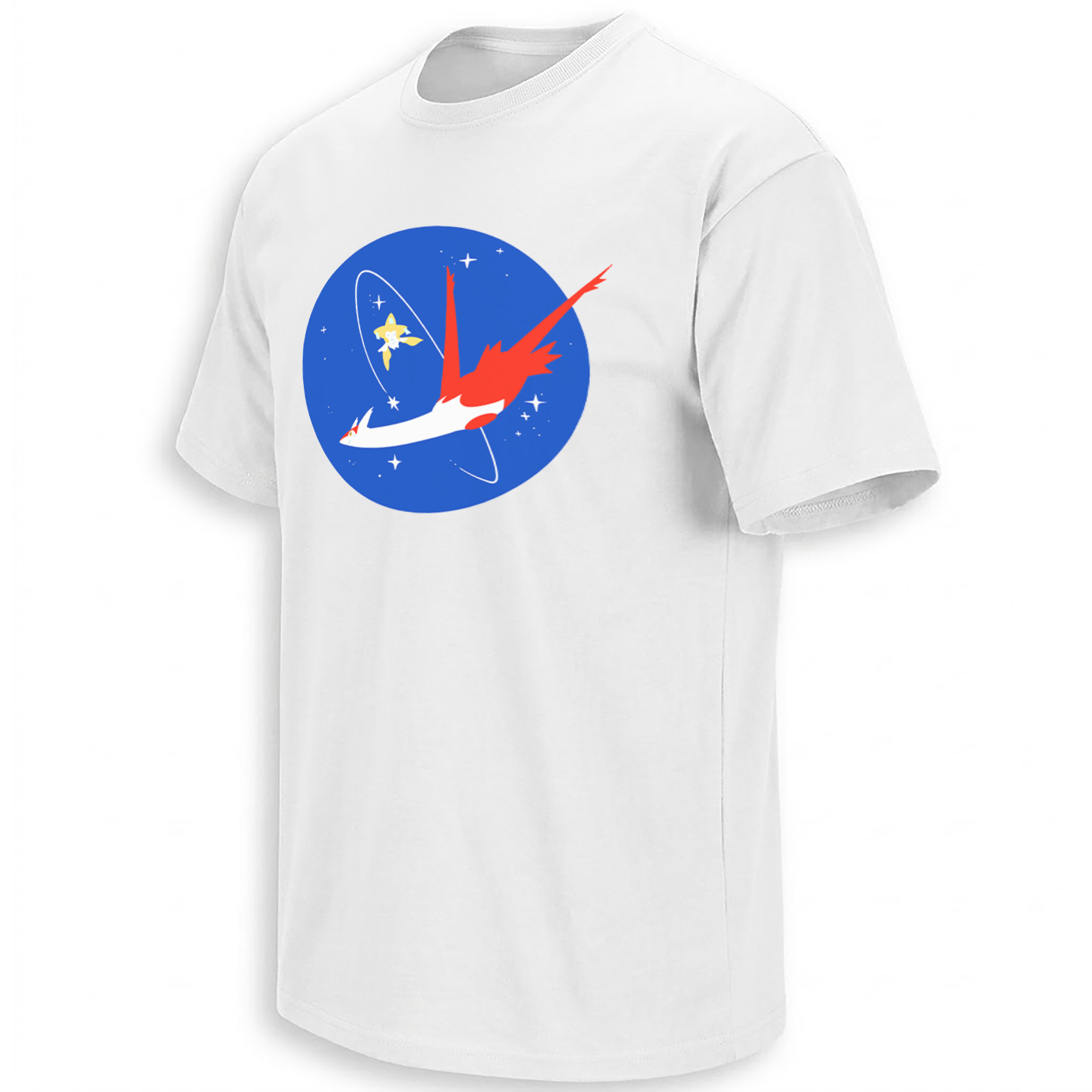
The contrast between Latias’ sharper red profile and Jirachi’s softer yellow geometry creates the visual hierarchy. Red suggests speed, trajectory and energy; yellow naturally behaves like emitted light. Against a dark cosmic background, the two colors separate instantly without losing the feeling that both characters occupy the same space.
Orbit graphics also provide an elegant solution to a common crossover-design problem. Two characters can easily look like separate stickers when placed side by side. A circular trajectory gives them a relationship. One appears to move around the other; the viewer’s eye follows the curve and reads the composition as one event.
Why Generation III Still Feels So Mythic
Latias and Jirachi both emerged from the Pokémon Ruby and Sapphire era, a period unusually rich in legendary-scale imagery. Hoenn brought weather gods, ancient titans, deep-ocean mythology, spaceborne threats and Pokémon that felt connected to phenomena larger than ordinary routes and towns.
Latias belongs to the intimate side of that mythology: intelligent, emotional and able to understand humans. Jirachi belongs to the fairy-tale side, asleep for centuries and surrounded by wishes. The combination allows a modern design to trigger Generation III nostalgia without relying on a literal screenshot from an old game.
For readers following character-specific pieces, Ellie Shirt’s internal product search also provides Latias designs and Jirachi designs . The broader newest designs archive captures other current fandom graphics without inventing a Pokémon collection URL that has not been confirmed.
Why the Pairing Feels Especially Timely Now
Pokémon is celebrating its thirtieth anniversary in 2026, which gives older generations another cycle of rediscovery. At the same time, Pokémon GO is actively placing Latias back into player routines during August. Jirachi’s status as one of the franchise’s signature mythical Pokémon means the combination bridges two types of nostalgia: the character fans remember and the character they are encountering again now.
That balance is what makes the design work as a cultural artifact rather than simply retro fan art. It remembers Hoenn, but one half of the composition is participating in a live 2026 Pokémon event.
Frequently Asked Questions
Why is Latias relevant in Pokémon GO in August 2026?
Latias is the Rank 100 encounter reward in the August 2026 Pokémon GO Pass, which is active from August 4 through September 8.
Why is Jirachi associated with wishes and stars?
Official Pokémon lore describes Jirachi as the Wish Pokémon, said to awaken after a thousand-year sleep and grant wishes. Jirachi: Wish Maker also connects its story to the Millennium Comet.
Have Latias and Jirachi appeared together in official Pokémon celestial imagery?
Pokémon TCG’s 2018 Sun & Moon—Celestial Storm expansion officially featured Prism Star cards for Latias and Jirachi, placing both within the same celestial-themed set.
What does the Celestial Orbit design represent?
The artwork interprets Latias as movement through space and Jirachi as the wish-star focal point, using orbit lines and a cosmic field to connect their different forms of celestial mythology.
The Latias & Jirachi Celestial Orbit design translates that relationship into one cosmic frame — especially timely while Latias is actively flying through Pokémon GO’s August 2026 event cycle.
Latias Jirachi Space Shirt combines the Eon Pokémon’s flight imagery with Jirachi’s wish-and-comet mythology in a celestial orbit graphic, arriving while Latias is featured in Pokémon GO’s August 2026 GO Pass.