
If You’re Seeing Fernando Tatis Jr. Flip the Bat, It’s Already Too Late
After a difficult start to 2026, Tatis is driving baseballs into the seats again — and his latest run has restored the visual swagger that makes a Padres home run unmistakably his.
Fernando Tatis Jr. has always understood that a home run contains two separate moments. First comes the baseball leaving the bat. Then comes the fraction of a second when everybody realizes it is not coming back.
That second moment is where the bat flip lives.
On August 11 against Milwaukee, Tatis drove his 12th home run of the season to right field at Petco Park. The blast gave him 164 career homers and moved him past Nate Colbert into second place on the Padres’ all-time list, behind only Manny Machado.
Two days earlier, Tatis had launched a three-run homer against Houston to give San Diego a 4–2 lead. That home run tied Colbert at 163. Six days before that, he had crushed a Statcast-projected 465-foot shot at 114.7 mph in Arizona.
With Tatis, the bat flip is not an accessory added after the home run. It is the visual punctuation telling the pitcher that the outcome has already been decided.
The Phrase Works Because the Baseball Has Already Left
“If You’re Seeing This, It’s Too Late” carries an obvious pop-culture echo, but on a Fernando Tatis Jr. graphic the phrase gains a second meaning. If the viewer is already seeing the pose — bat released, body opening toward first base, eyes following the flight — the competitive portion of the at-bat is effectively finished.
The hitter knows. The crowd knows. Often, the pitcher knows.
That delay between contact and official confirmation is one of baseball’s most cinematic spaces. Tatis has spent much of his career turning it into performance. His home-run celebrations helped shift MLB’s broader conversation away from the old belief that hitters should immediately lower their heads and run.
Years ago, MLB itself described one of his postseason flips as an expression of “unadulterated joy.” That history matters in 2026 because Tatis does not need to invent a new visual persona every time he heats up. The bat flip is already part of how baseball recognizes him.
The Graphic Freezes the Exact Second Before the Crowd Reacts
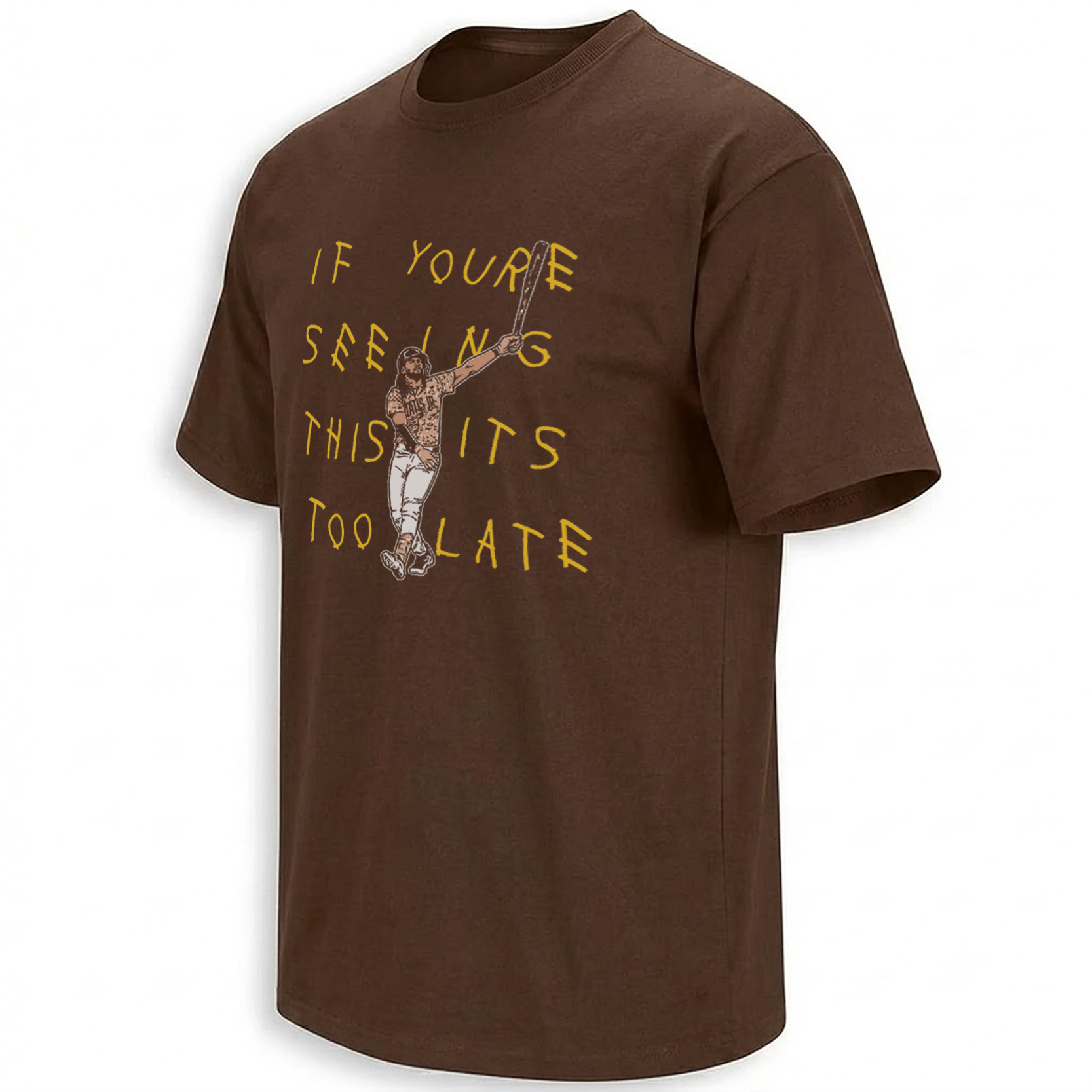
Visually, the piece works because it resists overexplaining the play. The posture communicates the story before the lettering is read. The body is upright rather than sprinting, the bat has become part of the composition rather than equipment, and the phrase sits above the image like a caption to an outcome already known.
Brown and sand connect the design to San Diego’s baseball identity, while the heavier editorial lettering gives it the feel of a poster rather than a conventional player-name graphic.
The composition is based on confidence after contact. It is not about the swing itself. It is about the instant when Tatis stops behaving like a hitter trying to reach base and starts behaving like somebody who already knows where the baseball is going.
Tatis Is Climbing Padres History While the Swagger Returns

Tatis’ August resurgence now carries historical context: his 164th career home run moved him alone into second place on San Diego’s franchise leaderboard. View Tatis on MLB.com →
The milestone arrives after an unusual season. Tatis did not hit his first 2026 home run until May 30, ending a 207-at-bat drought. That slow beginning makes the current visual language feel different from the effortless superstar mythology surrounding some earlier seasons.
This version is about re-emergence. The power did not disappear permanently; it took months to become visible again. By August, the long-distance shots were returning in clusters, and the bat-flip images were once again circulating alongside them.
The social image above is especially useful because it centers the exact visual vocabulary behind the design: Tatis after the swing, bat leaving his hands, performance beginning at the same moment the at-bat ends.
Why Tatis Bat Flips Still Matter in Baseball Culture
Bat flips are no longer shocking in Major League Baseball. That change actually makes individual style more important. When everybody is allowed to celebrate, the question becomes who has a celebration recognizable enough to belong to them.
Tatis remains unusually strong in that category. His bat flips are remembered because they fit everything else about how he plays: speed, dramatic defense, bright visual presentation and a tendency to make routine baseball moments feel slightly larger than regulation size.
That history gives the If You’re Seeing This, It’s Too Late graphic context beyond one particular home run. It works as a 2026 artifact because the phrase arrives just as the familiar Tatis visual language is becoming relevant again.
The broader San Diego Padres collection follows the same season through player moments, clubhouse language and San Diego-specific graphics, while the MLB Shirts collection connects those pieces to the wider visual culture of baseball.
Frequently Asked Questions
How many career home runs did Fernando Tatis Jr. have on August 11, 2026?
Tatis hit career home run No. 164 against Milwaukee on August 11, moving past Nate Colbert into second place on the Padres’ all-time home run list.
Who is ahead of Fernando Tatis Jr. on the Padres home run list?
Manny Machado remains ahead of Tatis on the franchise home run leaderboard.
Why are bat flips strongly associated with Fernando Tatis Jr.?
Tatis has used expressive home-run celebrations throughout his career, and several of his most memorable postseason and regular-season homers have been followed by recognizable bat flips.
What does “If You’re Seeing This, It’s Too Late” mean in the design?
The graphic uses the phrase as visual wordplay: by the time the viewer sees Tatis in his bat-flip pose, the ball has effectively already beaten the pitcher.
The Tatis bat-flip graphic captures the confidence returning to his 2026 season, while the Padres visual archive follows the other moments shaping San Diego’s year.
If You’re Seeing This It’s Too Late Shirt captures Fernando Tatis Jr.’s unmistakable bat-flip swagger during his August 2026 power surge and climb to second place on the Padres’ career home run list.