
Why “My Wife Is PsycHOTic” Works Before You Even Finish Reading It
The joke looks almost too simple to explain: take “psychotic,” visually isolate HOT, and let the reader discover that the same sentence can insult and compliment a wife at exactly the same time. That tiny typographic trick is why the phrase has become unusually durable internet apparel language.
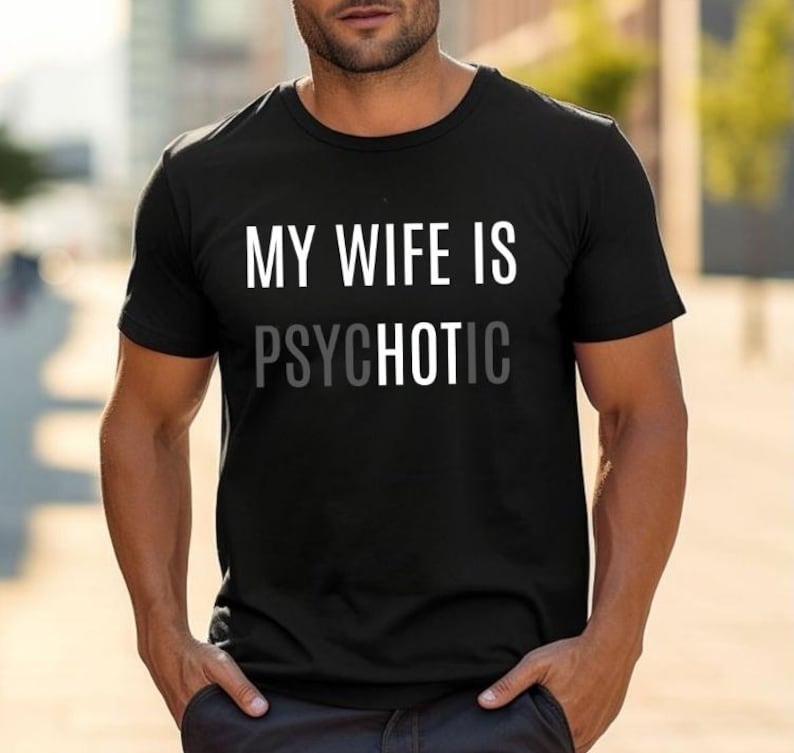
The best text memes often contain two readings competing for the same space. “My Wife Is Psychotic” initially arrives as one sentence. Then the eye catches the color change, enlarged letters or visual interruption in the center of the final word: PSYC–HOT–IC. Suddenly the punchline changes direction.
The wife is “psychotic.” The wife is also “hot.” Neither reading cancels the other. The wearer is simultaneously teasing his partner and announcing attraction to her, which is precisely the sort of exaggerated relationship humor that travels easily from private joke to Instagram caption, hat patch, sticker and T-shirt.
Unlike a meme built around a celebrity clip or one exact viral post, this phrase appears to have spread as a reusable piece of visual wordplay. Current marketplace listings, social posts and apparel variations repeatedly use the same central device: make HOT visually louder than the letters surrounding it. There is no need for a character, screenshot or complicated explanation. Typography performs the joke.
The graphic succeeds because the compliment is hidden inside the insult — and the wearer gets credit for saying both.
The Joke Is Older Than Any One Shirt
Searching the phrase today reveals a broad ecosystem rather than a single canonical source. “My Wife Is Psychotic,” “My Wife Is PsycHOTic,” “My Girlfriend Is PsycHOTic” and similar versions appear across marketplace listings and social posts. That repetition matters: it suggests the cultural unit is not one particular graphic but the transformation of the word itself.
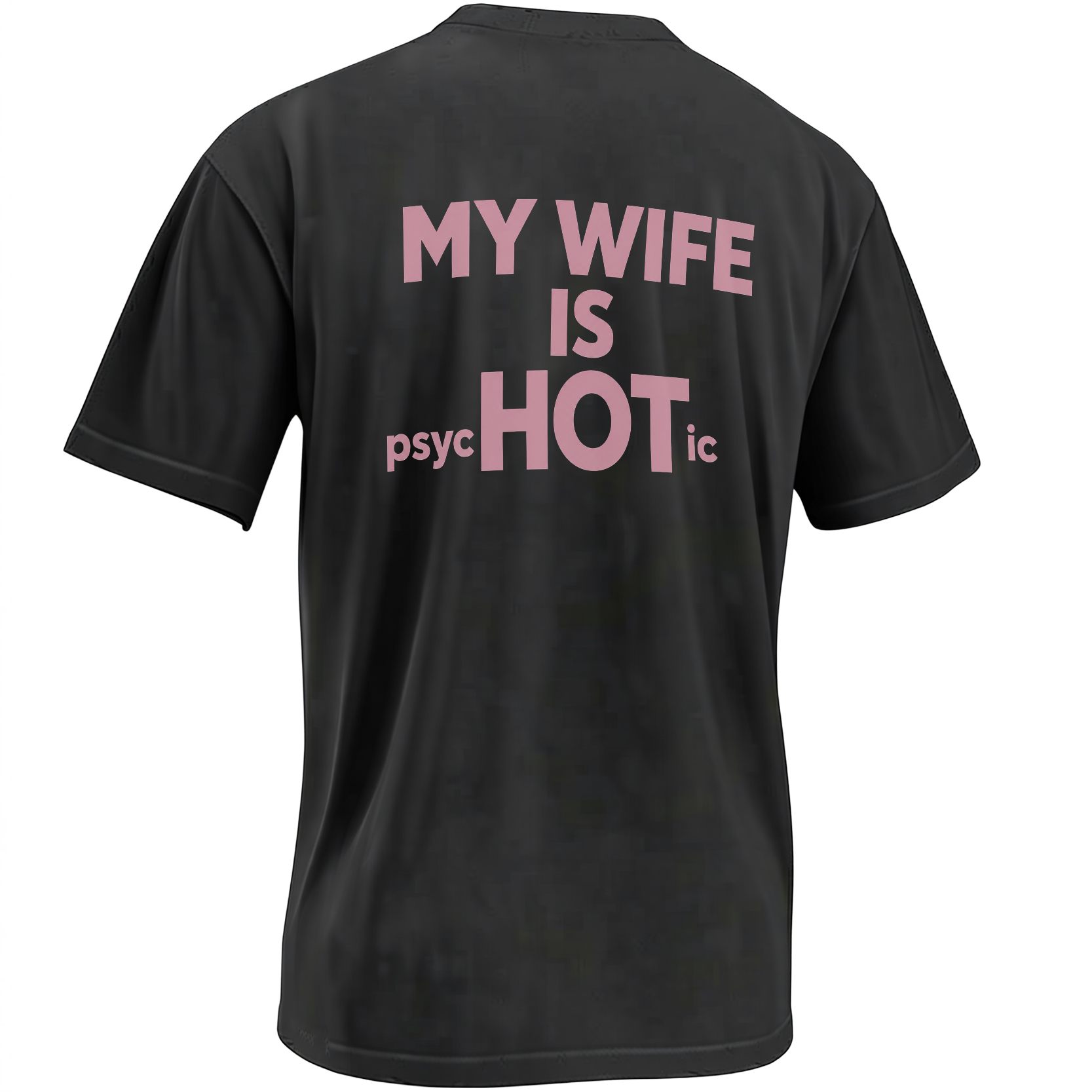
A current Etsy listing, for example, uses a much simpler “MY WIFE IS PSYCHOTIC” composition in which subtle contrast inside the word changes how the eye reads it. Other versions make HOT bright, oversized or parenthetical. The Ellie Shirt treatment pushes that logic further by making the hidden compliment impossible to miss.
Why PSYC-HOT-IC Is Stronger Than a Normal Punchline
Most joke shirts tell the reader exactly when to laugh. This one makes the viewer participate. At first glance, the brain recognizes “psychotic.” A fraction of a second later, the emphasized middle letters interrupt that reading. That micro-delay is the mechanism.
It behaves almost like a visual version of a double entendre. The literal word remains intact, but the design creates a second word without adding any new letters. HOT was already there; the graphic simply changes what the reader is allowed to notice.
That makes the concept particularly suited to short-form social culture. Someone can understand it in a thumbnail, across a room or during a two-second scroll. There is no context barrier, no lore requirement and no caption necessary to decode the basic premise.
Social Media Keeps Re-Discovering the Same Reading Trick
The persistence of the phrase is visible on Instagram as well. Posts using “PsycHOTic” continue to frame the joke as something instantly legible rather than something requiring an origin story. That is an important distinction in meme culture: not every successful joke needs one definitive viral creator. Some survive because the structure is so reusable that people repeatedly reinvent or redistribute it.
That also explains why the line fits married-couple humor so comfortably. The premise exaggerates the familiar idea that long-term relationships include admiration, irritation and inside jokes at the same time. The graphic works when readers understand that the insult is theatrical rather than literal.
The cultural reading is playful relationship hyperbole. “Psychotic” here functions as exaggerated meme language, not as a clinical description of mental illness.
The Design Turns Typography Into the Character
There is no celebrity face or complicated illustration doing the storytelling. The lettering itself becomes the character. The large headline establishes the premise, while the separation around HOT creates the visual punchline. Contrast is doing the same job a reaction shot would do in a video meme.
That makes the design closer to classic bumper-sticker humor and novelty typography than to contemporary image macros. Yet its compression feels extremely current. Modern feeds reward graphics that communicate before a user consciously decides to read them, and PSYC-HOT-IC can be decoded almost instantly.
Within Ellie Shirt, the piece fits naturally into the broader Newest collection, where current internet phrases, visual jokes and rapidly circulating graphics sit beside sports and entertainment moments. In this case, the cultural event is not a game or celebrity appearance. It is the continued life of a word joke that refuses to need an explanation.
Frequently Asked Questions
What does “My Wife Is PsycHOTic” mean?
It is a visual pun that highlights the word HOT inside PSYCHOTIC, allowing the phrase to work simultaneously as exaggerated teasing and as a compliment about the wearer’s wife.
Why is HOT emphasized in PSYCHOTIC?
HOT already appears as consecutive letters inside the word. Typography isolates those letters so readers discover a second message without changing the spelling.
Did the PsycHOTic joke come from one viral post?
No single authoritative origin is clearly documented in the available sources. The phrase appears across multiple apparel listings and social posts as a reusable visual joke.
Why does the joke work well on a shirt?
The contrast between PSYC, HOT and IC can be understood within seconds, making the joke readable from a distance or during a quick social-media scroll.
What makes the Ellie Shirt version visually distinctive?
The design makes HOT the interruption point of the composition, ensuring the hidden compliment becomes the visual center rather than an easily missed detail.
The My Wife Is PsycHOTic Shirt turns that discovery into the graphic itself, while Ellie Shirt’s Newest archive tracks the wider stream of phrases and visual jokes currently moving through internet culture.
My Wife Is PsycHOTic Shirt builds its marriage joke around one typographic reveal: HOT hidden inside PSYCHOTIC. The graphic turns exaggerated relationship humor into an instantly readable internet-style wordplay design.