The Ellie City Ledger
Friday, July 31, 2026 · Editorial Edition
The Shirt Inside the Story
Mamdani’s Tax Machine Rolls Into Political Satire
“Tanks for the Taxes” turns New York City’s complicated 2026 budget battle into a blunt visual joke: a mayor, a tax agenda and a metaphorical collection machine built to keep advancing.
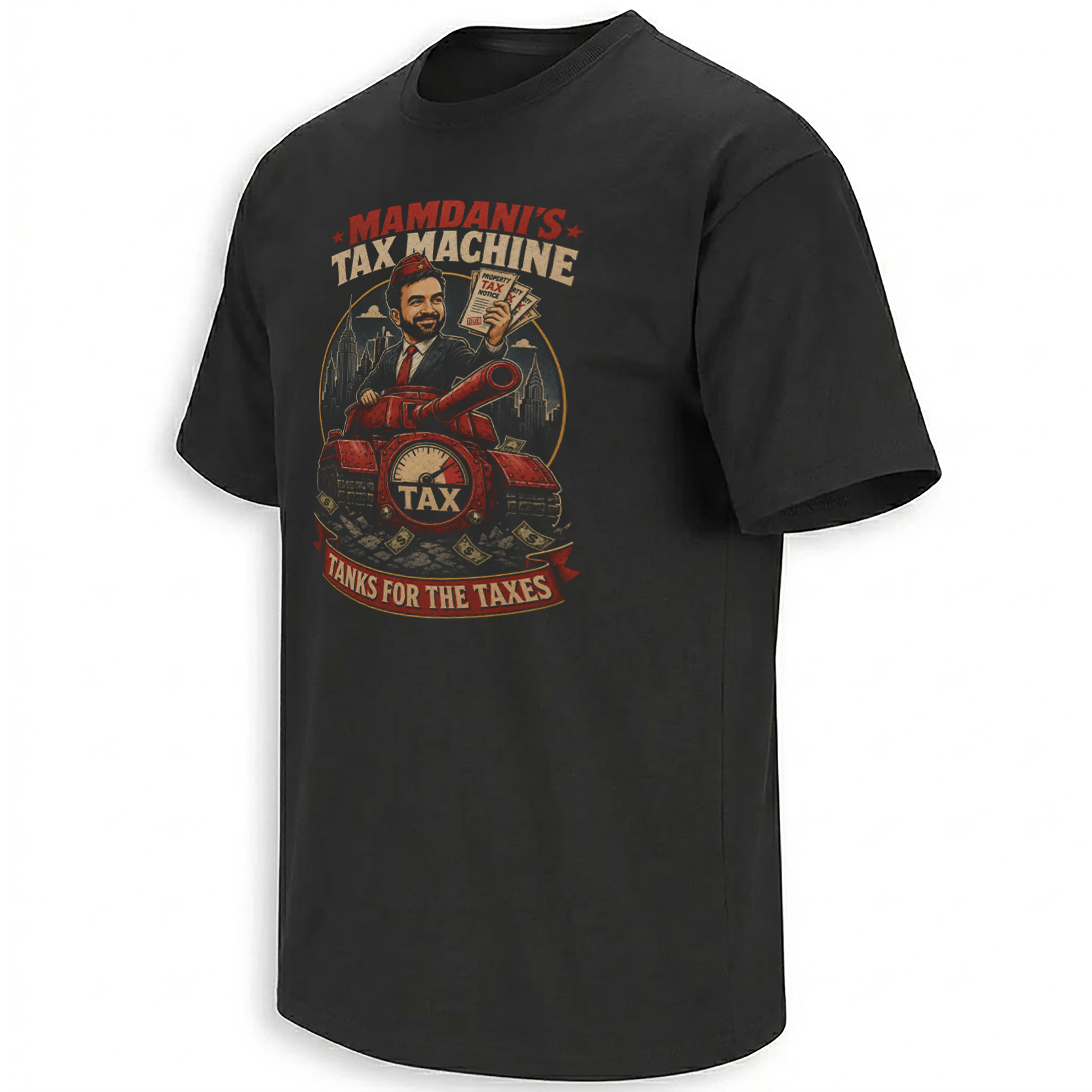
Political satire works fastest when it replaces an abstract policy with an object everyone immediately understands. A city budget is hundreds of pages long. A tank needs no explanation. Put the two together, add the phrase “Tanks for the Taxes,” and New York’s argument over revenue becomes a single provocative image.
The three Mamdani’s Tax Machine designs arrive during a particularly charged chapter in New York City politics. Mayor Zohran Mamdani entered 2026 promising an affordability agenda built around expanded public services, while confronting a multibillion-dollar budget gap and the political reality that many major city tax changes require Albany’s approval.
That conflict created ideal material for political apparel. Supporters presented new revenue from wealthy individuals and luxury property as a way to protect schools, parks, libraries and social programs. Critics saw an administration eager to expand government and too willing to use taxation as its primary weapon.
“Mamdani’s Tax Machine” belongs unmistakably to the critical side of that argument. It is not an official slogan or a quotation from the mayor. It is a satirical label that turns the administration’s tax policy into a machine that appears powerful, aggressive and difficult to stop.
The proposal that made “tax machine” feel believable
In February 2026, the Mamdani administration released a preliminary $127 billion fiscal-year 2027 budget. It assumed a 9.5% increase in the city’s property-tax rate that was projected to generate about $3.7 billion.
Mamdani presented that increase as the less desirable alternative. His preferred route was for state leaders to authorize additional taxes aimed at wealthy residents and highly profitable corporations. Without new authority from Albany, he argued, the city would be left with property taxes as one of the few major revenue levers it could control directly.
The distinction mattered in policy terms, but it did little to calm the political reaction. A proposed across-the-board increase could affect homeowners, landlords, commercial properties and, indirectly, tenants. City Comptroller Mark Levine called reliance on the increase inequitable and warned that New York’s existing property-tax system was already inconsistent.
For opponents, the episode established the image later captured by the shirts: when the budget required more revenue, the administration appeared ready to move a large tax mechanism into position.
Proposal versus final policy
The 9.5% general property-tax increase was not ultimately imposed. Mamdani’s May executive budget removed it and stated that the city had balanced its plan without raising property taxes on working New Yorkers. The shirts use political exaggeration, so readers should not interpret them as evidence that every tax proposal discussed in early 2026 became law.
From a broad tax threat to a targeted luxury-home tax
The tax story did not end when the 9.5% proposal disappeared. New York State instead authorized a new pied-à-terre surcharge aimed at high-value New York City residences owned by people whose primary residence is elsewhere.
The measure applies to qualifying luxury second homes valued above $5 million and took effect on July 1, 2026. Mamdani’s administration said it could raise approximately $500 million annually to support city services while avoiding a general increase on working-class property owners.
Supporters called the tax a long-overdue attempt to collect more from ultrawealthy owners who hold valuable New York real estate without living in the city full-time. Mamdani promoted it with the language of making the rich pay their “fair share.”
Critics focused on a different set of consequences: whether the surcharge could discourage investment, weaken the luxury real-estate market or encourage wealthy owners to shift money and business activity elsewhere.
Its rollout produced a fresh controversy in late July when property owners received notices saying they might be subject to the tax. Some recipients said they had been incorrectly identified and were being required to prove that their property was a primary residence. That confusion gave the “Tax Machine” satire new relevance: the joke was no longer only about what government planned to collect, but also about the machinery used to identify who should pay.
The satire imagines taxation not as a form, a hearing or a line in the budget, but as an armored machine advancing toward the next source of revenue.
Why “Tanks for the Taxes” is an effective political pun
The phrase succeeds because the sound of “tanks” closely echoes “thanks,” while reversing the emotional meaning. “Thanks for the taxes” would sound like a cheerful government acknowledgment. “Tanks for the Taxes” replaces that gratitude with force.
A tank also suggests momentum. It is heavy, industrial and designed to move through resistance. In the visual logic of the design, Mamdani is not simply advocating for a particular surcharge. He becomes the operator or public face of a larger fiscal machine.
That is deliberate caricature. The artwork does not attempt to calculate tax incidence or analyze municipal accounting. Like an editorial cartoon, it selects one anxiety—government’s appetite for revenue—and enlarges it until the argument can be understood from across a room.
One tax debate, two sharply different New York stories
Revenue protects an affordable city
Mamdani’s supporters argue that targeted taxes on extreme wealth can preserve childcare, transit, housing, schools, parks and libraries without forcing service cuts onto working New Yorkers.
The collection machine keeps expanding
Opponents argue that repeated tax proposals create uncertainty, reward government expansion and risk pushing residents, capital and businesses away from an already expensive city.
Both stories claim to be about affordability. One asks how New York can fund the services that make life possible for ordinary residents. The other asks whether additional government spending and taxation will make the city even harder to afford.
That tension explains why the designs have more cultural weight than a generic anti-tax shirt. They are attached to a recognizable mayor, a specific budget year and a real sequence of tax proposals, negotiations and implementation problems.
Three variations on the same armored metaphor
The three Ellie Shirt versions preserve the same central joke while giving shoppers multiple visual interpretations of the moment. Seen together, they work like alternate newspaper cartoons responding to the same headline.
Their repeated language is part of the effect. “Mamdani’s Tax Machine” names the political character, while “Tanks for the Taxes” supplies the punchline. Each design can stand alone, but the full group turns the phrase into a miniature political-satire series.
Explore all three Tax Machine designs
Mamdani’s Tax Machine
The lead interpretation turns the mayor and his fiscal agenda into a blunt, armored emblem of New York’s tax controversy.
View design one →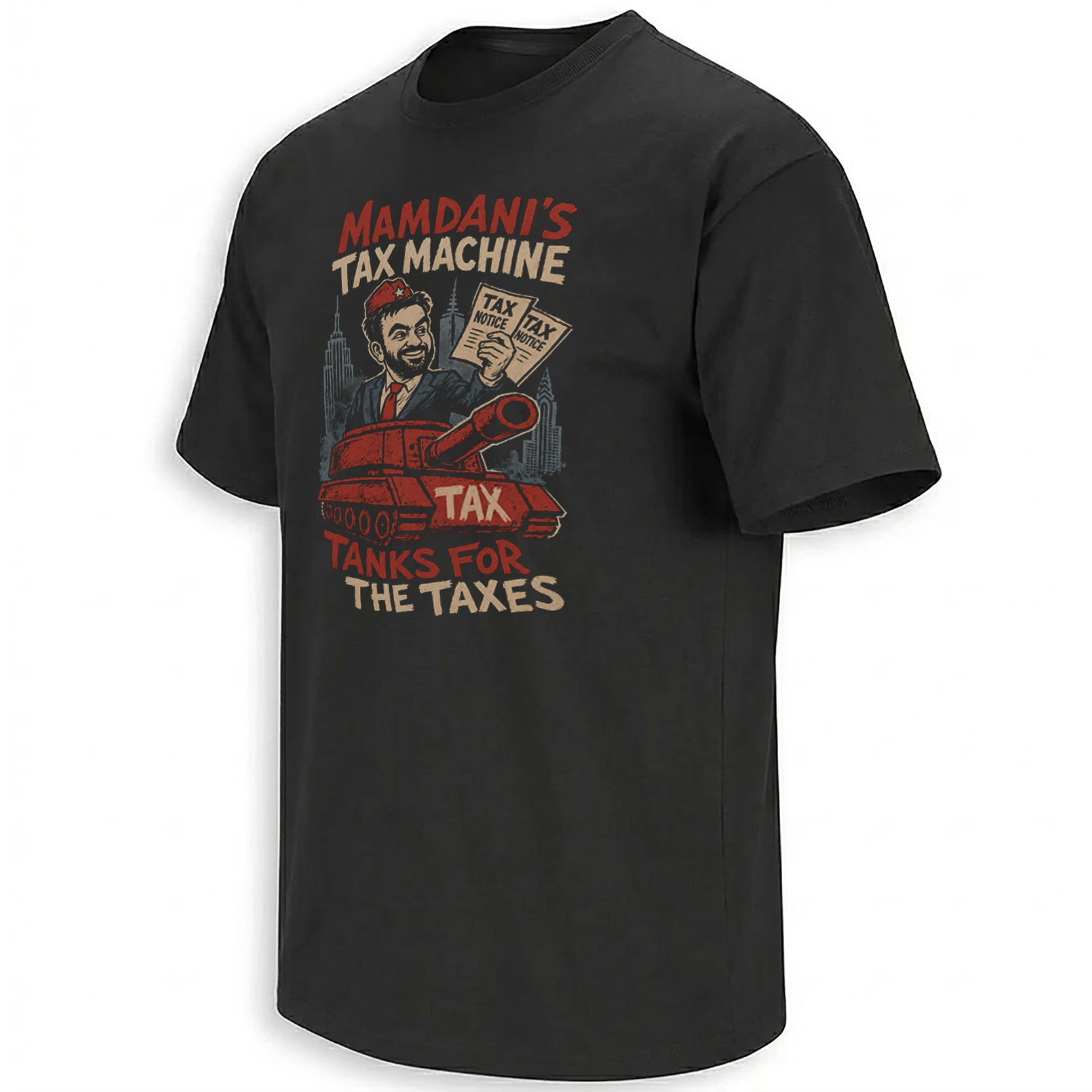
Tanks for the Taxes: Second Edition
A second visual treatment of the same pun, created for people who see aggressive revenue collection as the defining joke.
View design two →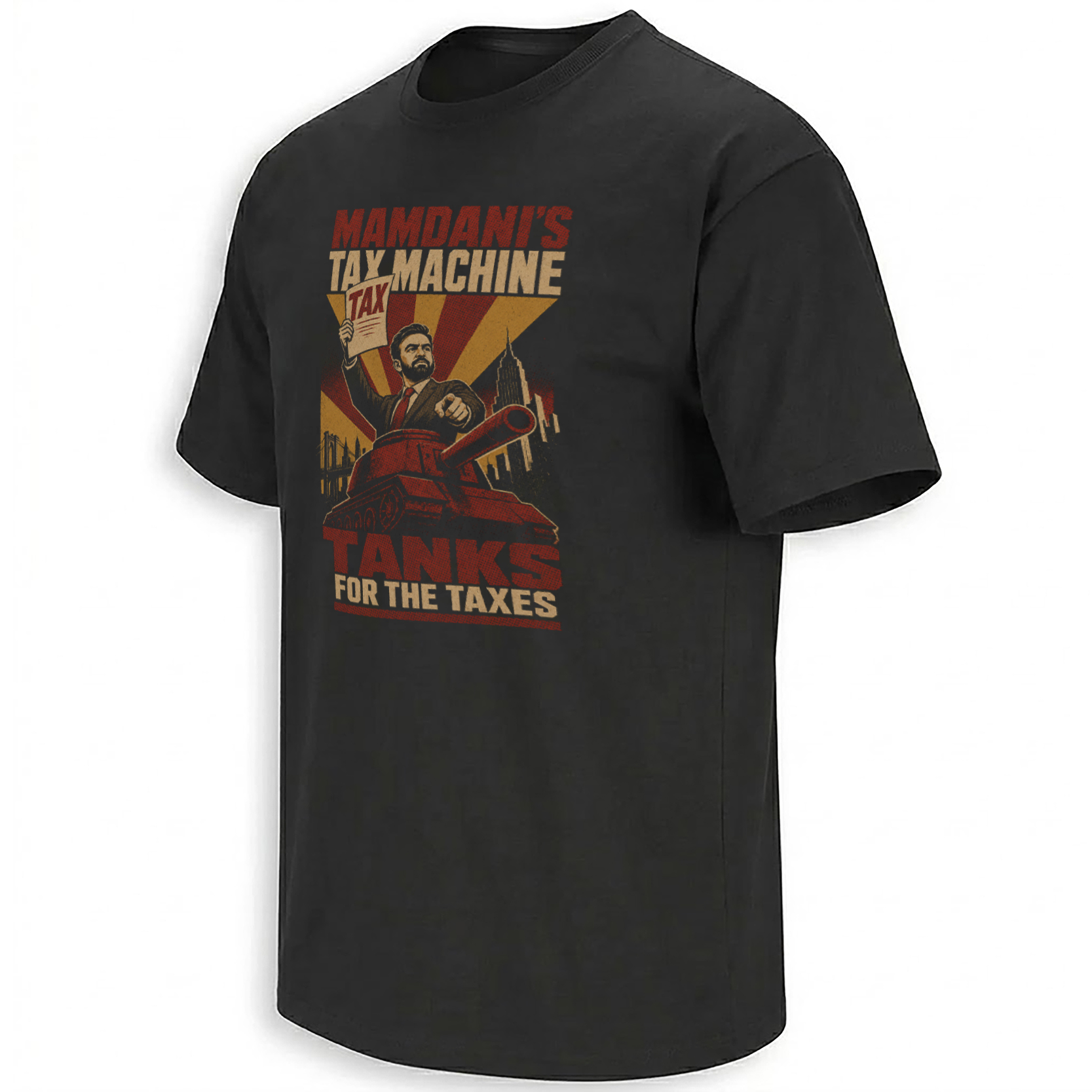
The NYC Tax Machine
The third variation connects the armored satire directly to New York City and the politics of its 2026 budget.
View design three →Political apparel as a portable editorial cartoon
Before social media, an editorial cartoon appeared in a newspaper and disappeared with the next day’s edition. Political apparel gives the form a longer life. The joke moves through streets, rallies, photographs and online conversations while the wearer becomes part of its distribution.
A shirt also makes the opinion personal. Sharing a meme requires one click; wearing it in public means accepting identification with its argument. In this case, the wearer is expressing skepticism toward Mamdani’s fiscal politics and toward the idea that additional taxation is the best answer to New York’s budget pressures.
That does not make the design a neutral economic analysis—and it is not intended to be one. Its cultural value lies in recording how a portion of the public perceived the administration during this moment: as an energetic political project backed by an equally energetic appetite for revenue.
Years later, the numbers and eligibility rules may require explanation. The image probably will not. “Mamdani’s Tax Machine” preserves the emotional memory of the debate: a sense that New York’s fight over affordability had become a fight over who would be billed for it.
Explore more wearable political commentary
Discover designs shaped by elections, public policy, viral headlines and America’s continuing culture wars.
For the most recently added cultural and political designs, visit the Ellie Shirt newest collection.
Reporting and official documents referenced
Frequently asked questions
What does “Mamdani’s Tax Machine” mean?
It is a satirical description of Mayor Zohran Mamdani’s tax and spending agenda. The phrase portrays government revenue collection as a powerful machine that continually searches for new sources of money.
Did Zohran Mamdani actually say “Tanks for the Taxes”?
No. “Tanks for the Taxes” is a political pun used by the shirt designs, not a verified quotation from Mamdani. It turns “thanks for the taxes” into an armored metaphor for aggressive collection.
Did New York City impose the proposed 9.5% property-tax increase?
No. The 9.5% increase appeared in the February 2026 preliminary budget as a possible way to generate approximately $3.7 billion. It was removed from the May executive budget.
What tax did New York implement in 2026?
New York authorized a pied-à-terre surcharge aimed at qualifying luxury New York City second homes owned by people whose primary residence is outside the city. The measure took effect on July 1, 2026.
Why did the pied-à-terre tax become controversial?
Supporters said it would make wealthy absentee owners contribute more toward public services. Critics raised concerns about investment, privacy and mistakes during the process of identifying properties that might be subject to the surcharge.
Are the three Mamdani Tax Machine shirts identical?
No. They are three visual interpretations of the same “Mamdani’s Tax Machine” and “Tanks for the Taxes” political-satire concept.
Three “Mamdani’s Tax Machine” designs capture the political reaction to New York City’s turbulent 2026 tax debate. Through the pun “Tanks for the Taxes,” the collection turns budgets, luxury-home surcharges and public frustration into a memorable piece of wearable satire.