The Shirt Inside the Story
How “XX‑XY” Became Part of the WNBA’s Fair-Play Debate
Two teenage fans, one courtside message and a confrontation at a Seattle Storm–Indiana Fever game turned a compact sports slogan into part of a much larger American argument about women’s competition, free expression and respectful disagreement.
The most revealing images from a sports arena are not always captured on the court. Sometimes they appear in the stands, where a shirt or a handwritten sign becomes the object through which an entire political and cultural argument is viewed. That is what happened in Seattle on July 28, 2026.
During the Seattle Storm’s home game against the Indiana Fever, two teenage fans attended in “XX‑XY” apparel and displayed a sign thanking Fever guard Sophie Cunningham for “speaking up for girls.” Their message referred to Cunningham’s recently stated position that women’s sports should remain organized around biological sex.
The teenagers’ appearance did not take place in a neutral atmosphere. Supporters of Cunningham’s position had gathered outside Climate Pledge Arena, while other fans and players expressed support for transgender inclusion. Inside the building, the shirts and signs functioned as more than fan merchandise. They identified the girls with one side of a debate already dividing the wider sports culture.
When an arena disagreement became the real headline
According to reporting by the Associated Press and Reuters, Seattle Storm co-owner Celeste Keaton confronted the two fans during the game. Reports of the exchange described profane and hostile language. The encounter quickly moved beyond an argument over sports policy because it involved an organizational leader directing that language toward teenage spectators.
The Storm subsequently apologized. Majority owner Ginny Gilder said that everyone attending a Storm game deserved to feel welcome and reiterated the organization’s commitment to an inclusive environment where fans are treated with respect.
On July 30, the WNBA confirmed that Keaton had been fined an undisclosed amount and suspended from attending the Storm’s next five home games. The punishment made the league’s distinction clear: disagreement may be unavoidable in a politically charged arena, but a position of authority brings an additional responsibility for how that disagreement is handled.
The larger cultural question was no longer only who should be eligible to compete. It was also whether a sports arena could make room for sharply opposing beliefs without turning spectators into targets.
Why the XX‑XY message travels so quickly
“XX‑XY” is unusually efficient as visual language. It compresses a complicated argument into four characters commonly associated with female and male chromosome patterns. On a shirt, the pairing works almost like two opposing teams on a scoreboard: brief, symmetrical and readable in seconds.
Supporters use the phrase to advocate for sex-based competition and what they describe as fair opportunities, physical safety and protected categories for female athletes. In that context, “protect women’s sports” and “let girls compete” are not presented as explanations of every eligibility question. They are rallying messages aimed at keeping female athletic opportunity at the center of the conversation.
Critics interpret the same shorthand differently. They argue that it can reduce complex questions of sex development, gender identity and individual eligibility to a binary slogan, while making transgender athletes feel excluded from sport. That difference in interpretation helps explain why a few letters on a shirt can receive applause from one section of an arena and rejection from another.
An important distinction
XX and XY describe common chromosomal patterns, but human biology includes variations and is not fully summarized by a four-character slogan. Athletic eligibility is also established by leagues, federations, schools and governing bodies through policies that may consider several criteria. The shirt communicates an advocacy position; it should not be mistaken for a complete medical or regulatory framework.
Sophie Cunningham and the politics surrounding a player’s voice
Cunningham’s comments had already made her a focal point before the Fever arrived in Seattle. Her supporters heard a professional female athlete defending the category that created an opportunity for women to compete. Opponents heard a prominent player supporting policies that could exclude transgender women.
After the courtside incident, Cunningham responded publicly by saying there should be love and a safe space for biological girls, biological boys, transgender women and transgender men. She also argued that people should be able to disagree while remaining kind, praised the teenagers for standing up for their beliefs and criticized the co-owner’s conduct.
Her response mattered because it resisted the simplest version of the internet argument. Cunningham did not withdraw her position on women’s competition, but she also framed respectful treatment as something that should extend to people with different identities and beliefs.
Two shirts, two versions of the same appeal
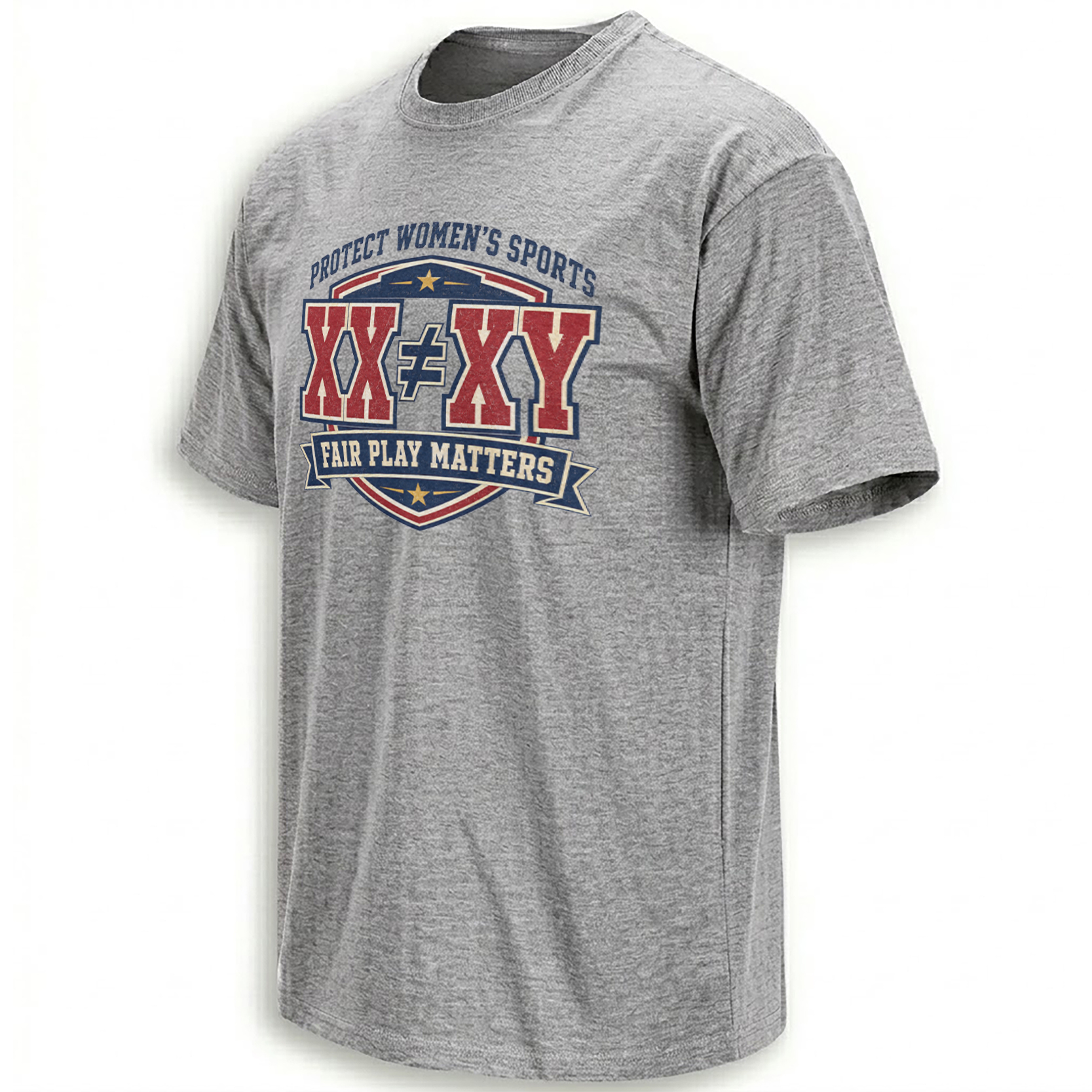
The two Ellie Shirt designs approach the cultural moment with different levels of emphasis. The first places “XX‑XY” at the center and connects the chromosome shorthand directly to protecting women’s sports and fair play. Its strength is immediacy: the design can be understood at the distance of an arena concourse or across a crowded photograph.
The second design expands the message through the phrases “Fair Play for Female Athletes” and “Let Girls Compete.” Instead of allowing the chromosome pairing to stand alone, it identifies the values its wearer intends to emphasize: athletic opportunity, sex-based competition and a fair field for female participants.
The designs connected to the debate
XX‑XY: Protect Women’s Sports
A compact arena-ready statement linking the XX‑XY motif with fair play and the preservation of women’s athletic categories.
See the editorial design →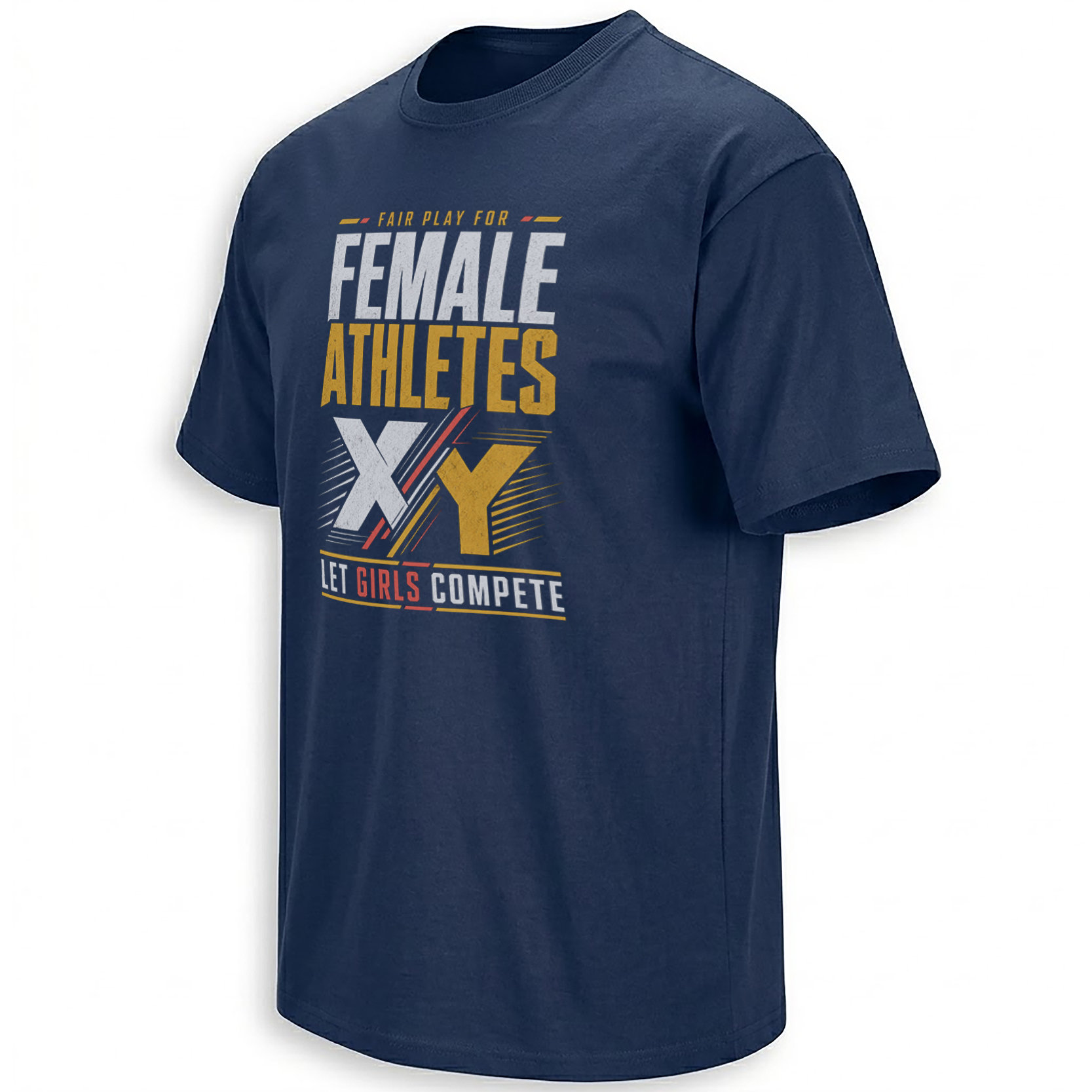
Fair Play for Female Athletes
A fuller statement that turns the chromosome symbol into a direct appeal to protect opportunities for girls in sport.
Explore the second interpretation →A shirt can record a moment without settling the argument
Political and cultural apparel rarely persuades through detailed policy. Its function is to declare, identify and preserve. The wearer signals where they stand; the photograph records that position; and the garment becomes attached to the event through which the public encountered it.
That is why the Seattle incident gave “XX‑XY” a meaning larger than its typography. The shirts became associated with teenage fans, a polarizing WNBA debate, an ownership apology and a league suspension. Whether a viewer agrees with the slogan or rejects it, the design now belongs to the visual record of this particular moment in women’s sports.
The episode also offered a useful test of the word “inclusive.” Inclusion cannot mean that every belief receives institutional endorsement. It should mean that fans can attend a game, express a lawful view and expect not to be personally abused by someone holding authority within the organization.
At the same time, fair treatment should not end with the people wearing one slogan. Transgender fans and athletes must also be able to enter sports spaces without harassment or dehumanization. A credible commitment to respect has to operate in both directions—even when the policy disagreement remains unresolved.
Follow the wider women’s basketball conversation
Explore designs shaped by players, fan culture and defining moments across the WNBA.
For more stories expressed through athletic culture, visit the Ellie Shirt sports collection. These pieces are best understood not simply as products, but as wearable fragments of the conversations taking place around teams, players and fans.
Reporting referenced
Frequently asked questions
Why did XX‑XY shirts become part of the WNBA discussion?
Two teenage fans wore XX‑XY apparel and displayed a sign supporting Sophie Cunningham during the July 28, 2026 Seattle Storm–Indiana Fever game. A reported confrontation with Storm co-owner Celeste Keaton, followed by an apology, fine and suspension, brought national attention to the shirts and their message.
What does the XX‑XY message mean in this context?
In the women’s-sports debate, supporters use XX‑XY as shorthand for sex-based athletic categories. The message advocates protecting competitive opportunities for female athletes, although the slogan does not describe every biological variation or every governing body’s eligibility policy.
What action did the WNBA take after the Seattle incident?
The WNBA fined Celeste Keaton an undisclosed amount and suspended her from attending the Seattle Storm’s next five home games. The Storm also apologized and said fans attending its games deserved to feel welcome and be treated respectfully.
Are the two Ellie Shirt designs identical?
No. One emphasizes the compact “XX‑XY” and “Protect Women’s Sports” message. The other adds “Fair Play for Female Athletes” and “Let Girls Compete,” making the intended advocacy position more explicit.
Why can a simple sports shirt become culturally significant?
Apparel can give a public debate an instantly recognizable visual symbol. When a design appears during a widely reported event, it can become a wearable record of the people, arguments and emotions surrounding that moment.
Two XX‑XY designs capture the women’s-sports fair-play debate that entered the national spotlight after the July 28, 2026 Storm–Fever game. They turn a complex cultural moment into a concise statement about female athletic opportunity, expression and respect.