
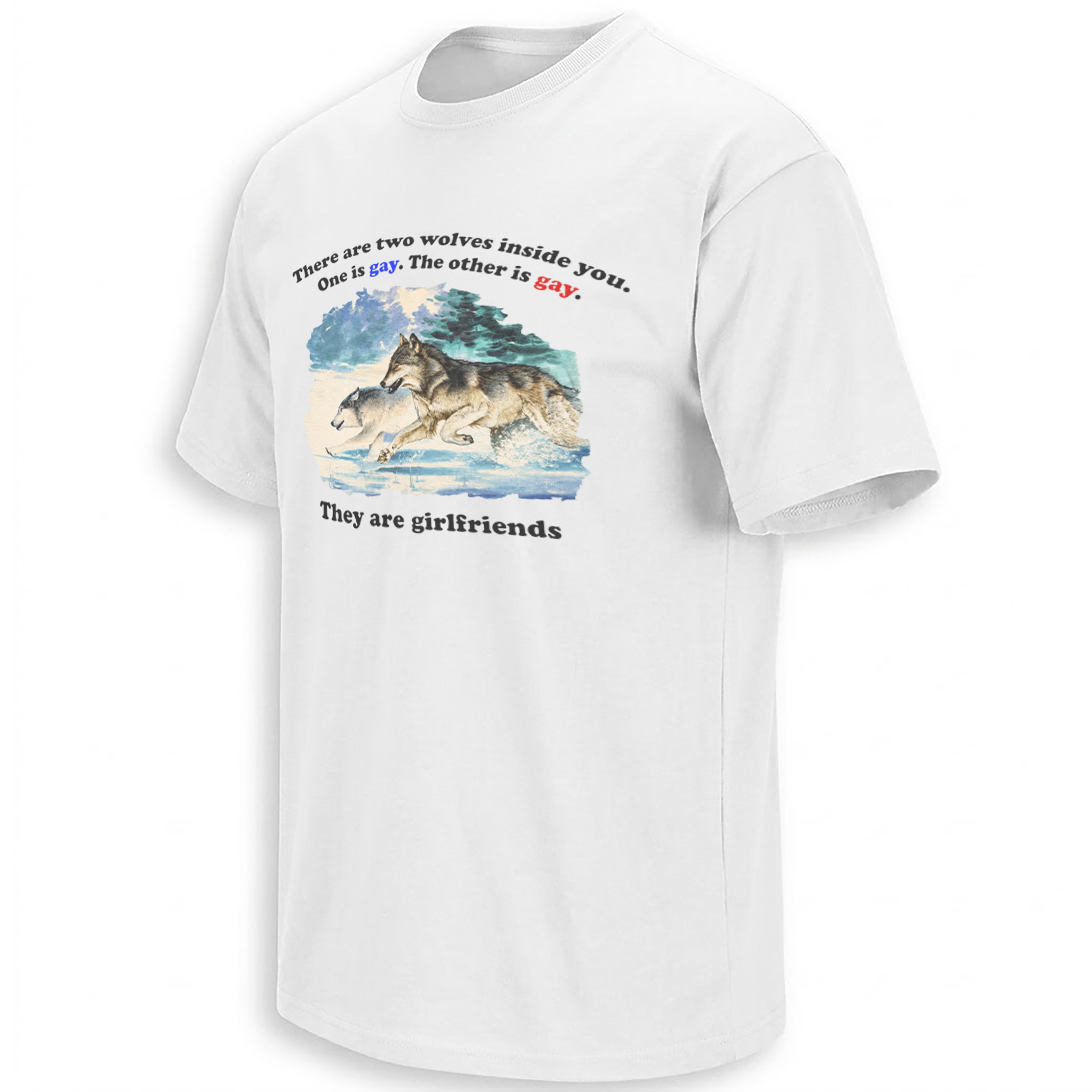
Two Gay Wolves They are not fighting. They are girlfriends.
One of the internet’s favorite inspirational parables imagined an eternal battle inside the human soul. Queer meme culture looked at the two wolves, rejected the conflict and gave them a relationship instead.
There are two wolves inside you. One is gay. The other is also gay. They are girlfriends. The joke succeeds because nearly everyone who has spent enough time online already knows what was supposed to happen next—and this version refuses to let it happen.
In the familiar moral story, two wolves represent opposing forces such as anger and compassion, evil and goodness or resentment and hope. They fight inside a person, and the wolf that wins is supposedly the one that person chooses to feed.
The meme removes the battle. Instead of asking which wolf deserves survival, it declares that both are gay and romantically involved. Moral conflict becomes queer companionship. A solemn lesson becomes an unexpectedly gentle punchline.
The internet was offered an internal war between good and evil. It responded by giving the wolves a love story.
Where the Two Wolves Meme Came From
The broader “Inside You There Are Two Wolves” meme grew from a story commonly circulated as a Native American or Cherokee proverb. In its best-known form, an elder describes two internal wolves—one associated with destructive emotions and the other with positive qualities. Asked which one wins, the elder answers: “The one you feed.”
The precise origin is uncertain. The story has repeatedly been attributed to Cherokee tradition, but researchers and internet historians have also connected modern versions to later religious and motivational storytelling. It is therefore more accurate to describe it as a widely circulated parable with disputed origins than to present its Cherokee attribution as settled fact.
According to Know Your Meme’s history of the format, parodies spread online during late 2018 and early 2019. The original dialogue was compressed into an adaptable template: “There are two wolves inside you. One is X. The other is X. You are X.”
Although the underlying story is frequently labeled a Cherokee proverb, its documented origin remains unclear. This article treats it as a modern motivational parable rather than assigning it definitively to a specific Indigenous tradition.
How the Internet Broke the Parable
A successful meme template gives people enough structure to recognize the reference and enough empty space to destroy its original seriousness. The two-wolves format offered both.
Its setup carries exaggerated spiritual importance. The reader expects a lesson about self-control, morality or competing identities. Meme versions interrupt that expectation with details too mundane, specific or absurd to support the original drama.
Sometimes both wolves want snacks. Sometimes they share the same name. Sometimes neither wolf understands what is happening. The humor comes from preserving the language of internal mythology while replacing the grand philosophical conflict with ordinary internet personality.
“One is gay. The other is gay. They are girlfriends” is one of the cleanest transformations because each sentence seems to continue the expected structure while quietly dismantling it.
Why “They Are Girlfriends” Is the Real Punchline
Declaring that both wolves are gay establishes the twist, but “they are girlfriends” completes it. Without the final sentence, the joke would simply replace two moral categories with a shared identity. The relationship changes the logic of the entire story.
The original version depends on opposition. The wolves cannot coexist peacefully because one must defeat the other. The queer rewrite rejects that forced binary. They are not competing identities, and the reader does not need to choose which one deserves to be fed.
The wolves can nurture each other. The supposed battle was a misunderstanding. What looked from outside like internal contradiction is revealed as affection.
This is why the meme feels wholesome despite its absurdity. Its punchline is not that being gay is strange. Its punchline is that a dramatic moral fable has misidentified two girlfriends as enemies.
Queer Joy Instead of Queer Conflict
LGBTQ stories are frequently framed through danger, rejection, political conflict or the need to justify one’s existence. Those subjects are real and necessary, but they are not the full range of queer life.
Internet humor creates space for another kind of representation: casual, affectionate and deliberately unserious. The wolves do not deliver a speech about acceptance. They simply exist inside the meme as girlfriends, and the audience is invited to accept that revelation as obvious.
That ordinariness is part of queer joy. The relationship is not presented as tragedy or debate. It is the solution to a joke.
The meme therefore works both as LGBTQ apparel and as internet-native humor. A queer viewer can recognize the playful representation, while anyone familiar with the two-wolves format can understand exactly how the parody overturns its source.
Why Wolves Became Perfect Internet Characters
Wolves already carry enormous symbolic weight. They can represent wilderness, loyalty, danger, independence, packs, moonlit mystery or the exaggerated intensity of motivational art.
Online culture repeatedly turns that seriousness into camp. Dramatic wolf imagery—especially two wolves posed beneath a moon—looks as though it should reveal an ancient spiritual truth. Pairing that aesthetic with a blunt sentence about two girlfriends creates an immediate contrast between visual intensity and emotional sweetness.
The joke does not need an elaborate illustration to remain recognizable. Two wolves facing one another can now suggest romance as easily as combat once the viewer knows the rewritten caption.
The graphic combines three recognizable languages: motivational wolf imagery, the “two wolves inside you” meme template and direct LGBTQ humor. That layered familiarity allows the design to work as both a conversation starter and a visual in-joke.
From Image Macro to Wearable Queer Folklore
Memes usually move quickly. They appear in feeds, are edited into new variations and disappear beneath the next wave of posts. Apparel slows that cycle down by giving a successful line a stable physical form.
The Two Gay Wolves Shirt preserves more than a single caption. It records the internet’s ability to take inherited moral language, question its assumptions and replace conflict with something warmer.
Wearing the design can communicate identity, allyship or simply affection for an especially efficient joke. Its meaning does not depend on explaining every stage of meme history. The final line tells the audience everything necessary: they are girlfriends.
The design connects naturally with Ellie Shirt’s LGBT Pride collection and the newest cultural designs. Together, those collections preserve the phrases and visual jokes through which queer internet culture turns recognition into community.
Frequently Asked Questions
What does the Two Gay Wolves meme mean?
It parodies the familiar story about two opposing wolves living inside a person. In this version, both wolves are gay and are girlfriends, replacing moral conflict with queer romance.
Where did the “two wolves inside you” meme originate?
It developed from a widely circulated motivational parable about good and evil wolves. Online parodies of the format became especially visible during late 2018 and early 2019.
Is the original two-wolves story really a Cherokee proverb?
It is frequently described that way, but its origin is disputed and has not been definitively established as a traditional Cherokee story. It is safer to call it a widely circulated modern parable.
Why is “They are girlfriends” important to the joke?
The final line eliminates the expected battle between the wolves. They are not opposing forces at all; they are a couple, turning the original moral conflict into an affectionate punchline.
Is the Two Gay Wolves Shirt an LGBTQ Pride design?
Yes. It combines a popular internet meme with playful lesbian and LGBTQ representation, making it suitable as queer humor, Pride apparel or an ally gift.
Is the meme making fun of gay relationships?
No. The humor comes from subverting the serious two-wolves parable. The girlfriends are presented as the unexpectedly wholesome alternative to the conflict the audience was trained to expect.
The Two Gay Wolves Shirt captures the queer meme that transformed an internal moral battle into a wonderfully uncomplicated love story.
The Two Gay Wolves Shirt rewrites the familiar “wolves inside you” parable with a wholesome LGBTQ twist. Neither wolf is evil, both are gay, and the supposed rivals are actually girlfriends.