
The Flag Still Unites America. The Slogan Draws a Line.
“If This Flag Offends You, I’ll Help You Pack” arrived at America’s 250th birthday carrying the same tension as the national conversation: pride expressed as belonging, but also as a challenge over who gets to define it.
The United States entered its 250th-anniversary summer surrounded by flags, fireworks and an argument about what patriotism now means. The American flag remained one of the few symbols that many people still described as unifying. Yet the emotions around it—pride, disappointment, ownership, protest and belonging—were anything but uniform.
That is the environment in which a blunt phrase such as “If This Flag Offends You, I’ll Help You Pack” gains new force. The slogan is not a neutral celebration. It turns the flag into a conversational test: accept the speaker’s expression of national pride or be treated as someone already halfway out the door.
The line has circulated for years on signs, decals and apparel, but America’s semiquincentennial gives it a sharper present-tense context. In 2026, the question is not whether the flag is visible. It is whether Americans can look at the same stars and stripes and still agree on the kind of country the symbol is asking them to imagine.
A shared symbol inside a divided anniversary
The most useful 2026 polling resists a simple “patriotism is dead” headline. An AP-NORC study for America’s 250th anniversary found that people were more likely to view the American flag as bringing the country together than tearing it apart. Freedom or liberty was the most common answer when respondents were asked what unites Americans.
At the same time, political interests and values were identified as the country’s leading source of division. Only about a third said the American Dream still holds true, while half believed it once did but no longer does. The flag, in other words, may remain shared even when the national story attached to it is contested.
Gallup’s June 2026 findings made that fracture even clearer. Thirty-three percent called themselves extremely proud to be American and another 20% very proud—the lowest combined climate in a trend that began in 2001. The partisan gap was enormous: 93% of Republicans expressed high pride, compared with 51% of independents and 27% of Democrats.
The flag can remain common property while the language wrapped around it decides who feels invited to stand beneath it.Ellie Shirt American culture desk
What the “help you pack” line actually does
The sentence is structured like an offer of assistance, but its humor comes from the threat beneath the politeness. “I’ll help” sounds neighborly; “you pack” implies removal. That collision makes the slogan compact, memorable and naturally suited to bumper-sticker culture.
A refusal to apologize for national pride, respect for the flag and frustration with rhetoric that treats visible patriotism as embarrassing or politically suspect.
A gatekeeping message that confuses criticism of government or history with rejection of the country—and suggests dissenters do not belong.
Both readings matter because the slogan depends on confrontation. A simple flag graphic says “this is what I value.” The added sentence says “your reaction to what I value will determine how I classify you.” That is why it travels so efficiently through contemporary political culture: it does not wait for an argument; it arrives preloaded with one.
The design language of unapologetic patriotism
The graphic uses a distressed American flag rather than a pristine ceremonial one. That weathered texture gives the image the character of an object that has survived work, travel and exposure. In apparel language, distressing also creates instant history; the graphic looks inherited from an older roadside sign or garage wall instead of produced for a single news cycle.
Large condensed lettering gives the sentence the pace of a warning placard. Red, white and blue establish the national reference before the words are fully read, while the broad horizontal layout resembles the visual grammar of a flag, a license-plate slogan and a political yard sign at once.
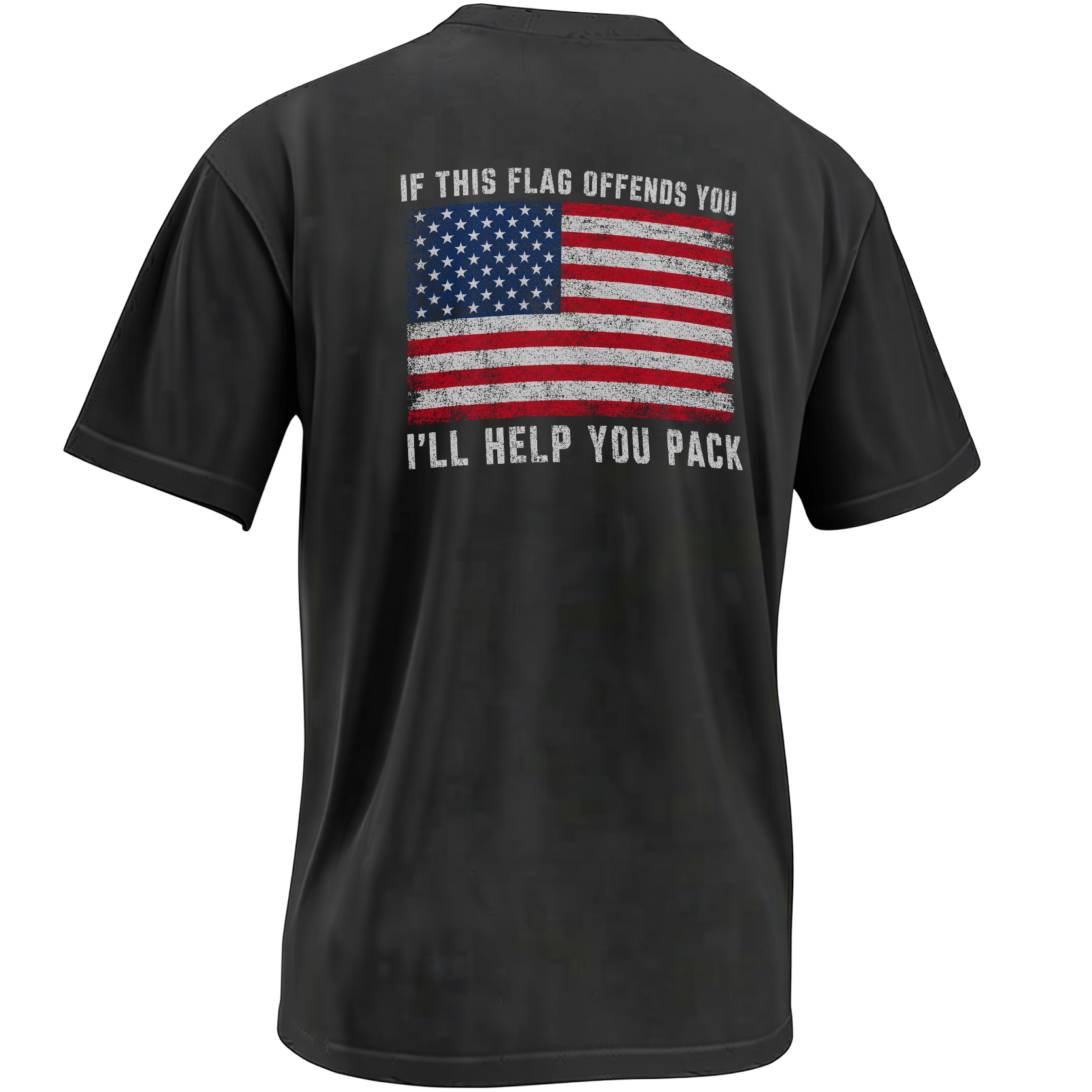
If This Flag Offends You, I’ll Help You Pack
The worn flag, block typography and mock-helpful punch line preserve a specific style of American patriotism: direct, defensive and designed to start the conversation before the wearer says a word.
View the graphic →The Flag Code question is more complicated than a meme
Discussions about flag apparel often produce a familiar counterargument: doesn’t the U.S. Flag Code say the flag should never be used as wearing apparel? Title 4, Section 8 does contain that language.
But online arguments frequently collapse two different things: making clothing from an actual flag and printing a flag representation on clothing. The design shown here is a graphic depiction, not a physical flag cut and sewn into a garment. The Flag Code sets standards of respect; invoking one isolated sentence does not automatically settle every question involving patriotic imagery on apparel.
This article interprets the slogan and its cultural context. It does not claim that criticism of the United States is “offense” at the flag, nor that any political group owns the meaning of American patriotism.
Why the slogan matters after the fireworks
Anniversary celebrations create a temporary impression of consensus. The flags come out, public ceremonies repeat shared language and national history is compressed into recognizable symbols. The harder question begins afterward: can those symbols hold pride and critique at the same time?
For supporters, this design preserves the refusal to surrender the flag as a positive emblem. For critics, it reveals the exclusionary edge that patriotic language can acquire. Its cultural relevance comes precisely from that disagreement. The graphic is a snapshot of a country still trying to decide whether patriotism is an inheritance, an achievement, a demand or an ongoing argument.
That debate continues across Ellie Shirt’s political graphics archive, where slogans document how national identity becomes wearable language. The broader newest designs collection captures the faster cycle through which current arguments become visual artifacts.
Reporting and primary sources
Frequently asked questions
What does “If This Flag Offends You, I’ll Help You Pack” mean?
It is a confrontational patriotic slogan. Supporters generally use it to reject shame about displaying the American flag; critics see it as implying that dissent or discomfort makes someone less American.
Why was the slogan especially relevant in 2026?
The United States marked the 250th anniversary of the Declaration of Independence in 2026 while new polling showed both declining national pride and continued belief that the flag can be a unifying symbol.
Does the U.S. Flag Code prohibit every flag image on a shirt?
The Flag Code says the flag should not be used as wearing apparel, but discussions commonly distinguish an actual flag used as garment material from a printed representation of a flag. The featured design is a graphic depiction.
Why does the design use a distressed flag?
The worn texture gives the image an archival, workwear character. It makes the graphic feel weathered and inherited, reinforcing the slogan’s claim to durable, unapologetic patriotism.
If This Flag Offends You I’ll Help You Pack Shirt pairs a distressed American flag with one of patriotic apparel’s bluntest slogans, capturing the tension between national pride, dissent and belonging during America’s 250th-anniversary year.