Dirty Water on Repeat
Fifteen consecutive wins carried Boston from eleven games below .500 into a Wild Card place—and made one familiar Fenway victory song sound newly impossible.
The final out of Boston’s fifteenth straight victory traveled from the hole at shortstop, bounced once and settled into Willson Contreras’ glove. Fenway Park released the sound it had been saving, and the 2026 Red Sox arrived beside the 1946 team in franchise history.
The 6–3 win over Baltimore in the opening game of a July 22 doubleheader did not establish a new club record. It tied the existing one: 15 consecutive victories, a mark that had stood for 80 years. The Orioles won the nightcap 5–1, ending Boston’s attempt to claim a sixteenth.
Yet the streak had already changed the season. Boston began it on July 3 at 11 games under .500 and used those two-and-a-half weeks to move into postseason position. A summer that had looked pointed toward selling at the Trade Deadline suddenly demanded a completely different conversation.
“Dirty Water” did not merely play after wins during this run. It became the soundtrack of a season repeatedly refusing to end.
How Fifteen Wins Reversed the Meaning of 2026
On June 24, the Red Sox left Colorado with a 32–46 record, last place in the American League East and a six-game deficit in the Wild Card race. The problem was not simply the standings. Injuries and inconsistency had made the season feel structurally broken.
Then the club began stacking the kind of victories that make a long streak feel narratively coherent even when the details change. Some nights were powered by clean pitching. Others required late contact, defensive plays or a hitter solving one decisive pitch. By the time the number reached double digits, every close inning carried the pressure of protecting a shared object.
The streak ran from July 3 through July 22. Boston swept a nine-game road trip before the All-Star break, returned to Fenway and swept the first-place Tampa Bay Rays in four games, then kept moving against Baltimore. MLB noted that only seven other teams in the Expansion Era had produced a winning streak of at least 15 games.
Why “Dirty Water” Was the Only Possible Headline
The Standells released “Dirty Water” in the 1960s, but its identity inside Fenway Park was created decades later. The Red Sox’s own historical archive traces the tradition to the 1998 home opener, when the song played as Mo Vaughn circled the bases after a walk-off grand slam. It remains the music heard after every Red Sox home victory.
That ritual turns the song into a compact emotional signal. The opening guitar does not need to summarize the box score. It tells the crowd that the difficult part is finished and the night now belongs to Boston.
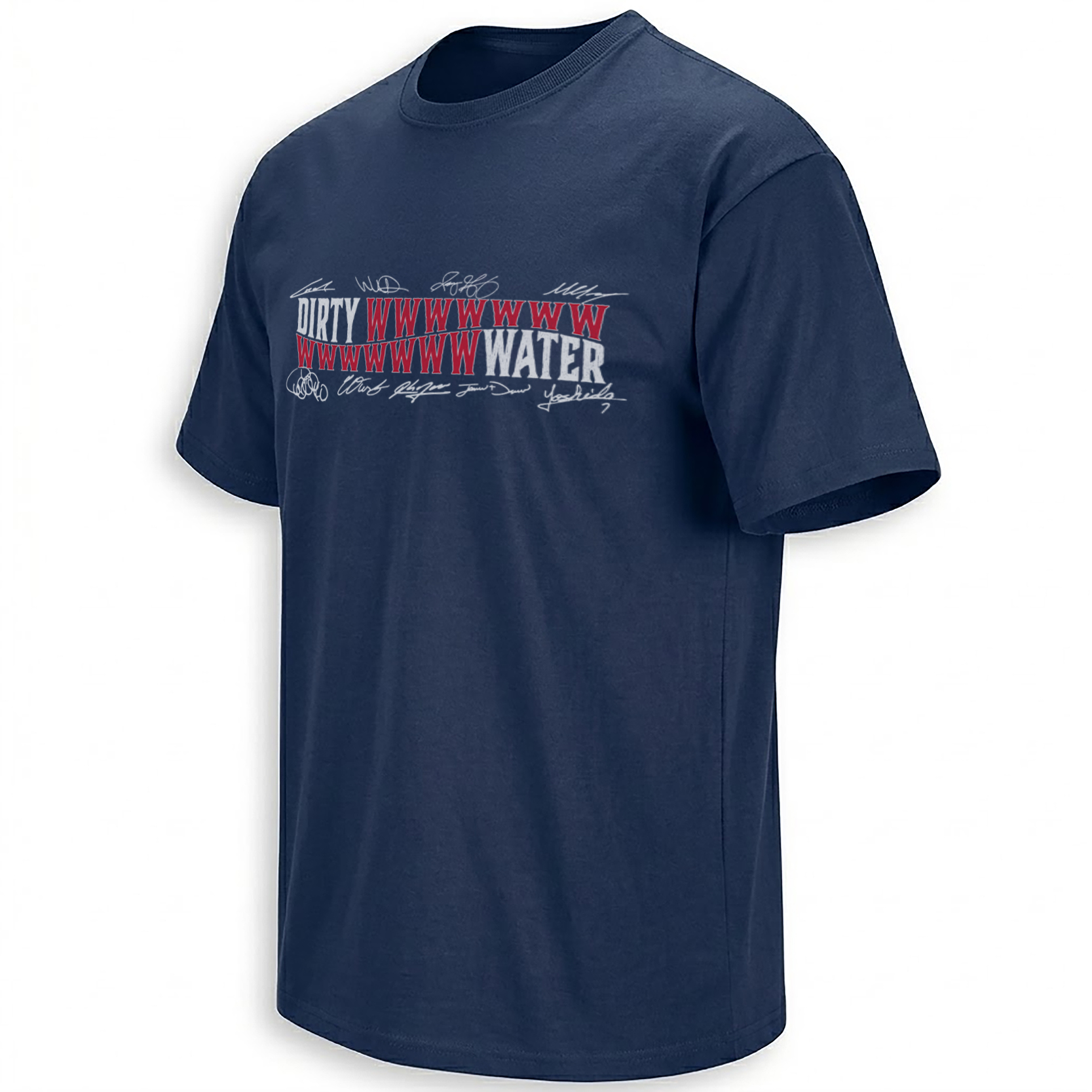
The exaggerated run of W’s in the graphic transforms “Dirty Water” into “Dirty WWWWWWWWWWWWWWWater.” It is a typographic scorecard: one letter for each victory, inserted directly into the city’s familiar postgame language.
During a normal season, “Dirty Water” marks one home win. During a 15-game streak, repetition becomes the story. The song returns, the W column grows and a tradition that fans already know acquires a new layer tied to one precise July.
The 1946 Comparison—and the Difference
The first Red Sox team to win 15 straight was already built like a powerhouse. The 1946 club, led by Ted Williams, won the American League pennant and carried a 104–50 record into a seven-game World Series loss to St. Louis.
The 2026 team reached the same streak from the opposite emotional direction. It did not begin July as the obvious force in its league. It began the run trying to rescue relevance. That contrast explains why the number felt so dramatic: every win did double work, adding to history while repairing the present.
Interim manager Chad Tracy also occupied unusual historical territory. According to MLB and Elias, the only managers whose teams produced longer streaks in a season they did not begin as manager dated to the nineteenth century. That fact underlined how little about Boston’s path followed the shape of a normal contender.
What Remained After the Streak Ended
A winning streak eventually creates the illusion that the next victory is owed. Baseball corrects that feeling quickly. Baltimore scored four runs in the first inning of the nightcap, and Boston never completed the comeback Fenway had begun to expect.
The reaction after the loss revealed the larger value of the run. The crowd stayed engaged, and the clubhouse message centered on pride rather than collapse. Willson Contreras reminded teammates that tying a record from 1946 was history, even if defeat arrived a few hours later.
At 52–49 after the doubleheader, Boston held the third American League Wild Card position by two games, according to MLB’s July 23 report. The team had gone 20–3 since June 25 and changed the front office’s approach to the August 3 Trade Deadline from a likely sale into a possible opportunity to add.
That is the real legacy available to the streak. Fifteen wins can become an isolated wonder, or they can become the stretch that made the rest of the season possible. The 2026 Red Sox left July 22 with the record tied and the larger answer still unwritten.
The Graphic as a Fenway Summer Timestamp
The design avoids a roster collage or a long list of scores. Instead, it modifies a piece of Boston language fans can identify instantly. The elongated word creates its own rhythm: every W looks like another night survived, another final out and another return of the song.
That economy is what makes the graphic useful as an artifact. “15-game winning streak” provides the fact. “Dirty Water” supplies the city, the ballpark and the feeling. Together they preserve the moment when a team that had been written off kept winning long enough to stand next to 1946.
View the Dirty Water 15-Game Win Streak design, continue through the Boston Red Sox collection, or place the run inside the wider MLB collection.
Frequently Asked Questions
How many straight games did the 2026 Boston Red Sox win?
Boston won 15 consecutive games from July 3 through July 22, 2026, tying the longest winning streak in Red Sox history.
Did the 2026 Red Sox set a new franchise winning-streak record?
No. They tied the 15-game record established by the 1946 Red Sox. Baltimore won the second game of the July 22 doubleheader, preventing Boston from reaching 16.
Who did Boston beat for its fifteenth consecutive win?
The Red Sox defeated the Baltimore Orioles 6–3 in the first game of a July 22 doubleheader at Fenway Park.
Why is “Dirty Water” connected to the Red Sox?
The Standells’ song became a Fenway Park victory tradition after being played during the 1998 home opener. The Red Sox continue to play it after home wins.
What does the long run of W’s in “Dirty Water” mean?
The fifteen W letters represent the fifteen consecutive Red Sox victories, turning the name of Fenway’s victory song into a typographic record of the streak.
Dirty Water 15-Game Win Streak Shirt turns fifteen W’s into a Fenway timestamp for the Red Sox’s July 3–22, 2026 run that tied the franchise record set in 1946.