Rewrite Your Own Destiny
Raven Queen’s defining conflict still feels unusually modern: what happens when the story everyone expects from you is the one story you cannot accept?
Ever After High begins with a premise that sounds playful and becomes serious almost immediately: the children of famous fairy-tale characters are expected to inherit not only their parents’ names, but their endings.
Raven Queen is assigned the most uncomfortable version of that inheritance. As the daughter of the Evil Queen, she is supposed to grow into the villain in Apple White’s future story. The school calls this destiny. Raven recognizes it as a demand to become someone she is not.
That refusal turned Raven into the emotional center of the franchise and separated Ever After High from a simple collection of fairy-tale makeovers. The Royal-versus-Rebel divide was really an argument about consent, family expectation and whether tradition deserves obedience merely because it is old.
A fairy tale becomes personal the moment its character is allowed to ask: “What if I do not want this ending?”
Why Raven Queen’s Choice Still Lands
Raven is compelling because she does not reject her destiny in search of power. She rejects it because the assigned role conflicts with her character. She is compassionate, loyal and uncomfortable with the harm her inherited story would require. Her rebellion begins as an ethical decision before it becomes a school-wide movement.
That detail matters to viewers returning to Ever After High years after its 2013 debut. As children, fans could read the story as a dramatic rivalry between beautifully styled Royals and Rebels. As adults, the same conflict resembles more familiar pressures: family scripts, career expectations, labels inherited before a person is old enough to question them and the fear that choosing differently may disappoint people one loves.
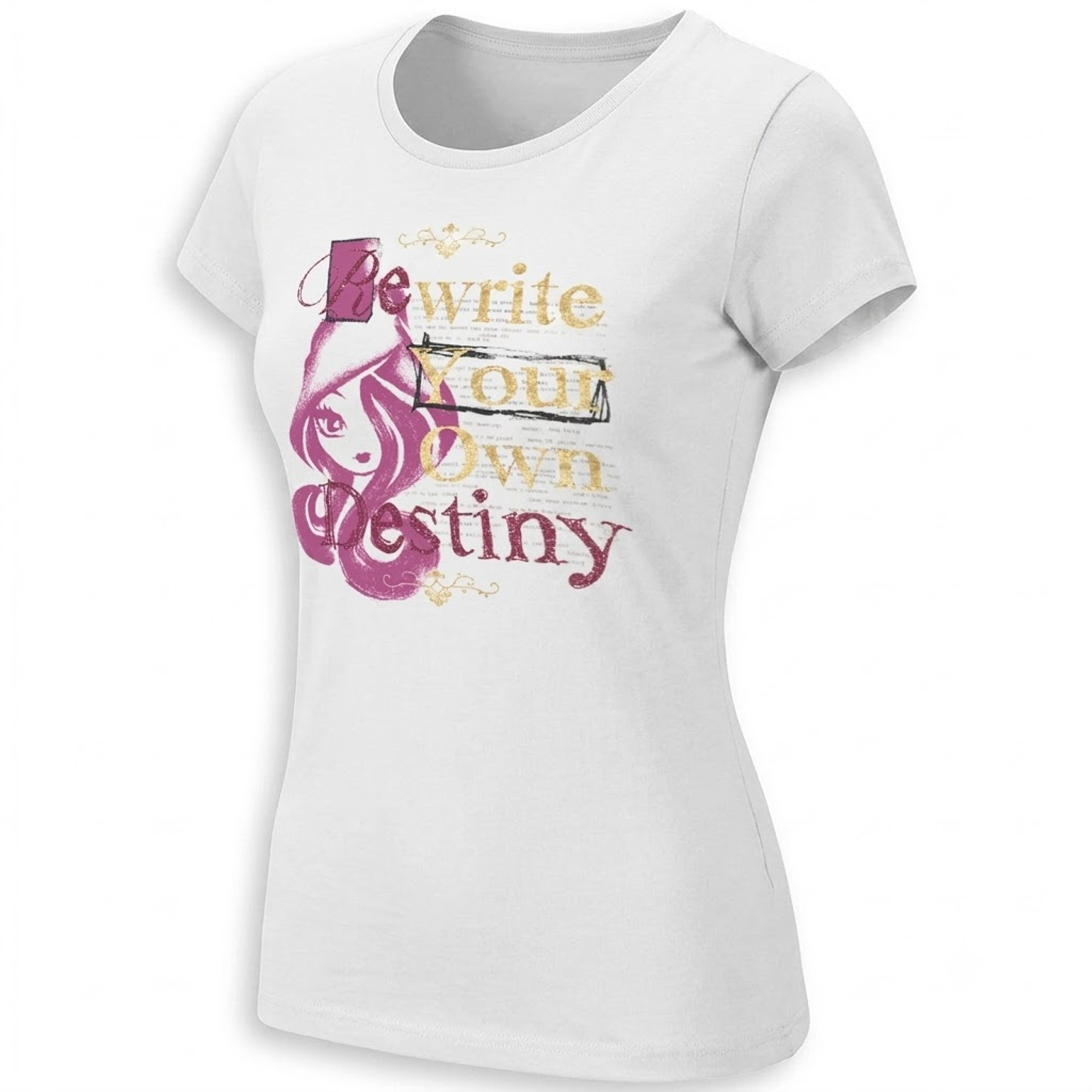
The official “Raven’s Tale” language asks whether the future is fate or destiny waiting to be rewritten. That question gives “Rewrite Your Own Destiny” its lasting force. It is not generic motivational copy pasted onto Raven Queen. It condenses the central problem around which her entire story was built.
The Design as a Rebel-Era Memory Object
Ever After High’s visual language always balanced antique storybook ornament with modern fashion-doll attitude. Raven’s palette—black, purple, silver and jewel-toned shadows—made that combination especially clear. She could belong to an old enchanted kingdom while still reading as the sharpest contemporary figure in the room.
The “Rewrite Your Own Destiny” graphic uses Raven as the face of that contradiction. The character imagery provides the nostalgia, while the phrase moves the design into the present tense. Fans are not only remembering a favorite Rebel; they are carrying forward the idea that made her matter.
Why Ever After High Nostalgia Feels Different
Nostalgia for a toy-and-animation franchise often begins with surface detail: elaborate dolls, character themes, theme songs, webisodes and the excitement of discovering a new release. Ever After High certainly offers all of that. Its silhouettes, color stories and pun-filled names remain immediately recognizable.
Yet the fandom’s continued discussion also returns to the writing. Fans still debate whether the Royals understood the cost of preserving the stories, whether Apple White’s fear made her sympathetic, and what Raven’s refusal meant for students whose destinies contained suffering. Those debates survive because the series declined to make its central dilemma entirely easy.
Raven’s choice threatened the system that protected Apple’s expected future. Apple’s anxiety, in turn, showed why people can cling to a harmful structure when they believe their existence depends upon it. Ever After High wrapped that tension in glitter, crowns and enchanted mirrors, but the underlying argument respected its audience.
From “Rebel” Label to Personal Philosophy
The strongest character slogans become useful outside their original fiction. “Rewrite Your Own Destiny” works that way because it does not require a literal enchanted book. Destiny can be the family profession someone is expected to enter, the personality others have assigned to them or the old version of themselves they no longer want to perform.
Raven’s example does not promise that rewriting will be easy. Her decision creates uncertainty and conflict. That is precisely why it avoids feeling hollow: authorship has consequences, but following a script one believes is wrong has consequences too.
In that sense, the design functions as a quiet badge for people who recognized themselves in the Rebels. It keeps the ornate Ever After High aesthetic, but its real subject is self-definition.
View the Rewrite Your Own Destiny Raven Queen design or follow the latest additions inside Ellie Shirt Newest, where current fandom, nostalgia and internet culture continue to become visual artifacts.
Frequently Asked Questions
Who is Raven Queen in Ever After High?
Raven Queen is the daughter of the Evil Queen and the reluctant leader of the Rebels. She rejects the expectation that she must inherit her mother’s villainous role.
What does “Rewrite Your Own Destiny” mean in Ever After High?
It expresses the Rebel belief that students should be able to choose their own futures instead of automatically reenacting the fairy-tale roles assigned by their families.
Why does Raven refuse her destiny?
Raven does not want to become evil or harm others simply to preserve a traditional story. Her refusal grows from the conflict between her compassionate nature and the villainous role expected of her.
What is the difference between Royals and Rebels?
Royals generally support following inherited fairy-tale destinies, while Rebels defend the right to choose a different story. The series also shows that characters on both sides have complicated reasons for their positions.
Why does Raven Queen still resonate with nostalgic fans?
Her story combines a distinctive gothic fairy-tale aesthetic with a lasting question about family expectations, consent and the right to define oneself.
Rewrite Your Own Destiny Shirt revisits Raven Queen’s defining Ever After High choice through Rebel-era imagery, dark fairy-tale color and a message about refusing an inherited ending.