Can Someone Please Just Put a Woman in Charge?
Lady Liberty has spent more than a century holding the torch. This design asks what might happen if America finally let her lead.
“Can someone please just put a woman in charge?” is written like a casual request, but its emotional register is much larger: frustration with familiar leadership, impatience with unequal representation and hope that a different voice might change the direction of the room.
The sentence does not identify a candidate, party, election or office. Instead, it presents female leadership as a broad cultural proposition—one that can apply to government, business, education, community organizations and any institution in which authority has historically been concentrated elsewhere.
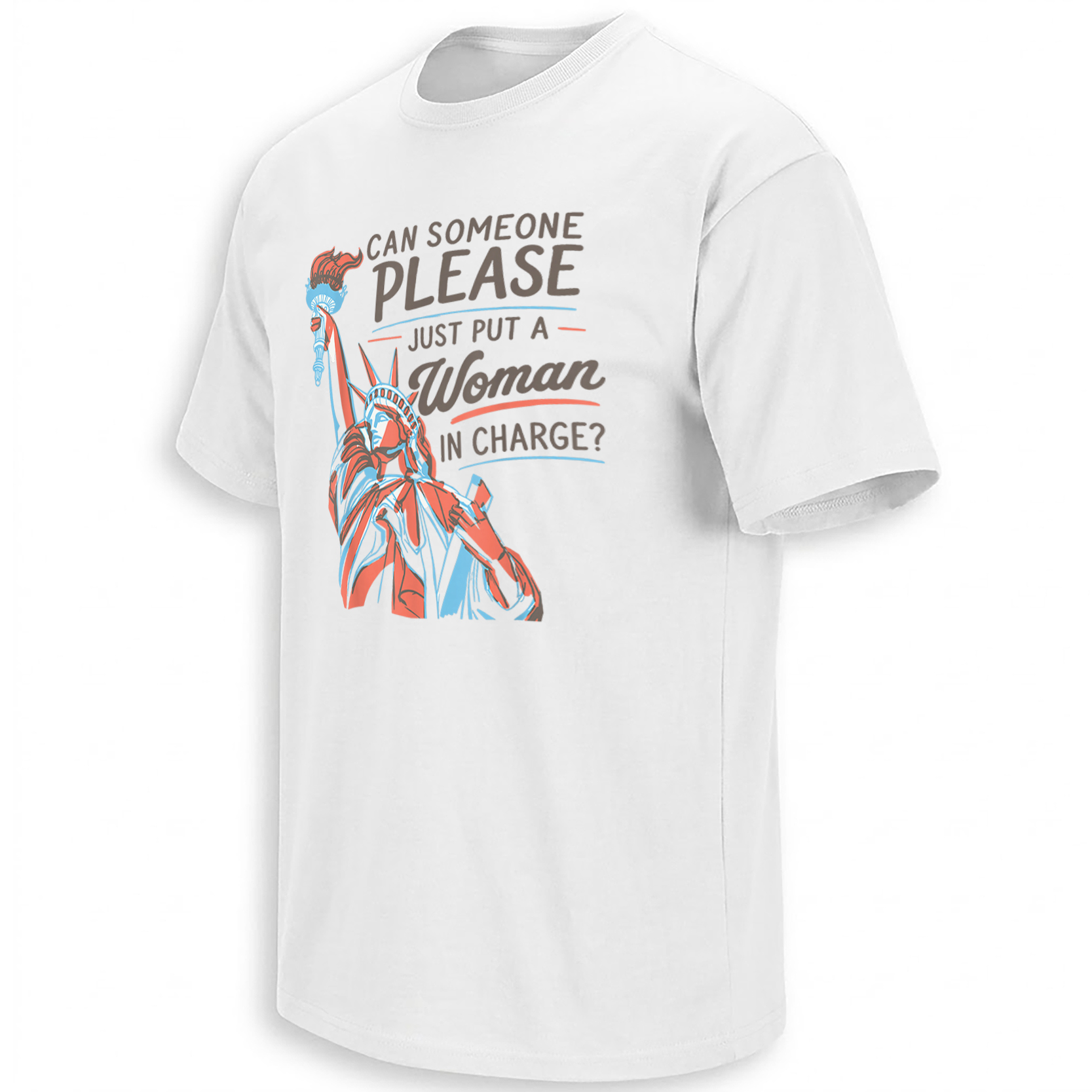
Placing the Statue of Liberty beneath that request gives the joke its visual argument. America already possesses one of the world’s most recognizable female political symbols. She stands at the nation’s entrance, holds its torch and represents its highest promises. The artwork simply asks why a woman so trusted as a symbol can still feel exceptional as a leader.
Lady Liberty has always carried the torch. The question is whether the country is ready to follow her. The central contradiction behind the design
Why the word “please” matters
Without “please,” the phrase could read as a direct command: put a woman in charge. Adding the word changes its personality. It sounds polite, weary and almost disbelieving that the request still needs to be made.
That combination of courtesy and exasperation is familiar in political humor. The speaker is not presenting a detailed platform. They are reacting to repetition—the feeling that the public keeps encountering the same arguments, personalities and institutional failures while an obvious alternative remains underused.
The small word “just” performs a similar function. It frames female leadership not as a radical experiment but as the straightforward option that somehow keeps being postponed.
Lady Liberty becomes more than decoration
The Statue of Liberty ordinarily appears as a national emblem rather than an individual actor. She welcomes, illuminates and symbolizes, but she does not speak.
This design quietly changes her role. Her raised torch begins to resemble a gesture of readiness. The crown, robe and monumental pose supply authority, while the text above her translates that authority into a contemporary question about women and power.
The visual pairing also exposes an enduring contradiction in political imagery. Nations often personify liberty, justice, victory and democracy as women while real women continue to face disproportionate barriers when seeking formal authority.
The artwork does not need to resolve that contradiction. It makes the contradiction visible and lets a familiar national figure carry the argument.
 The cultural artifact
Stacked lettering, handwritten emphasis and red-blue offset linework transform Lady Liberty into the central figure of a vintage-inspired feminist leadership poster.
The cultural artifact
Stacked lettering, handwritten emphasis and red-blue offset linework transform Lady Liberty into the central figure of a vintage-inspired feminist leadership poster.
A feminist message without a named candidate
Political merchandise is frequently tied to a person, campaign year or electoral outcome. That specificity can generate immediate energy, but it can also cause the message to expire with the campaign.
“Put a woman in charge” works differently. It advocates for a change in the cultural understanding of leadership without restricting that change to one politician.
A viewer may interpret the line as support for a woman president, but the wording never says “president.” The same statement can be carried into a workplace led by women, a classroom developing future leaders or a community attempting to distribute decision-making more equitably.
That openness also prevents the design from claiming that all women share one ideology. Its argument is about access to authority and the normalization of women as leaders—not automatic agreement with every woman who holds power.
How the typography stages the argument
The lettering creates a hierarchy before the complete sentence has been read. “Please” receives enlarged condensed capitals, visually amplifying the appeal. “Woman” shifts into flowing script and becomes the composition’s most personal word.
That script does not weaken the message. It interrupts the harder campaign-style lettering and prevents masculinity-coded typography from becoming the only available visual language for authority.
Red and pale blue outlines surround Lady Liberty with a deliberately imperfect offset effect. The colors evoke American political posters, but their softened tones avoid the polished appearance of official campaign branding.
On white and sand garments, the faded palette resembles an artifact from an earlier movement that has been rediscovered because its demand remains unfinished.
The statement broadly supports women’s leadership. It does not name a political party, endorse a particular candidate or claim that gender alone determines whether someone will govern well.
From symbolic womanhood to actual authority
Public culture is comfortable placing idealized women on monuments, seals, paintings and patriotic posters. Symbolic women can represent courage or justice without competing for a budget, casting a vote or challenging an established hierarchy.
Actual leadership is more demanding because it transfers decision-making power. The design’s humor emerges from treating that transfer as remarkably simple: if familiar systems are not producing the desired result, let someone else take charge.
Yet the word “someone” also acknowledges that representation requires participation. Leaders are not installed by slogans alone. They emerge through recruitment, mentorship, funding, elections, appointments and a willingness to recognize authority when it arrives in a form institutions have historically overlooked.
The Can Someone Please Just Put a Woman in Charge Shirt preserves that larger argument as one visually immediate question carried by America’s most recognizable woman.
More verified women’s rights, equality and empowerment designs can be explored through Ellie Shirt’s Feminist collection.
Woman in charge phrase FAQ
What does “Can someone please just put a woman in charge?” mean?
It expresses support for women receiving greater leadership opportunities while humorously suggesting that female leadership may offer a needed change from familiar systems.
Is the phrase specifically about electing a woman president?
It can be interpreted that way, but the artwork does not name the presidency. Its wording also applies to women leading workplaces, schools, organizations and communities.
Why does the design feature the Statue of Liberty?
Lady Liberty is an internationally recognizable female symbol of freedom, hope and democracy, making her a fitting figure for a statement about women’s leadership.
Does the shirt endorse a political candidate or party?
No. It contains no candidate name, party label, campaign logo or election year.
Why is “Woman” written in script?
The change in lettering makes “Woman” the visual center of the sentence and introduces a more personal, human quality into the political-poster composition.
What do the red and blue outlines represent?
They create a patriotic palette and a vintage offset-print effect associated with American campaign posters and editorial graphics.
Where can readers find more feminist designs?
Additional women’s empowerment and equality designs are available at https://ellieshirt.com/collections/feminist/.
See the Lady Liberty feminist leadership design that turns political exhaustion into one hopeful public request.
A feminist political statement that transforms Lady Liberty from a national symbol into a compelling visual argument for women’s leadership.