The 10’s Are Back
John Mateer commands the offense. Kip Lewis organizes the defense. Their shared number turns two returning seniors into one compact statement about Oklahoma’s unfinished 2026 mission.
A college football roster can carry the same jersey number twice as long as those players do not occupy the field together. Oklahoma’s 2026 roster turns that administrative detail into something much more compelling: number 10 belongs to the quarterback and the linebacker, the offensive leader and the defensive leader.
John Mateer and Kip Lewis stand on opposite sides of the ball, but their returns give the Sooners a shared structure. Mateer is responsible for directing Oklahoma toward the end zone. Lewis is responsible for preventing opponents from reaching it.
“The 10’s Are Back” compresses that symmetry into four words. The phrase celebrates two returning redshirt seniors while also acknowledging the larger reason their presence matters: Oklahoma enters 2026 with experienced leaders capable of defining both halves of a football game.
One number carries the ball. The other hunts it. Together, the two 10s give Oklahoma a leader on either side of the line.
Why Oklahoma can have two number 10s
College football teams frequently assign the same number to one offensive player and one defensive player. Because Mateer and Lewis normally participate in different units, the shared number can function without creating confusion during a standard play.
Oklahoma’s official 2026 roster lists both players at number 10. Mateer is a 6-foot-1, 224-pound redshirt senior quarterback. Lewis is a 6-foot-1, 226-pound redshirt senior linebacker.
Their near-matching listed dimensions make the parallel even cleaner, but their jobs could hardly be more different. One reads coverages before the snap and distributes the football. The other diagnoses formations, attacks gaps and closes space after the snap.
Mateer returns with something to repair
Mateer’s 2025 season cannot be understood through one uncomplicated label. Oklahoma won ten games and reached the College Football Playoff, but the quarterback’s individual path was altered by a broken thumb suffered against Auburn on September 20.
He underwent surgery and returned quickly, demonstrating the competitiveness that helped make him an immediate Oklahoma leader after transferring from Washington State. The early comeback also meant attempting to manage SEC defenses while his throwing hand remained part of the story.
Mateer finished the season with 2,885 passing yards, 14 touchdown passes and 11 interceptions. He added 431 rushing yards and a team-leading eight rushing touchdowns, preserving the dual-threat dimension that makes him difficult to defend even when the passing game loses rhythm.
His most encouraging late-season evidence arrived in the College Football Playoff loss to Alabama, when he threw for 307 yards and two touchdowns. The result ended Oklahoma’s season, but it also left Mateer with a direct view of the level the Sooners must reach.
Rather than enter the NFL Draft, he returned for his redshirt senior season. At 2026 SEC Media Days, Mateer discussed adjustments to his throwing motion and a renewed emphasis on team goals. “The 10’s Are Back” therefore does not celebrate an untouched hero. It celebrates a quarterback returning after difficulty with the opportunity to write a stronger ending.
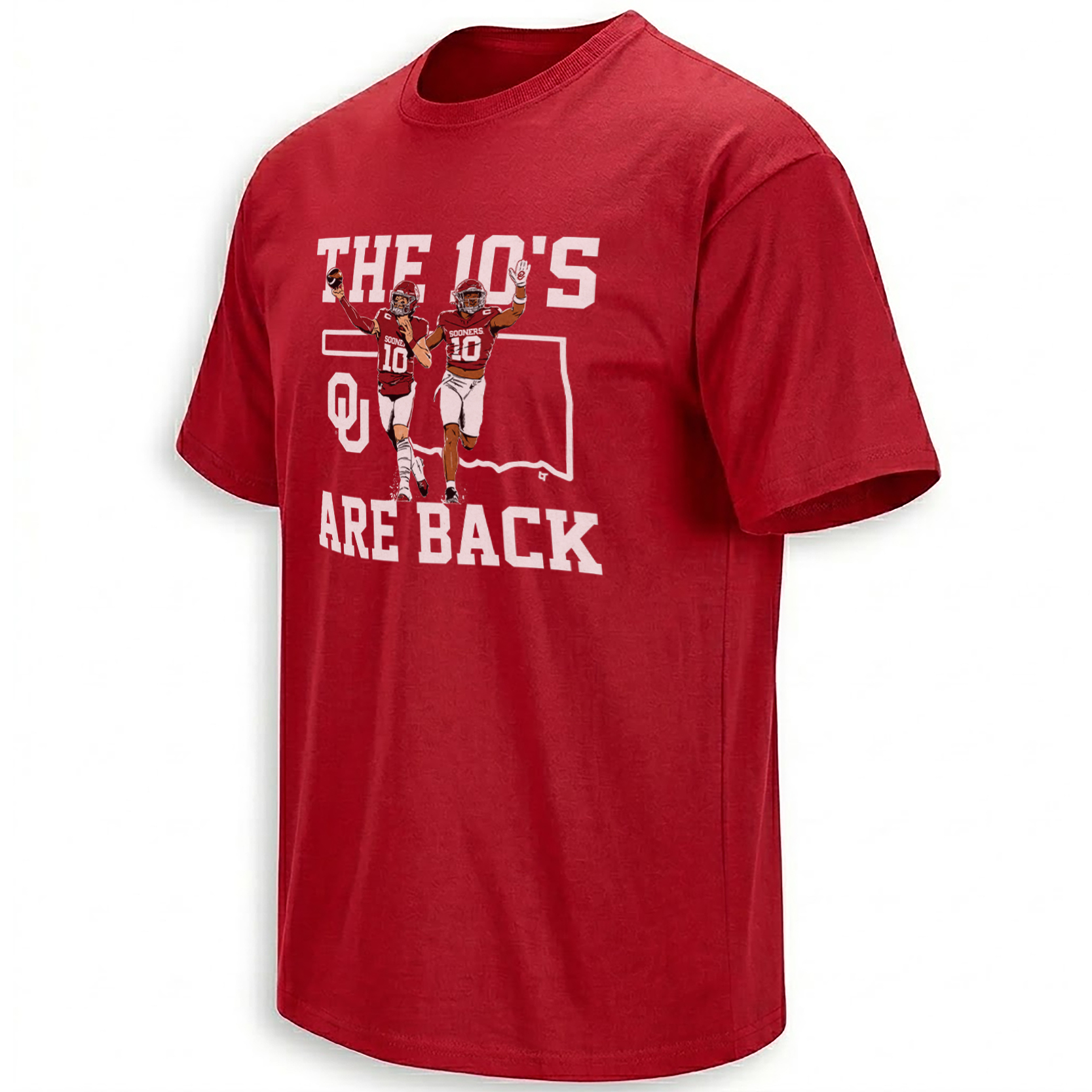 10×2
Oklahoma’s offensive and defensive leaders share the frame
Two crimson number 10 uniforms run forward across the outline of Oklahoma, transforming a duplicated jersey number into a statewide return statement.
10×2
Oklahoma’s offensive and defensive leaders share the frame
Two crimson number 10 uniforms run forward across the outline of Oklahoma, transforming a duplicated jersey number into a statewide return statement.
Lewis gives the defense an experienced center
Kip Lewis’ value begins with familiarity. He has developed inside Oklahoma’s program rather than arriving for one short chapter, progressing from a highly regarded Carthage, Texas, recruit into a veteran presence in the middle of the Sooners’ defense.
Linebacker play in Brent Venables’ system involves more than pursuing the football. The position must process formations, communicate adjustments, recognize run-pass conflicts and arrive with enough control to finish the play.
Lewis provides that combination of experience and physical urgency. His ability to close downhill gives Oklahoma a defender who can turn recognition into contact, while his accumulated snaps allow younger teammates to operate beside someone who understands how the structure is intended to fit together.
A returning quarterback is naturally visible because every offensive snap begins in his hands. A returning linebacker can be equally important for the opposite reason: he helps ensure that eleven defenders begin the snap with the same understanding.
Two returns change the emotional shape of 2026
Oklahoma’s 2025 season established a foundation without producing the ending the program wanted. The Sooners defeated ranked opponents, reached ten victories and earned a playoff place before Alabama eliminated them in the opening round.
Returning veterans allow the program to frame 2026 as a continuation rather than a reset. Mateer and Lewis remember the climb, the pressure of the SEC schedule and the abruptness of the postseason exit. Younger players do not need those experiences described hypothetically; the two number 10s carried them onto the next roster.
That continuity is especially valuable at quarterback and linebacker. Both positions sit near the intellectual center of their units. Each player receives information, communicates it and must make a decisive response while the formation changes around him.
Their leadership also has a public dimension. Mateer’s decision to return prevented Oklahoma from entering another offseason quarterback search. Lewis’ return retained an established defensive voice. Together, their choices told supporters that the preceding season was not viewed as a completed destination.
Oklahoma’s new season has not begun as of this article’s July 22 publication. The Sooners are scheduled to open against UTEP on Friday, September 4, so the artwork records preseason expectation rather than claiming a completed 2026 result.
How the design turns roster information into folklore
The artwork begins with oversized white lettering: “THE 10’S.” Its collegiate block style resembles stadium signage and establishes the duplicated number before the players are fully examined.
Mateer and Lewis then run forward in matching crimson uniforms. One raises a football, signaling possession and offensive creation. The other raises a hand, supplying the visual counterweight and presenting the pair as co-leaders rather than one star with a supporting figure.
Behind them sits the outline of Oklahoma. That element expands the message beyond two individuals. Their return is represented as something belonging to Norman, the university and the wider state identity surrounding Sooners football.
The interlocking OU mark occupies the left side while “ARE BACK” closes the composition beneath the players. The hierarchy reads almost like a stadium announcement: recognize the number, identify the program and understand the news.
Crimson fabric completes the effect. The limited red-and-white palette rejects unnecessary detail and makes the piece immediately legible as an Oklahoma football artifact even from a distance.
Why “back” carries more weight than “returning”
“Returning” is administrative language. It belongs to roster releases and eligibility discussions. “Back” is emotional language. It suggests that something important was missing, threatened or unfinished and has now been restored.
For Mateer, “back” can refer to physical recovery, another season in Norman and the chance to respond to the difficult middle of 2025. For Lewis, it describes the preservation of a defensive identity that could have lost one of its veteran anchors.
Placed in the plural, “The 10’s Are Back” prevents either player from owning the phrase alone. Oklahoma supporters are asked to see the pair: the player attempting to finish drives and the player attempting to end them.
The The 10’s Are Back Shirt captures this specific preseason moment, when Oklahoma can still imagine a complete season shaped by the experience and complementary leadership of both number 10s.
More Norman-inspired designs are available through the full Oklahoma Sooners collection. This piece stands apart because it uses one number to explain two sides of the team and one shared reason for optimism.
Understanding Oklahoma’s two number 10s
Who are “The 10’s” on the Oklahoma shirt?
The phrase refers to John Mateer and Kip Lewis. Oklahoma’s official 2026 roster lists Mateer as a number 10 quarterback and Lewis as a number 10 linebacker.
How can two Oklahoma players wear number 10?
College football teams can assign the same number to different players. Mateer plays offense and Lewis plays defense, so they ordinarily do not participate in the same play.
Is John Mateer returning to Oklahoma in 2026?
Yes. Mateer returned for his redshirt senior season after starting 12 games, helping Oklahoma reach the 2025 College Football Playoff and playing part of the year after suffering a broken thumb.
What positions do Mateer and Lewis play?
Mateer is Oklahoma’s dual-threat quarterback. Lewis is a linebacker and experienced defensive leader.
When does Oklahoma begin the 2026 season?
Oklahoma is scheduled to open its 2026 season at home against UTEP on Friday, September 4.
Where can fans find more Oklahoma Sooners designs?
Additional designs are available at https://ellieshirt.com/collections/ncaa/oklahoma-sooners/.
The dual-number artwork preserves Oklahoma’s 2026 preseason promise: Mateer moving the offense, Lewis controlling the defense and number 10 returning everywhere the Sooners need leadership.
John Mateer and Kip Lewis turn one shared jersey number into Oklahoma’s defining 2026 partnership—number 10 directing the offense, number 10 leading the defense and both returning with unfinished work.