
Life Is Stressful. Take This. The cigarette-pack meme that delivers its worst possible solution with a perfectly straight face
A hand enters the frame like a video-game helper offering an essential item. What it provides is neither medicine nor wisdom, but a packet of cigarettes—and the entire joke lives inside that deliberately terrible exchange.
The Meme Begins Like an Act of Kindness
“Life is stressful” sounds unusually sincere for an internet joke. “Take this” sounds helpful. The image between those statements transforms apparent concern into deadpan sabotage.
The basic construction is almost childishly simple. One line identifies a universal problem. A hand extends an object as though someone has arrived with the solution. The second line asks the viewer to accept it.
If that object were a cup of tea, a vacation ticket or a reassuring note, the composition would be sentimental. Instead, the hand holds a cigarette pack. The offer is culturally recognizable as a temporary escape while being medically indefensible as stress treatment.
That contradiction creates the punchline. The image does not need a character, setting or extended caption. It merely presents terrible advice using the calm visual grammar of a helpful gift.
The hand looks like it has brought a cure. The cigarette pack reveals that it has only brought the next problem.
“Take This” Uses the Language of Games and Survival Stories
In games, fantasy narratives and adventure stories, an outstretched hand often signals assistance. A guide gives the protagonist a weapon, key, potion or tool required for the next stage.
“Take this” has therefore become a miniature storytelling command. It implies urgency, usefulness and trust: the giver knows the world is difficult and has selected the object that will help the recipient survive it.
The cigarette disrupts every part of that implication. It is not a solution to the mission. It is the sort of familiar vice people may reach for precisely because the mission feels exhausting.
That makes the meme work even for viewers who do not smoke. Nearly everyone recognizes the broader pattern of answering pressure with something comforting, impulsive or knowingly counterproductive.
The Joke Compresses an Entire Coping Cycle Into Four Words
The phrase succeeds because it omits every intermediate step. There is no discussion about deadlines, bills, relationships, sleep or anxiety. “Life” absorbs all possible causes of stress at once.
The response is equally compressed. No one evaluates the consequences or proposes a long-term plan. The hand simply appears with immediate relief.
Work, money, relationships and daily uncertainty become one universal statement: life is stressful.
The extended hand promises a fast answer without requiring explanation or self-improvement.
The visual depends on the familiar cultural association between smoking, taking a break and calming down.
The supposedly helpful object carries dependence and health consequences of its own.
Why the Stress Claim Is Darker Than It First Appears
The meme borrows from a widespread belief that smoking relieves anxiety. A cigarette can feel calming to a person experiencing nicotine cravings, but that sensation does not turn smoking into an effective response to stress.
The UK National Health Service explains that nicotine withdrawal can produce irritability and anxiety. Smoking temporarily relieves those withdrawal sensations, encouraging people to associate the cigarette with relaxation even though the cycle itself contributes to tension.
That factual contradiction gives the artwork its darker intelligence. The object offered as relief can help sustain the very discomfort that makes the offer appealing.
The outstretched hand presents smoking as a tiny emergency kit for adult life.
The audience recognizes addiction, health risk and temporary relief beneath the apparently generous gesture.
The humor should therefore be read as ironic rather than therapeutic. The design reproduces the language of bad coping advice; it does not make cigarettes safe or medically useful.
Why Cigarette-Pack Imagery Is So Visually Powerful
Cigarette packaging is unusually recognizable from shape and color alone. A small rectangular box, a sharp red field, white space and dark display lettering can evoke decades of tobacco advertising before a viewer processes the details.
That recognition gives the meme speed. The hand does not need to hold a realistically rendered individual cigarette. The packet communicates the entire category—and its cultural baggage—from across the room.
The familiar red-and-white geometry also clashes effectively with the softness of the human hand. One element looks personal and generous. The other looks commercial, standardized and emotionally cold.
Together they create a counterfeit act of care: mass-produced danger delivered as though it were a thoughtful gift.
Two Designs, Two Different Kinds of Deadpan
Ellie Shirt’s two interpretations preserve the same statement but alter the pacing and personality of the joke.
The first version uses bold lettering, a diagonal hand and a partially opened cigarette pack. Its composition feels active, almost like someone has suddenly thrown the proposed solution into the conversation. The cigarette extending from the box makes the invitation more explicit.
The second version is quieter and stranger. Its engraved hand appears to present a closed packet with ceremonial seriousness. Typewriter-style lettering gives the statement the mood of an anonymous note, an old instructional card or a fragment recovered from an especially unhealthy self-help manual.
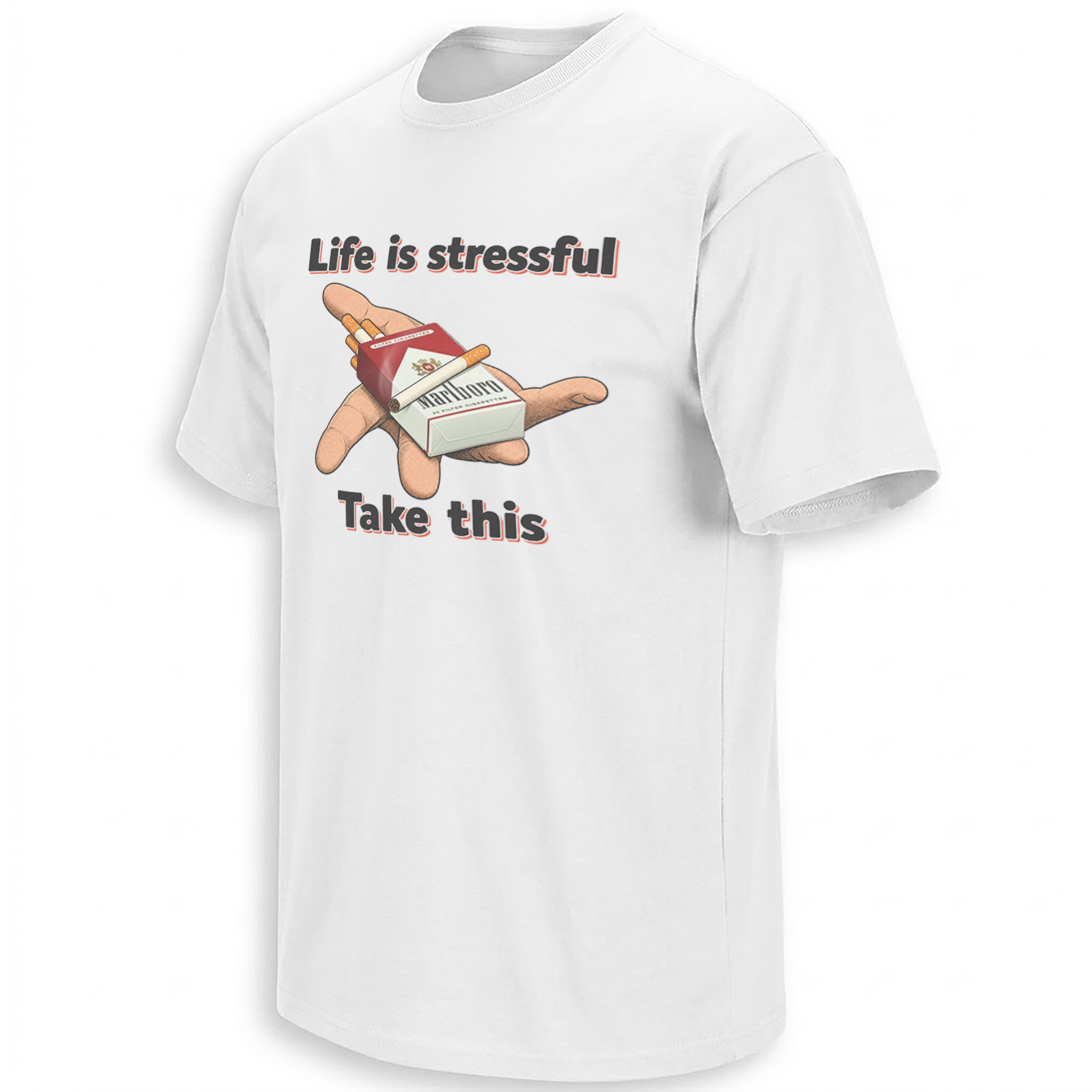
Bold text, an active hand gesture and a visible cigarette turn the design into a direct piece of bad advice.
View the open-pack artifact →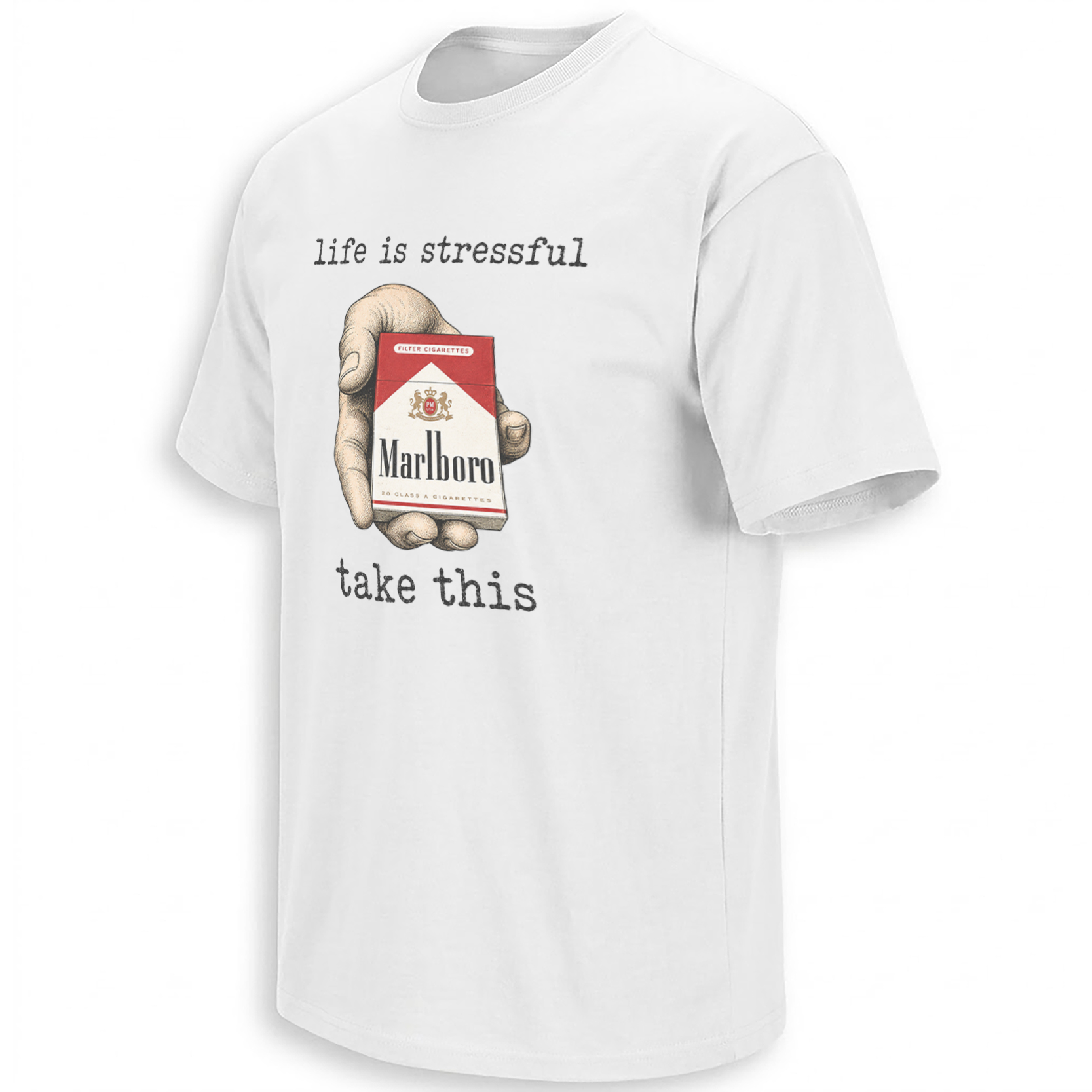
Engraved linework and typewriter lettering make the terrible suggestion look oddly official.
View the vintage-hand artifact →The Open Pack Makes One Version More Confrontational
In the first artwork, the packet is already open and a cigarette is immediately available. There is almost no distance between the advice and the act it proposes.
The typography reinforces that directness. “Life is stressful” occupies the upper register while “Take this” anchors the bottom, forcing the eye through the hand and packet as it moves between the two statements.
The red shadow behind the dark letters connects the wording to the red package. Text and object consequently feel like parts of one loud meme rather than a caption attached to an illustration.
The Vintage Hand Makes the Other Version Feel Uncomfortably Polite
The second design places greater emphasis on the giver. The hand is larger, centrally balanced and drawn with the fine crosshatching associated with vintage advertisements, instruction manuals and old editorial illustrations.
Its pose is patient rather than energetic. The packet rests squarely in the palm as if the viewer is being invited to make a considered decision.
That formality sharpens the absurdity. Something dangerous is not being forced upon the audience; it is being presented with the manners of a host offering a mint.
It Belongs to the Internet’s “Bad Advice” Tradition
Dark reaction memes frequently take an ordinary difficulty and answer it with intentional overreaction. The response may be laziness, avoidance, self-sabotage or a vice presented as if it were practical wisdom.
The audience is not expected to accept the recommendation literally. Recognition is the point. The meme says that adult life can become stressful enough for an obviously flawed shortcut to feel emotionally legible.
This is also why the design travels without requiring a famous person or a specific news event. Stress is evergreen, and the structure can be understood within seconds.
It is not a lifestyle manual. It is a four-word portrait of the moment when self-awareness loses an argument to immediate relief.
No Verified Original Creator Should Be Invented
Variations of the wording and cigarette-offering image have circulated through social platforms and smoking-humor accounts. Searchable Instagram examples show the phrase being discussed as an addiction-cycle meme before Ellie Shirt’s July 2026 designs.
Available evidence does not establish one definitive first post, illustrator or original creator. Reposts, altered captions and visually similar versions make confident attribution unreliable.
The responsible description is therefore modest: this is a circulating internet joke built from recognizable cigarette imagery and an established bad-advice format. The shirts preserve two visual interpretations rather than claiming authorship of the underlying phrase.
These graphics are discussed as dark-humor artifacts, not health advice or smoking promotion. Cigarette smoking is addictive, harms nearly every organ and is a major preventable cause of disease and death.
Why the Meme Works on a Shirt
A social-media post can disclose its punchline instantly because every element appears within the same screen. A shirt introduces physical distance, allowing the joke to arrive in stages.
From across a room, the viewer first catches “Life is stressful,” a line broad enough to resemble motivational clothing. Moving closer reveals the cigarette pack and turns the design into its opposite.
That delayed recognition is valuable in wearable humor. The graphic does not merely display a finished joke; it creates a small moment in which the viewer misreads its emotional intention.
The two versions also offer different personalities. One reads as loud internet humor. The other resembles a strange archival message whose terrible advice has survived several generations.
A Timestamp for Coping-Meme Culture
The lasting subject here is not tobacco branding alone. It is the internet’s habit of translating emotional overload into absurdly compact coping instructions.
Modern feeds are crowded with jokes about burnout, anxiety, bills and the impossibility of keeping up. Many of those jokes avoid a serious answer because the laugh comes from admitting that no simple answer exists.
“Life is stressful. Take this” executes that idea with ruthless economy. It identifies the largest possible problem, offers the smallest possible object and allows the audience to calculate everything that could go wrong.
The hand remains open. Whether the viewer interprets it as temptation, satire, nostalgia or a warning depends on what they bring to the image.
The relationship between smoking, nicotine withdrawal, anxiety and perceived relief was checked against the NHS overview of smoking and mental health and its nicotine-withdrawal guidance. General health-risk language was verified through the CDC’s cigarette-smoking overview. A searchable Instagram discussion of the meme and addiction cycle supports prior circulation but is not treated as proof of original authorship.
Explore More Recently Cataloged Internet Humor
Find new dark-humor graphics, visual punchlines and wearable internet artifacts in Ellie Shirt’s Newest Collection.
“Life Is Stressful, Take This” Meme FAQ
What does the “Life Is Stressful, Take This” meme mean?
It presents a cigarette pack as an immediate answer to stress. The humor comes from delivering an unhealthy and temporary coping mechanism with the visual language of a helpful gift.
Is the meme seriously recommending smoking?
It is best understood as dark irony rather than genuine health advice. The joke depends on viewers recognizing that a cigarette is a dangerously flawed response to stress.
Why does the design show an outstretched hand?
An open hand commonly communicates help, generosity or the presentation of a useful item. Placing a cigarette pack in that hand turns apparent kindness into the punchline.
Does smoking actually reduce stress?
Smoking can temporarily relieve nicotine-withdrawal discomfort, leading people to associate cigarettes with relaxation. Health authorities explain that smoking can increase tension and sustain a cycle of craving and temporary relief.
How are the two Ellie Shirt versions different?
One uses bold lettering, an angled hand and an open pack for a louder meme-like delivery. The other uses typewriter lettering and a vintage engraved hand for a quieter, more formal deadpan effect.
Who originally created the phrase?
No definitive original creator was verified. Similar versions have circulated through social platforms and humor accounts, but searchable reposts do not establish first authorship.
Why does cigarette-pack imagery work so quickly?
The rectangular package and familiar red-and-white visual structure are immediately recognizable, allowing the viewer to understand the object—and its cultural implications—before reading every detail.
Is the shirt intended for children?
The theme concerns cigarettes, addiction and adult dark humor, so it is culturally appropriate for an adult audience rather than children.
A helpful hand offers the worst possible stress-management tool. Two cigarette-pack designs preserve the deadpan contradiction at the center of a circulating dark-humor meme.