
Fenway Park · July 18, 2026
“You Gotta Be Kidding Me”: Wilyer Abreu’s Fenway Power Surge Became the Call of the Summer
Four home runs in two games, a go-ahead blast in the seventh and one disbelieving broadcast call: Wilyer Abreu turned Boston’s winning streak into appointment viewing.
By the time the ball disappeared into Fenway Park’s right-center-field seats, ordinary play-by-play language was no longer sufficient. Wilyer Abreu had just done it again. The response from the broadcast booth—“You gotta be kidding me!”—sounded less like prepared commentary than the only reasonable reaction left.
On July 18, 2026, Boston trailed the Tampa Bay Rays 6–5 with two outs in the bottom of the seventh. Abreu worked the count, found a 96.5 mph four-seam fastball from Garrett Cleavinger and launched it a Statcast-projected 412 feet. His two-run homer gave Boston a 7–6 lead it would keep, extending the club’s winning streak to 12 games.
The Home Run That Made Fenway Snap
The decisive swing was Abreu’s second homer of the afternoon and his fourth in less than 24 hours. He had homered twice in the second game of Boston’s July 17 doubleheader sweep, then opened the following game with another emphatic statement: a 435-foot shot to straightaway center with a 108.5 mph exit velocity.
Back-to-back multi-homer games placed Abreu in rare Red Sox company. He became the first Boston player to accomplish the feat since Mookie Betts in 2016 and only the second to do it in consecutive games at Fenway Park, joining George Scott in 1971.
“You gotta be kidding me!”
The call captured more than one swing. It expressed the accumulating disbelief of watching the same hitter repeatedly reverse games.
Why the Call Became Bigger Than a Highlight
Great sports calls work because they stop pretending the person behind the microphone is emotionally separate from the event. The repeated phrase did not explain launch angle or pitch location. It communicated shock, turning the audience’s reaction into part of the highlight itself.
Abreu supplied his own version of the same feeling. After watching the ball leave, he discarded the bat, pounded his chest and shouted “Are you crazy?” in Spanish toward the Boston dugout. The broadcast and the hitter were speaking different languages but expressing the same idea: the sequence had passed beyond normal expectation.
A Winning Streak That Changed Boston’s Mood
The moment mattered because of where Boston had been. The Red Sox began this surge below .500 and searching for a stable identity. Their doubleheader sweep brought them back to even; the July 18 comeback moved them above .500 and delivered a 12th consecutive win.
Boston had trailed by three runs and had not completed a comeback of that size all season. Ceddanne Rafaela’s two-out RBI double narrowed the gap before Abreu supplied the final reversal. At Fenway, momentum suddenly felt less like an abstract cliché and more like something the crowd could hear approaching.
The Shirt as a Broadcast Freeze-Frame
The Wilyer Abreu “You Gotta Be Kidding Me” shirt works because it does not reduce the occasion to a box score. It records the language through which supporters experienced the home run.
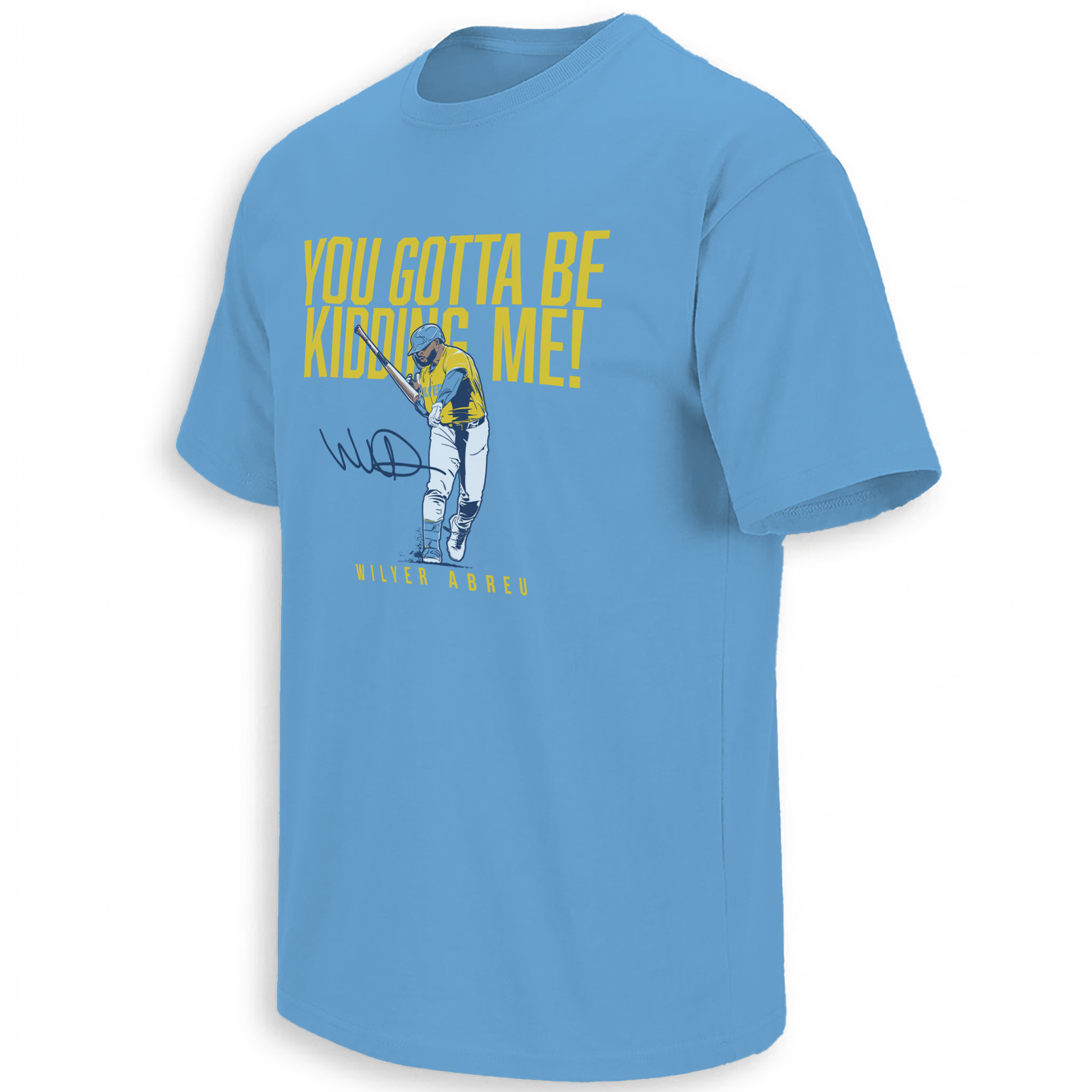 FOUR HOMERS · TWO GAMES
Wilyer Abreu’s Fenway Moment, Preserved in Broadcast Language
A baseball graphic built around the call that accompanied Abreu’s go-ahead home run and Boston’s 12th consecutive victory.
The strongest sports apparel often behaves like a shared password. A fan does not need the entire play reconstructed after seeing the phrase. Those six words immediately return the sound of the booth, the flight of the ball and the roar from 33,077 people.
As more home runs, calls and improbable comebacks enter the season’s memory, Ellie Shirt’s broader MLB Shirts collection functions as a visual record of how baseball moments become fan language.
What Comes After the Disbelief?
A four-homer burst does not define an entire season, but it can change how a hitter is perceived. Abreu was no longer simply contributing to the streak; for two days, he was its loudest embodiment.
That is why “You gotta be kidding me” remains the right caption. It avoids the cold finality of a statistic and preserves the live sensation that anything Boston needed, Abreu appeared capable of supplying.
Frequently Asked Questions
When did Wilyer Abreu hit the “You Gotta Be Kidding Me” home run?
Abreu hit the go-ahead two-run homer against Tampa Bay on July 18, 2026, in the bottom of the seventh inning at Fenway Park.
How far did Wilyer Abreu’s go-ahead home run travel?
Statcast projected the decisive home run at 412 feet to right-center field.
How many home runs did Abreu hit in two games?
He hit four: two during the July 17 doubleheader nightcap and two more on July 18.
What did the home run mean for Boston’s winning streak?
It gave Boston a 7–6 lead over Tampa Bay and helped extend the Red Sox winning streak to 12 games.
What did Wilyer Abreu shout after the home run?
MLB reported that Abreu shouted “Are you crazy?” in Spanish toward the Red Sox dugout.
Why does the phrase work on a baseball shirt?
It preserves the spontaneous broadcast reaction, allowing the design to function like an audio and visual timestamp of the home run.
Short Description
The You Gotta Be Kidding Me Shirt commemorates Wilyer Abreu’s remarkable four-home-run stretch and his 412-foot go-ahead blast at Fenway Park on July 18, 2026. A Boston baseball design inspired by the broadcast call that captured the disbelief of the Red Sox’s 12th straight victory.