Spain Won the World Cup—and the Internet Made Yamal Bathe Messi
A real 2007 charity photograph once made Lionel Messi look like the guardian of football’s future. After Spain defeated Argentina in the 2026 World Cup final, a new parody reversed the bath—and transformed succession into one instantly readable image.
Within hours of Spain becoming world champion, one of football’s strangest photographs acquired a new ending. The original image, taken in 2007, shows a 20-year-old Lionel Messi helping bathe an infant Lamine Yamal during a charity-calendar shoot at Camp Nou. The new meme reverses the scene: Yamal is now the adult leaning over the bath, while Messi occupies the smaller role.
The parody arrived with exceptional timing. On July 19, 2026, Spain defeated defending champion Argentina 1–0 after extra time at New York New Jersey Stadium. Ferran Torres broke the deadlock in the 106th minute, delivering Spain its second men’s World Cup title and its first since 2010.
At opposite ends of football’s timeline stood Yamal and Messi. Yamal, 19, became one of the rare teenagers to play in a men’s World Cup final. Messi, 39, reached what may have been the final World Cup match of his career. Spain’s victory did not erase Messi’s place in the sport, but it gave the internet a perfect opportunity to redraw the relationship between the two Barcelona figures.
The real story behind Messi bathing baby Lamine Yamal
The first photograph was not a staged prophecy and Yamal was not selected because anyone knew what he would become. It came from a 2007 charity-calendar project involving FC Barcelona, UNICEF and the Catalan newspaper Sport.
Yamal’s family had been connected with the shoot through a UNICEF raffle. Photographer Joan Monfort paired the infant with Messi, then a gifted but still-emerging Barcelona star. Monfort later recalled that Messi appeared unsure how to handle the baby, making the tenderness and slight awkwardness of the resulting pictures feel completely natural.
The photograph remained largely forgotten outside the families and organizations involved. It resurfaced dramatically in 2024 when Yamal’s father shared it during his son’s breakthrough at the European Championship. By then, the baby in the tub had become one of world football’s most recognizable young players.
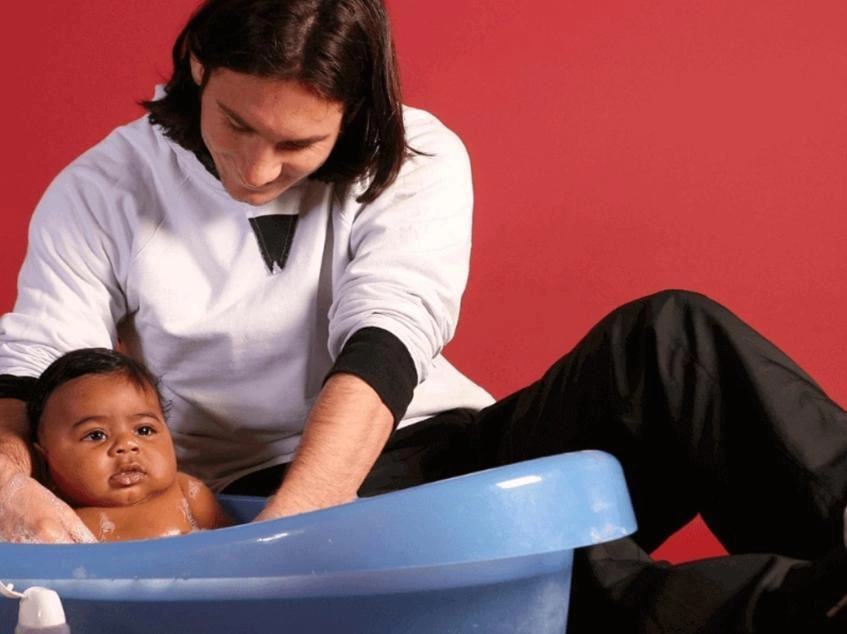
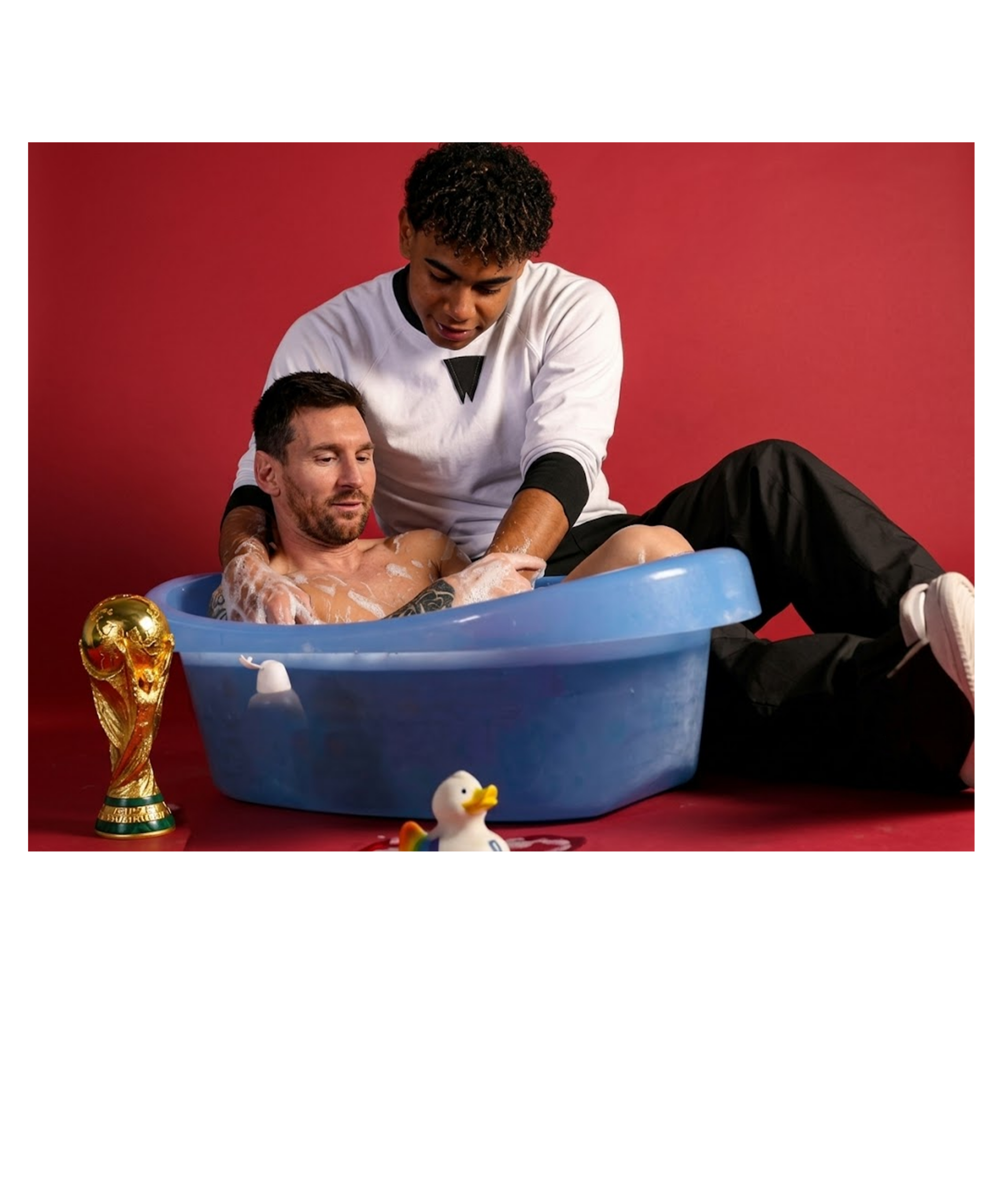
The 2007 photograph of Messi with baby Yamal is authentic. The reversed image showing adult Yamal bathing Messi is a newly created parody—not a real photograph—and should be understood as visual commentary on the 2026 World Cup final.
Why the reversal became bigger than a simple football joke
Internet memes succeed when a complicated idea can be understood before the caption is finished. This one requires almost no explanation. The viewer sees the same bath, the same arrangement and two figures whose ages and positions have been exchanged.
The original had already been treated online as a kind of accidental football baptism. Fans joked that Messi had blessed the infant or transferred part of his ability to him. That interpretation was never literal, but it gave the photograph a mythic quality: the established genius unknowingly meeting a child who would later inherit Barcelona’s right wing and Spain’s creative expectations.
The 2026 version changes “blessing” into “succession.” Yamal’s Spain had just defeated Messi’s Argentina in the most symbolically loaded final possible. Reversing the bath allowed the internet to compress nineteen years, two national teams and an entire debate about football’s next defining player into one frame.
The final made a viral photograph feel like destiny
The Spain–Argentina matchup had been surrounded by the image before kickoff. Messi even discussed the photograph publicly in New York, describing the shared history as extraordinary and praising Yamal’s rise. Once the two players appeared on opposite sides of a World Cup final, the photo no longer felt like an amusing Barcelona coincidence. It became part of the event’s central narrative.
Spain controlled the final without requiring Yamal to produce a personal masterpiece. Argentina’s defensive approach restricted space, while Emiliano Martínez repeatedly kept the holders alive. The decisive breakthrough ultimately belonged to substitute Ferran Torres, supported by the work that kept the move alive before his 106th-minute finish.
That collective outcome is important. The meme celebrates Yamal as the young face of the champions, but Spain’s second star came from a team performance. Its meaning is cultural rather than statistical: Yamal did not personally dethrone Messi; his generation reached the summit while Messi’s left it.
Yamal did not replace Messi—and that is why the meme works
Football’s desire to name “the next Messi” often flattens both players. Messi’s career cannot be transferred through a photograph, and Yamal’s future should not be measured solely against an impossible predecessor. Even the bath image gained its power because neither participant knew what the other would eventually represent.
The reversed meme is more interesting when read as a handover rather than a replacement. Messi remains the figure whose career shaped the football imagination Yamal entered. Yamal now represents the possibility that a new era can create its own visual language instead of endlessly recreating the old one.
Their embrace after the final reinforced that softer reading. Spain’s triumph produced pain for Argentina and possibly closed Messi’s World Cup story, but the relationship between the two images is affectionate rather than cruel. The joke works because the original scene was tender.
How the design turns a photo diptych into a World Cup artifact
The graphic uses the two-image sequence like a photographic contact sheet: first the authentic 2007 scene, then the deliberately reversed 2026 parody. The audience does not merely see “before and after”; it sees football history reorganized through visual symmetry.
Spain’s red-and-yellow championship language gives the second frame its immediate context, while the domestic softness of the bathtub makes an amusing contrast with the scale of a World Cup final. One of sport’s largest events is remembered through one of its smallest, strangest visual metaphors.
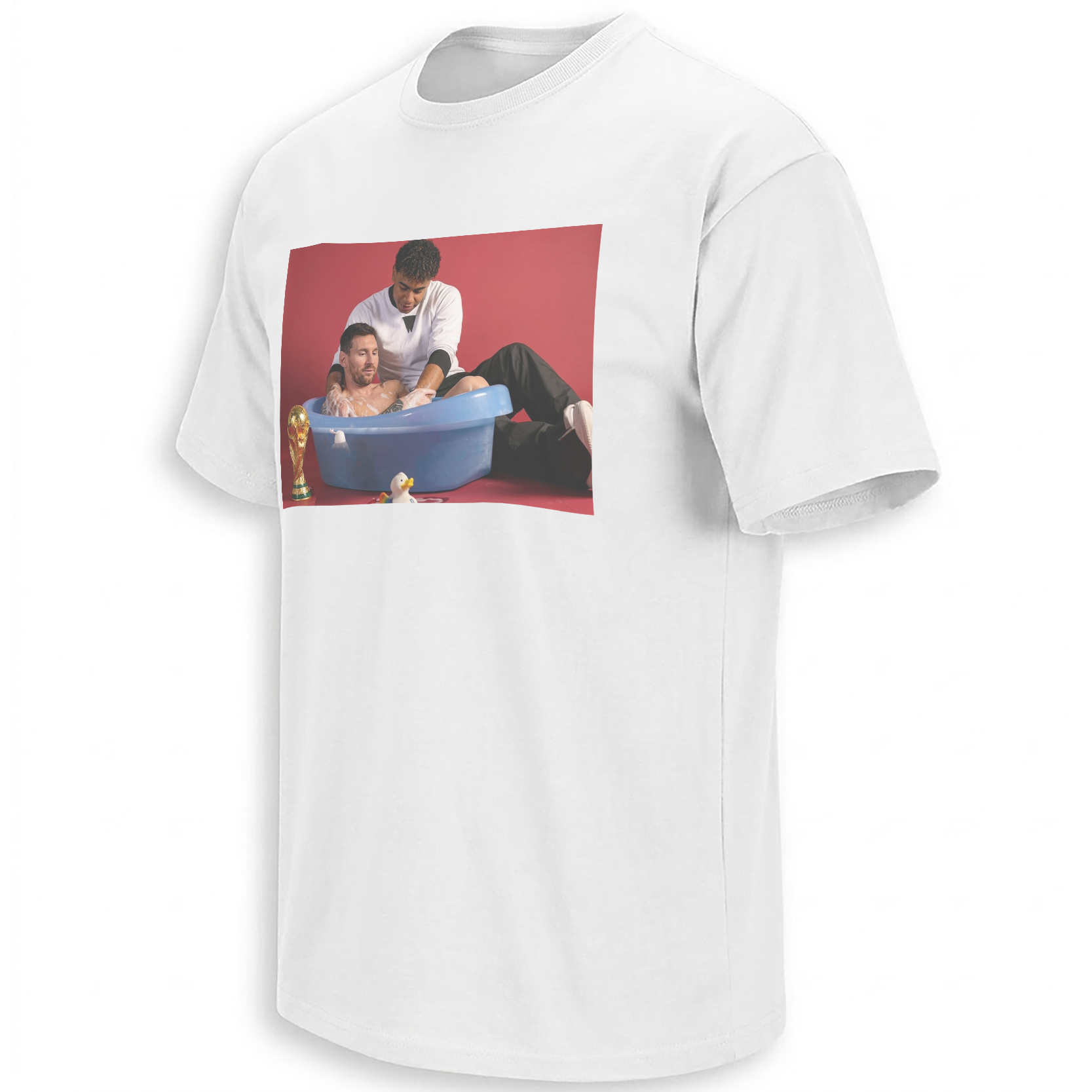
The light background preserves the feeling of an archival photograph while making the reversed World Cup punchline read like a newly developed print.
View the photo-story piece →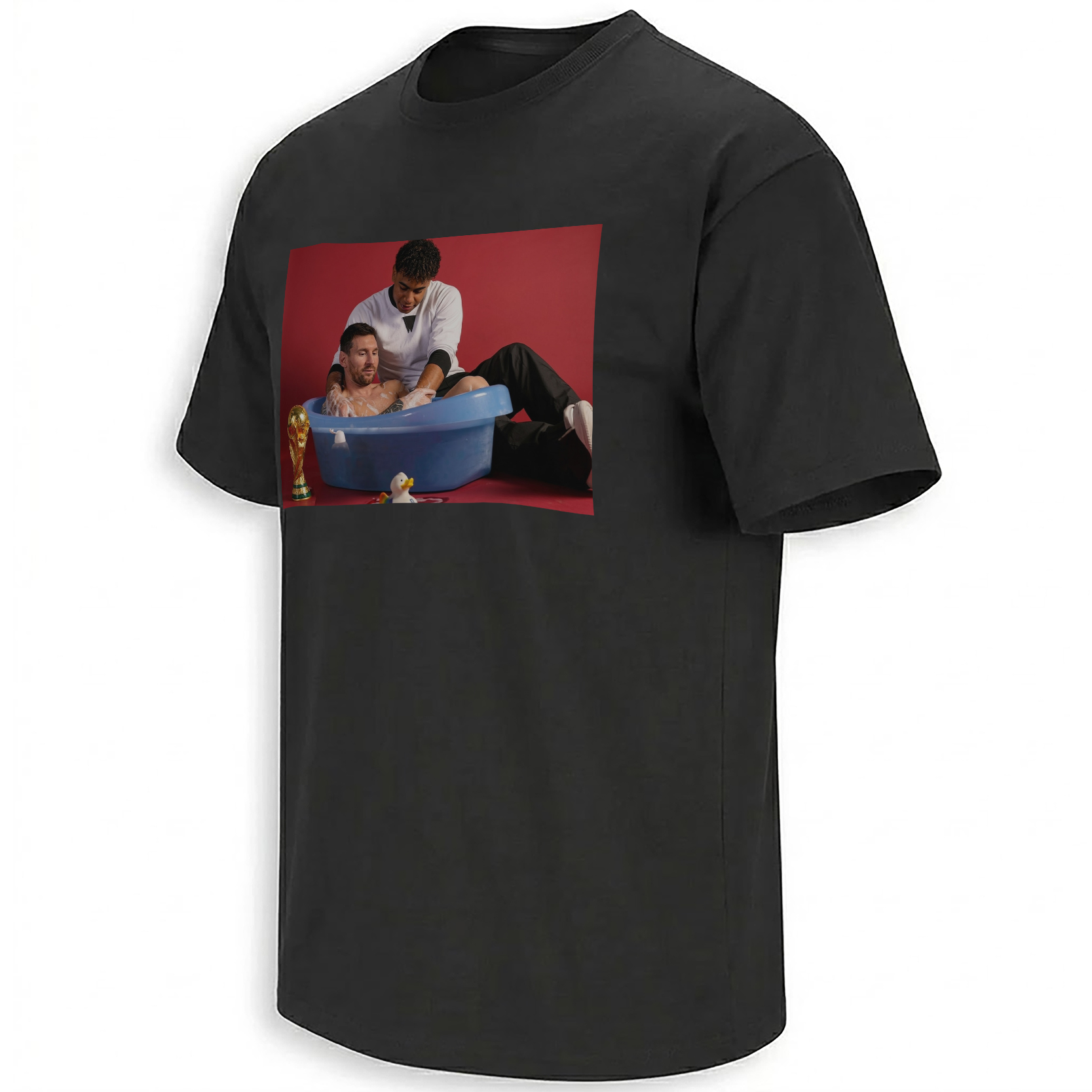
Against black, the paired images feel closer to a documentary contact sheet—two frames separated by nineteen years and one World Cup final.
View the championship artifact →This is where the Lamine Yamal Bathes Messi design becomes less like ordinary championship merchandise and more like a timestamp. It records how fans interpreted the result before the trophy celebration had even left the news cycle.
The wider newest Ellie Shirt archive follows the same principle, documenting the screenshots, jokes and cultural references through which major sports results acquire a second life online.
Frequently Asked Questions
Is the photograph of Lionel Messi bathing baby Lamine Yamal real?
Yes. Photographer Joan Monfort took the authentic image during a 2007 charity-calendar photoshoot involving FC Barcelona, UNICEF and Sport newspaper at Camp Nou.
Is the image of adult Lamine Yamal bathing Lionel Messi real?
No. The reversed 2026 image is a parody meme created after Spain defeated Argentina in the World Cup final. It reimagines the composition of the authentic 2007 photograph.
Why were Messi and baby Yamal photographed together in 2007?
Yamal’s family participated through a UNICEF-linked charity-calendar project. Messi, then a 20-year-old Barcelona player, was paired with the infant for the photoshoot.
What happened in the 2026 World Cup final?
Spain defeated Argentina 1–0 after extra time on July 19, 2026. Substitute Ferran Torres scored the decisive goal in the 106th minute, giving Spain its second men’s World Cup title.
Why did the reversed Messi–Yamal bath meme become meaningful?
It transformed the final into a visual story about football’s generational handover. Messi cared for Yamal in the authentic 2007 image; after Yamal’s Spain defeated Messi’s Argentina, the meme playfully exchanged their positions.
Did Lamine Yamal score the winning goal against Argentina?
No. Ferran Torres scored Spain’s winning goal in extra time. Yamal’s role in the meme is symbolic: he represents the young face of Spain’s championship generation.
The Lamine Yamal Bathes Messi World Cup graphic preserves two different truths in the same composition: the tenderness of a real 2007 charity photograph and the playful generational reversal created after Spain became 2026 world champion.
Lamine Yamal Bathes Messi Shirt reverses the famous 2007 charity photograph after Spain defeated Argentina in the 2026 World Cup final, transforming football’s generational handover into a two-frame cultural meme.