
Select Your South Side Slugger The White Sox Lineup Entered 8-Bit Mode Five young hitters, one baseball wizard and a rebuild beginning to resemble a playable team
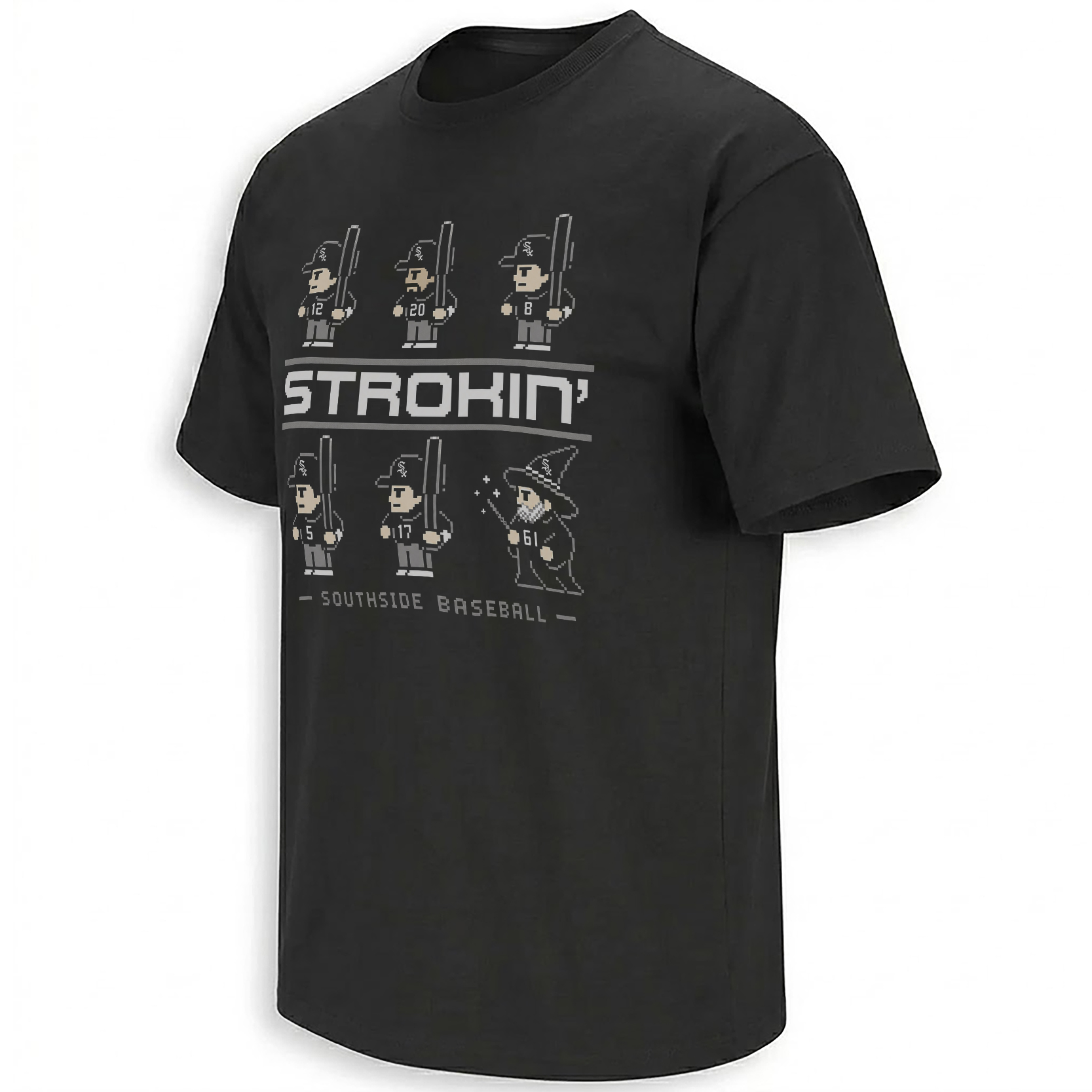
Colson Montgomery, Miguel Vargas, Kyle Teel, Munetaka Murakami and Sam Antonacci appear as bat-carrying sprites beneath one compact command: STROKIN’. The graphic transforms Chicago’s young offense into a character-selection screen.
A rebuilding team often feels like a video game before the roster is fully unlocked. Prospects arrive one by one, attributes change, new characters replace placeholders and fans spend months arguing about which combination finally makes the lineup competitive.
The 2026 White Sox have moved beyond the menu-screen feeling of endless preparation. Their younger hitters have begun producing a recognizable offensive identity: left-handed power, international star energy, young catching talent and enough unexpected contributors to make the South Side feel active again.
The STROKIN’ graphic translates that shift into the visual language of an old baseball cartridge. Five players stand with bats raised, waiting to be selected. A sixth character arrives as a wizard, because no retro game roster is complete without one secret option that ignores ordinary realism.
The rebuild stops feeling abstract when fans can finally imagine pressing START on a lineup they recognize.
Why “Strokin’” Works as South Side Language
The phrase is short enough to resemble a scoreboard command and loose enough to carry several baseball meanings at once.
It suggests clean contact, line drives and hitters repeatedly putting good swings on the ball. It also sounds like something that can be chanted, printed across a dugout graphic or flashed after a run-scoring sequence without requiring a paragraph of explanation.
Most importantly, the word is collective. The design does not say that one star is carrying the White Sox. “Strokin’” describes what happens when several hitters begin connecting their plate appearances into one offensive rhythm.
The Shirt Behaves Like a Character-Selection Screen
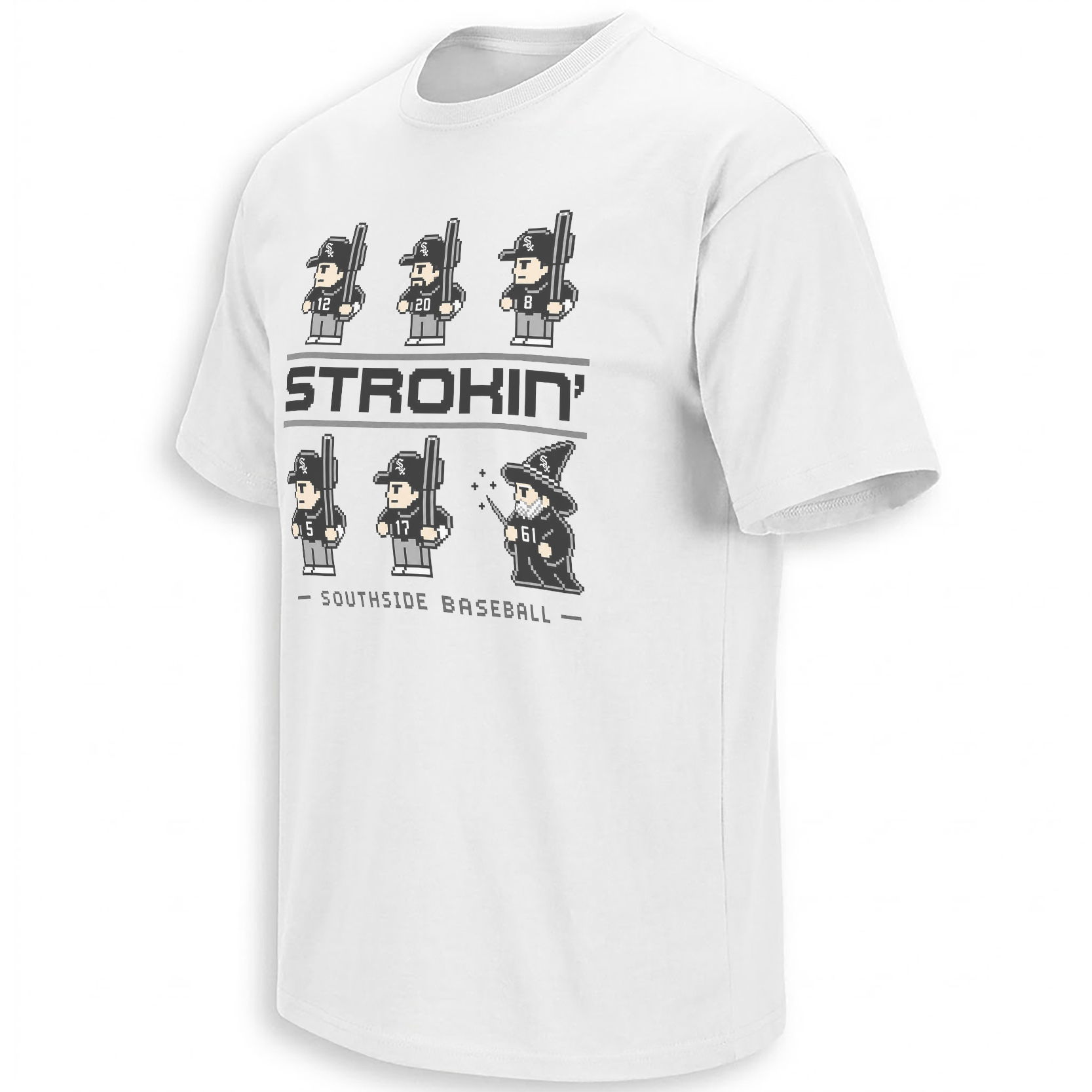
The Strokin’ Shirt avoids a realistic roster collage. Each player is reduced to the minimum information an old video game would require: cap, jersey, number, face, bat and ready position.
Three characters form the top row. Two more appear below the title panel. The uniform posture makes them feel selectable, while their jersey numbers allow fans to read individual identities inside the shared pixel system.
The Five Players Behind the Sprites
The left-handed power presence whose long home runs give the lineup one of its clearest damage profiles.
A central first-half producer whose progression helped change the White Sox from a development story into a competitive one.
The young catcher who gives the roster screen another foundational position rather than another interchangeable slugger.
International star power and immediate home-run gravity, represented as one of the lineup’s strongest boss-level bats.
Youthful speed and energy from another player whose rise widened the possible combinations inside Chicago’s lineup.
A fantasy sprite holding a wand and surrounding himself with pixel sparks, converting offensive momentum into literal baseball magic.
Why the Wizard Makes the Entire Design Better
Without the wizard, the composition would remain a clever roster graphic. With him, it becomes a fictional game world.
Retro games often hide their strongest cultural memories in characters that break the ordinary rules: secret fighters, strange mascots, impossible power-ups or bonus players accessed through a code.
The bearded figure in a pointed hat performs that role here. He does not correspond to a standard realistic portrait. He turns the phrase “South Side magic” into a selectable character and suggests that the lineup is not simply swinging bats — it is casting something over the inning.
Monochrome sprites create the old-game roster; vertical bats make every hitter look ready for selection; digital block lettering turns STROKIN’ into a title screen; player numbers preserve real identities; and the wizard supplies the surreal bonus level.
Pixel Art Is Perfect for a Young Core
Realistic player collages tend to present a roster as already complete. Pixel art communicates development differently because every character looks modular.
A sprite can gain attributes, change equipment, move into a stronger lineup slot or become the player someone chooses first. That visual logic matches the way fans follow young baseball players through a season.
Montgomery can add power. Teel can grow into the catching role. Antonacci can bring speed. Vargas and Murakami can become the recognizable middle of the order. The design does not freeze those players at a final statistical destination. It places them at the beginning of a game fans are still playing.
From Rebuild Screen to Playoff Conversation
Chicago’s recent baseball memory makes the design’s timing important. A young roster is not automatically exciting simply because the players are young. Fans need evidence that development is producing a shared direction.
The current lineup has begun supplying that evidence through home-run stretches, first-time All-Star recognition and a stronger first half than the South Side had been trained to expect.
The game-screen layout captures the emotional shift. These players no longer feel like names listed in a future depth chart. They feel available now.
Black and White Bases Create Two Different Consoles
Pale gray characters appear to glow against black fabric, giving the sprites the feeling of a roster loaded on an old monochrome monitor.
Dark pixel lines on white fabric resemble character diagrams from a cartridge booklet or early computer-baseball score sheet.
Why Roster Graphics Matter During a Transition
Single-player shirts preserve individual performances. Roster graphics preserve relationships.
The appeal of this design comes from seeing Montgomery beside Vargas, Teel beside Murakami and Antonacci beside the strange final character. The lineup exists through proximity.
That makes the artwork a timestamp of the period when Chicago’s next core began becoming legible. Players will develop at different speeds and future rosters will change, but this arrangement records the moment fans started recognizing the group as one shared South Side story.
The White Sox Archive Is Becoming a Game With More Characters
The wider Chicago White Sox collection follows the same roster through several visual languages: individual player graphics, shared-name designs, South Side slogans, magical motifs and prospect pieces.
The broader MLB collection places this pixel lineup inside baseball’s longer relationship with video games, scoreboards, collectible player icons and the fan habit of imagining every roster as a set of playable strengths and weaknesses.
Frequently Asked Questions
Which White Sox players appear in the Strokin’ design?
The five hitter characters represent Colson Montgomery, Miguel Vargas, Kyle Teel, Munetaka Murakami and Sam Antonacci.
Which jersey numbers appear on the pixel characters?
The five player numbers are 12, 20, 8, 9 and 17. The separate wizard character wears number 61.
What does “Strokin’” mean in this White Sox design?
It refers to Chicago hitters repeatedly making strong contact and driving the ball, presented as a compact South Side lineup slogan.
Why are the players drawn as pixel characters?
Pixel art makes the roster resemble an early baseball video game in which each hitter stands with a bat and waits to be selected.
Who is the wizard wearing number 61?
The wizard is a humorous fantasy character rather than a standard realistic player portrait, turning South Side offensive momentum into literal pixel magic.
Why does the design focus on several players instead of one star?
The roster layout documents the emerging relationship among Chicago’s young hitters and the collective offensive identity developing around them.
How do the black and white shirt versions differ visually?
The black base resembles glowing sprites on an arcade screen, while the white base feels closer to pixel character art printed in a retro game manual.
The STROKIN’ pixel roster preserves Chicago’s young offensive core as a playable South Side team, while the wider White Sox archive unlocks more player moments, slogans and current roster characters.
Strokin’ Shirt transforms Montgomery, Vargas, Teel, Murakami and Antonacci into bat-carrying White Sox pixel sluggers, completed by a No. 61 baseball wizard and retro Southside Baseball title-screen styling.