The White Sox Went No. 1 Now Chicago Has a New Swing to Follow
Roch Cholowsky entered the White Sox organization as the first overall selection in the 2026 MLB Draft, giving the South Side something bigger than another prospect ranking: the opening frame of a new baseball story.
Before Roch Cholowsky took a professional at-bat, Chicago already had an image for the beginning: his name filling the scoreboard, his family reacting to the announcement and a White Sox crowd applauding the first overall pick before a game at Rate Field on July 11.
Draft night usually sells possibility in abstract language. Scouts discuss hit tools, defensive projection, signing value and development timelines. Fans hear all of it, but emotionally they are processing something simpler: the organization has placed its future behind a new name.
Cholowsky’s arrival made that feeling unusually visible. The UCLA shortstop was not merely added somewhere inside a large class. He was selected No. 1 overall, the first player called in the 2026 MLB Draft and only the third top overall selection in White Sox franchise history.
A first overall pick does not arrive with completed history. He arrives with an entire fan base preparing to remember the first frame.
Why This Pick Felt Different on the South Side
The No. 1 label changes how a player enters public imagination. Every swing in the minors becomes part of a larger projection. Every adjustment receives more attention. Every promotion feels like a step toward an ending fans have already begun writing.
Cholowsky also entered an organization that was not simply waiting at the bottom of the standings for distant hope. At the moment of the selection, the White Sox’s Major League club was competing near the top of the American League Central, giving the pick the unusual energy of a future asset joining a team already building present-tense momentum.
His own reaction strengthened the connection. After visiting Chicago before the draft, Cholowsky spoke about becoming attached to the city and wanting the partnership to work. That language matters to fans because it turns the transaction into a chosen relationship rather than a name mechanically matched to a draft slot.
The Swing Became the First Symbol
A prospect does not yet possess a full archive of professional highlights. There is no decade of signature moments to compress into a graphic. The visual language therefore has to begin with possibility, and the cleanest possible symbol is the swing.
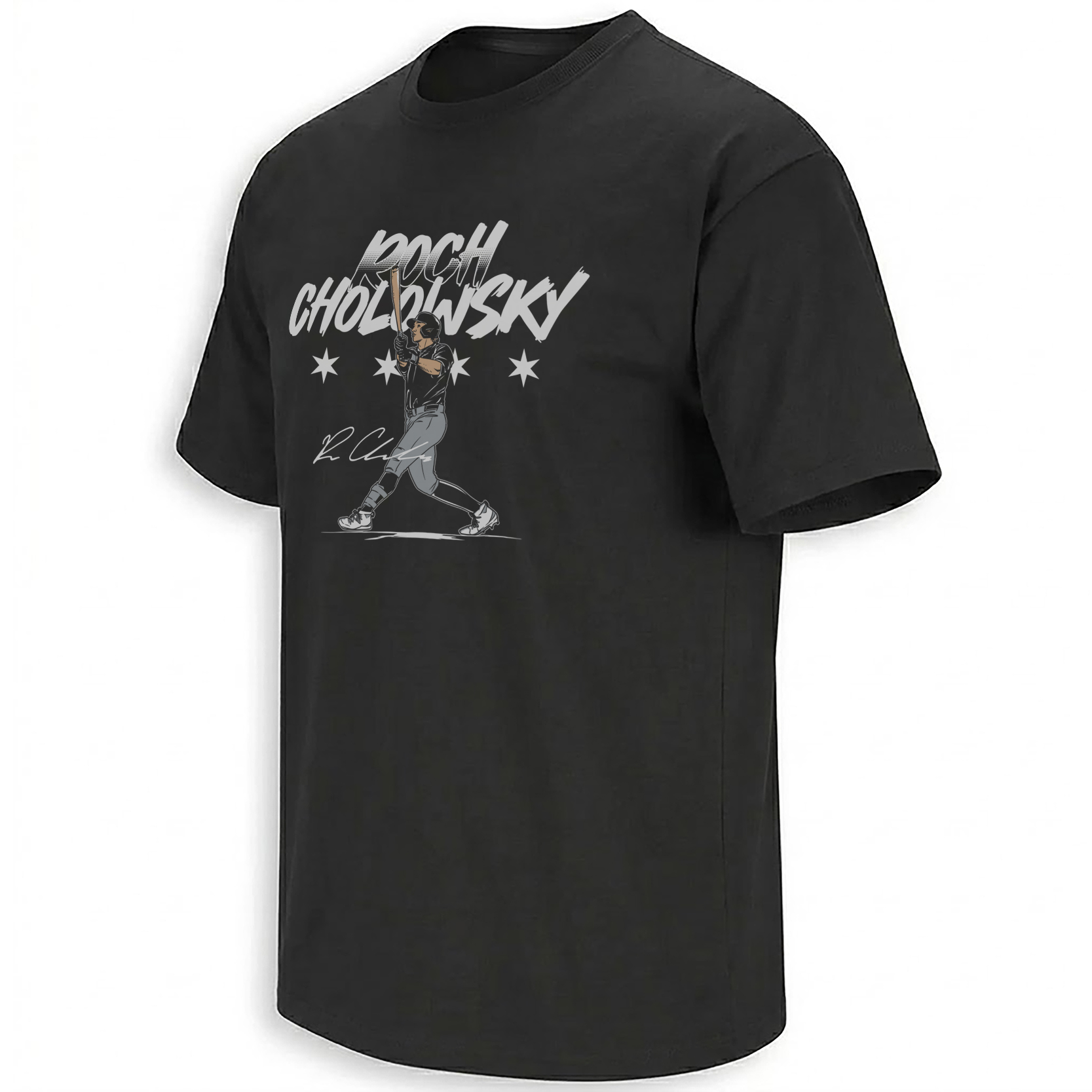
The Roch Cholowsky Shirt freezes him in a right-handed follow-through, the body already rotated and the bat still carrying the direction of the imagined ball. It does not claim a Major League accomplishment that has not happened. It preserves the action fans expect to follow as his career develops.
A Graphic Built Like a Prospect Card
The artwork avoids the crowded language of a championship design. There is no trophy, no exaggerated statistic and no attempt to predict how the career will end. Instead, the composition behaves like an early collectible produced at the exact moment a player enters an organization.
Cholowsky’s name dominates the upper field in large brush-script lettering. The irregular strokes create movement behind the illustrated batter and prevent the design from feeling like a static roster label. The signature-style mark adds a second layer of identity, closer to an autographed card or draft-day poster than a standard team logo treatment.
Four Chicago-inspired stars run behind the player. Their job is subtle but important: they connect the prospect to the city before he has accumulated a long archive of South Side imagery. The stars establish place, while the player’s name and swing establish the future.
Black, white and gray create a controlled South Side palette. Brush lettering supplies speed, the full follow-through supplies power, and the signature treatment gives the graphic the feeling of something collected before the player’s story became familiar.
Why Fans Collect the Beginning
Prospect culture is built on a strange emotional timeline. Fans learn the names before the wider sports audience does. They watch minor-league box scores, debate positional paths and remember the first call-up long after casual viewers have forgotten how the journey began.
That makes draft-era imagery different from ordinary player merchandise. It represents belief without pretending certainty. Wearing or saving an early graphic is a way of saying that the beginning itself mattered — before the Major League debut, before the first home run and before the player’s career could be reduced to a final set of numbers.
With Cholowsky, that beginning has unusual historical weight. The White Sox previously held the first overall selection only twice, including the pick used on future Hall of Famer Harold Baines in 1977. Cholowsky enters that lineage without being asked to duplicate it. The connection simply explains why Chicago recognizes the moment as rare.
What Chicago Is Actually Waiting to See
The immediate temptation around a No. 1 pick is to skip directly to the Major Leagues. Cholowsky himself acknowledged that the work ahead remains significant. That patience is part of the real story.
Fans will follow how the power translates, where he settles defensively and how his development interacts with an organization already holding several talented shortstops. Those questions are not reasons to reduce the excitement. They are the substance of prospect fandom — the long process through which a name becomes a player the city understands.
As that process begins, the wider Chicago White Sox collection functions like a running South Side archive, placing Cholowsky’s draft moment alongside current-player graphics, team phrases and other pieces of Chicago baseball identity.
The broader MLB collection gives the design another context: baseball’s long tradition of remembering prospects before they become established stars, when the story is still made almost entirely from projection, scouting language and hope.
Frequently Asked Questions
When did the White Sox draft Roch Cholowsky?
The Chicago White Sox selected Roch Cholowsky with the first overall pick in the 2026 MLB Draft on July 11, 2026.
Where did Roch Cholowsky play college baseball?
Cholowsky played shortstop for UCLA before beginning his professional career in the White Sox organization.
Why was the No. 1 selection historically significant for Chicago?
Cholowsky became only the third first overall MLB Draft selection in White Sox franchise history, following Danny Goodwin in 1971 and Harold Baines in 1977.
What do the four stars in the Roch Cholowsky design represent?
The four stars reference Chicago’s visual identity and connect the prospect-focused artwork to the city and its South Side baseball culture.
Why does the design focus on Cholowsky’s swing?
The swing works as an early-career symbol of his offensive potential without claiming accomplishments that still belong to the future.
The Roch Cholowsky swing graphic preserves that opening frame, while the wider White Sox visual archive will record the players, phrases and moments that define what comes next.
Roch Cholowsky Shirt captures the White Sox’s 2026 No. 1 overall draft pick through a powerful right-handed swing, Chicago stars, monochrome South Side styling and an early-career signature treatment.