
The Blue Jays Found a Dragon — and Toronto Found Its New Home Run Language
A struggling offense, an assistant coach’s toy-store stop and Jonatan Clase’s three-run swing turned a stuffed dragon into the loudest new character in Blue Jays baseball. Six graphics now preserve every side of the ritual: the joke, the fire, the roar and the fearless mindset behind it.
The Toronto Blue Jays did not discover the Home Run Dragon while everything was easy. They found it on July 7, 2026, in San Francisco, after a road trip had compressed the offense into frustration, protective at-bats and nearly thirty consecutive innings without a run.
Then Jonatan Clase changed the temperature with one swing. Making his first major-league start of the season, the outfielder drove a three-run home run to right field and gave Toronto an early lead over the Giants. When he returned to the dugout, the usual handshake line had acquired a new creature.
Clase received a stuffed dragon mounted on a stick. The red Canada Day home run jacket went over his uniform. Teammates gathered around the toy as though the offense had summoned it rather than purchased it hours earlier. Toronto eventually won 9–3, but the score alone could not explain why the scene traveled so quickly.
The Home Run Dragon gave a lineup emerging from a slump something more useful than another mechanical slogan. It gave the players an image, a ritual and a question that every hitter could carry toward the plate: who gets to bring out the dragon next?
The dragon did not arrive after Toronto rediscovered its confidence. It became the object through which the players performed that confidence into existence.
The Origin Story Begins in a San Francisco Toy Store
The most effective baseball rituals often begin with almost no ceremony. They emerge from boredom, superstition, travel, inside jokes or a staff member willing to test an idea that would sound ridiculous anywhere outside a major-league clubhouse.
Before the July 7 game, assistant hitting coach Cody Atkinson stopped at a local toy store with a specific problem in mind. Toronto’s hitters had entered what the staff described as protective and stressed states. The coaching group wanted a symbol that could pull the lineup away from feeling hunted and return it to the mentality of a predator.
They considered other objects, including a sword and a wolf pack, before choosing a dragon. Atkinson purchased a stuffed dragon, a hand puppet and a smaller trinket. When the cashier asked whether the toys were for his children, the answer was better: they were for the Toronto Blue Jays.
The dragon was selected to represent fearlessness, predator energy and the ability to change the emotional routine surrounding a struggling offense. It cost almost nothing compared with the cultural value it produced once the cameras found it.
The creature appeared in the batting cage before the game. Vladimir Guerrero Jr. and Brandon Valenzuela interacted with it. George Springer carried it around and helped transform the prop from a coaching exercise into a clubhouse character.
By the time Clase homered, the dragon already had a role waiting. Springer brought it into the dugout celebration, the team’s social channels introduced it as the Home Run Dragon and an ordinary stuffed animal became part of the 2026 Blue Jays visual record.
Why a Dragon Was the Right Symbol for This Lineup
A wolf would have represented a pack. A sword would have represented attack. The dragon offered something broader: danger, fire, spectacle and a creature that does not require permission to occupy the largest space in the story.
The hitting staff’s language centered on becoming the hunter rather than the hunted. That distinction matters because prolonged slumps change the emotional shape of an at-bat. Hitters begin reacting to the pitcher, protecting the zone and carrying the memory of previous failure toward the next pitch.
The dragon reverses that picture. It is not a defensive animal. It does not survive by becoming smaller. It owns the air above the battlefield, produces its own fire and forces every other figure to adjust around it.
Defensive swings, stress, overprotection and the feeling that each pitcher controls the terms of the confrontation.
Attack the heart of the zone, expect damage, create the next dugout celebration and make the pitcher feel the danger first.
Guerrero summarized the symbolism through the simplest possible baseball logic: dragons breathe fire, and once Toronto brought one into the dugout, the bats caught fire too.
No serious hitter believes a stuffed toy changes bat speed or repairs swing decisions. That is not the point. Baseball is a sport of repetition, and repetition can become emotionally suffocating. A prop interrupts the loop. It gives the lineup permission to laugh, reset and imagine success before the next plate appearance begins.
The First Design Preserves the Actual Dugout Energy
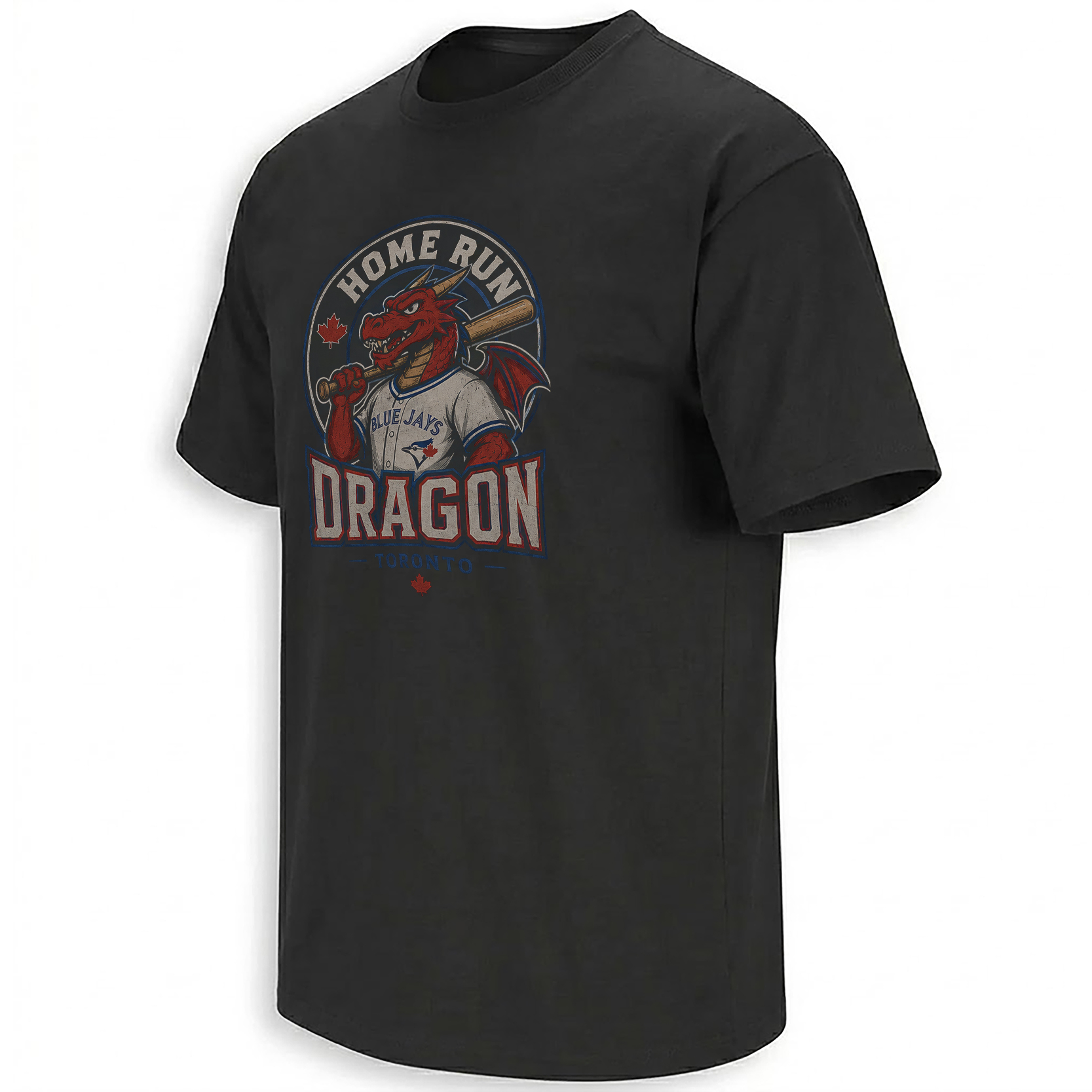
The Home Run Dragon dugout celebration design stays closest to the moment that created the mythology. Rather than transforming the creature into a completely separate fantasy mascot, it frames the Blue Jays celebration as the main event.
Players, team colors and the oversized dragon form a dense baseball collage. The visual language resembles a championship locker-room graphic even though the subject is more playful: one road-game ritual becoming large enough to represent the whole lineup.
That distinction gives the piece unusual emotional range. It can be read as comedy because the central object is a stuffed animal. It can also be read as a legitimate record of team chemistry because the players committed fully to the celebration.
From One Prop to Six Ways of Reading the Moment
Viral sports moments rarely remain attached to one image. Fans reinterpret them according to personality. Some remember the exact dugout scene. Some want the cleanest slogan. Others prefer the mascot enlarged into fantasy art, a comic character or a symbol that can live beyond the game in which it first appeared.
The six Home Run Dragon designs work because they do not repeat one composition with minor color changes. Each one isolates a different emotional reason the ritual connected.
The collection moves from documentary dugout energy to fantasy poster art, royal-blue mascot graphics, fear-first slogans and the “bark versus roar” joke that turns Toronto’s new creature into a challenge for the rest of baseball.
The closest visual record of the original ritual, built around team chemistry, Toronto colors and the dragon carried through the dugout after the breakthrough homer.
Open the original moment →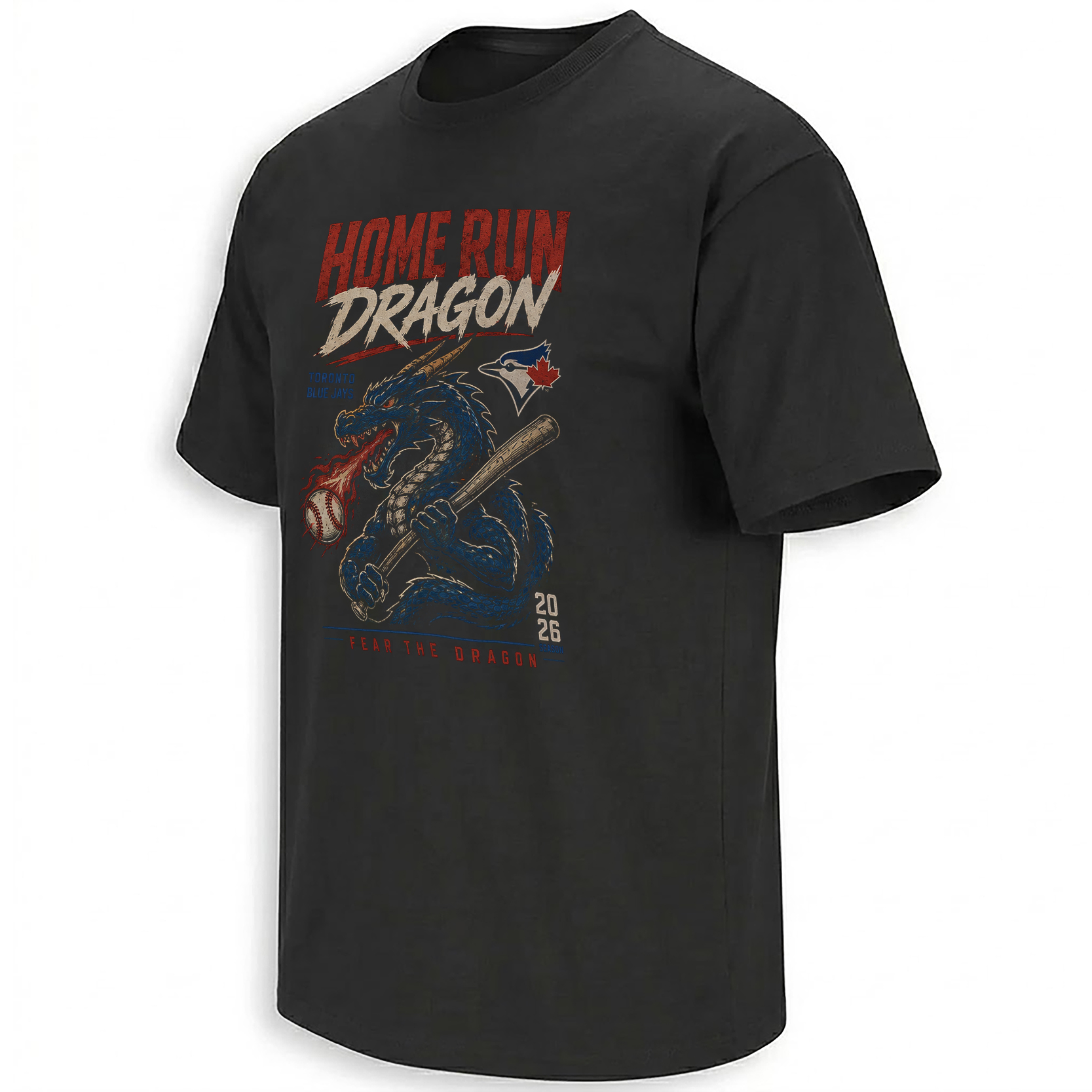
A direct opponent-facing interpretation that converts the clubhouse mascot into a warning: Toronto’s hitters are no longer waiting for the game to come to them.
See the warning graphic →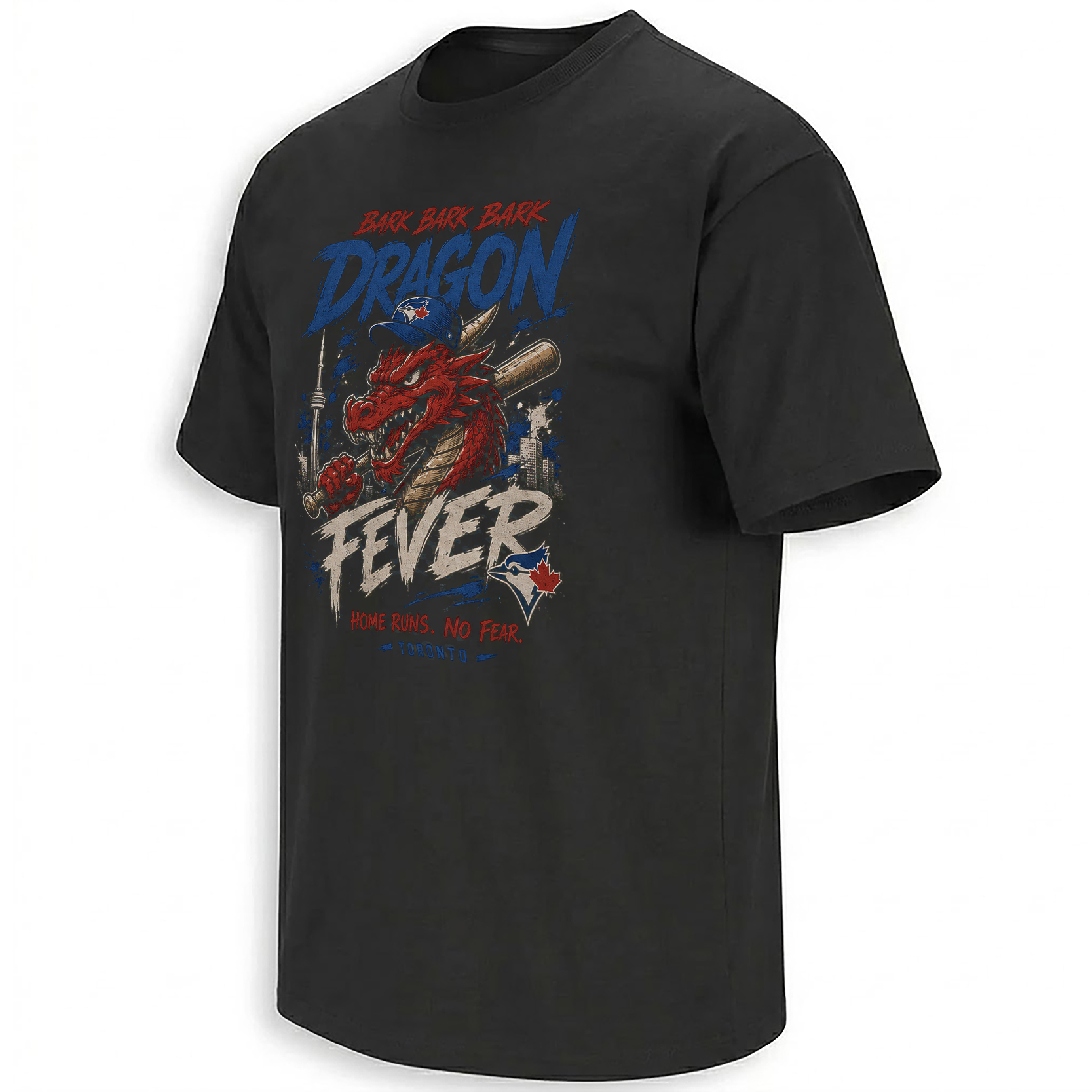
The ritual becomes a full Toronto baseball outbreak, using fantasy heat, mascot energy and the idea that one dugout joke can spread through an entire fan base.
Enter Dragon Fever →
A cleaner team-first treatment that lets royal blue dominate, turning the dragon into a recognizable Toronto baseball character rather than a one-game novelty.
View the royal-blue mascot →
A year-marked version designed as a direct timestamp of the 2026 season, when a toy-store prop entered the Blue Jays’ official dugout language.
Open the 2026 artifact →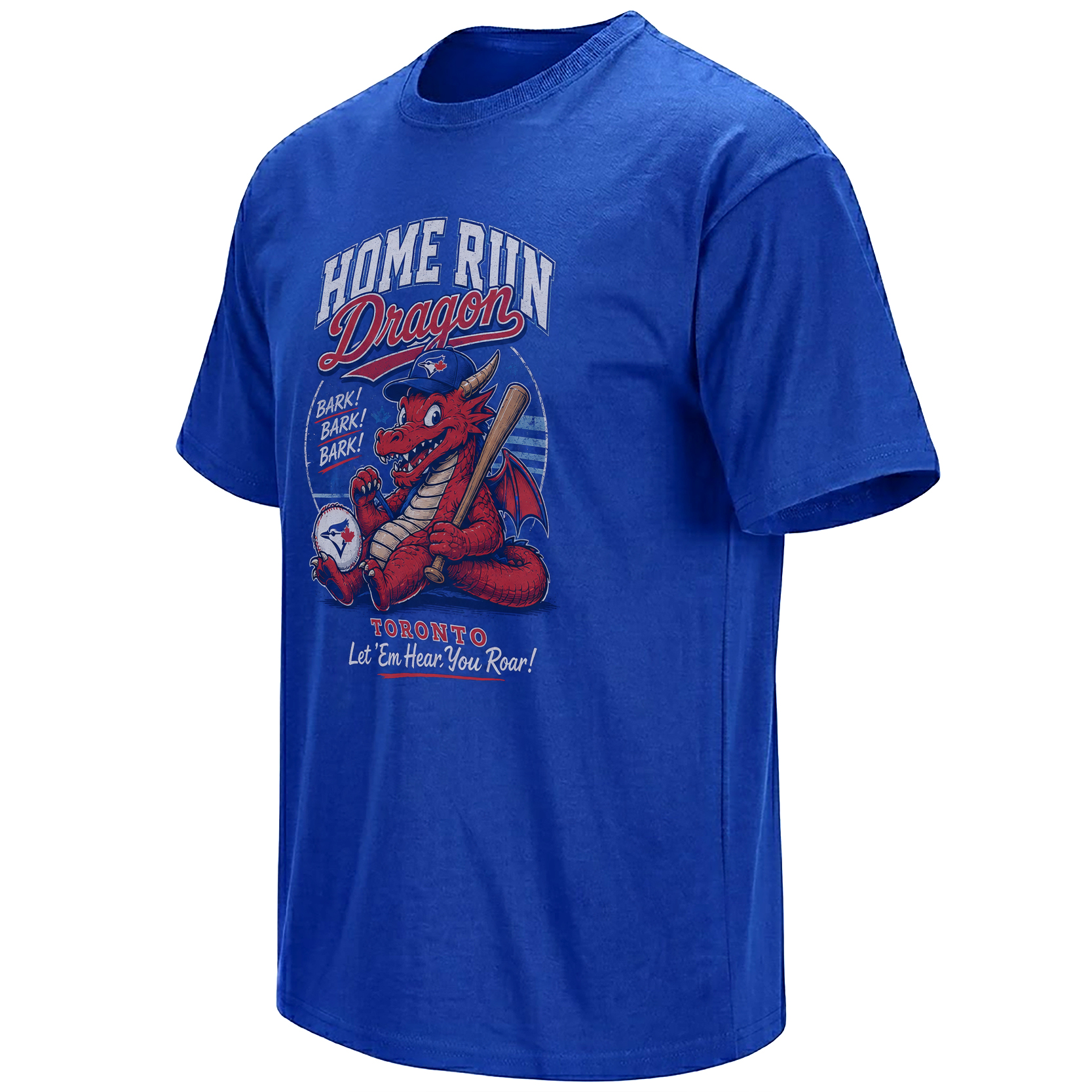
The most playful character-driven design, contrasting ordinary dugout noise with the larger sound Toronto wants associated with its next home run.
Hear the dragon roar →Which Home Run Dragon Design Tells the Strongest Story?
Best for readers who want the graphic most closely tied to the real team moment, Clase’s home run and the players’ collective reaction.
Best for fans drawn to competitive language, opponent intimidation and the hitting staff’s hunter-versus-hunted philosophy.
Best for fantasy-art collectors and supporters who see the mascot as a phenomenon spreading through Toronto baseball culture.
Best for a clean Blue Jays color identity and for fans who want the creature to read immediately as a Toronto baseball mascot.
Best for preserving the date and treating the design as a clear artifact of this exact Blue Jays season.
Best for humor, mascot personality and fans who prefer the ritual’s playful clubhouse energy over a serious fantasy treatment.
Why “Fear the Dragon” Is Bigger Than a Mascot Slogan
The phrase succeeds because it can address three audiences at once. For Toronto hitters, it describes the identity the coaching staff wanted restored. For opposing pitchers, it functions as a warning. For fans, it turns the next home run into the release of a creature already waiting inside the dugout.
“Fear” also reframes the original slump. During the cold stretch, the Blue Jays appeared to be the group reacting to danger. The dragon inverts that relationship. The lineup is no longer afraid of another empty inning; the pitcher is supposed to fear the swing that activates the celebration.
That is why the strongest dragon graphics lean into fire, teeth, claws and oversized lettering. They are not attempting to reproduce the softness of the actual plush toy. They illustrate the creature as the hitters wanted to imagine it: not cute, but fearless.
How One Swing Changed the Emotional Timeline
Toronto’s offense entered San Francisco carrying a long scoreless stretch, limited production and the psychological weight of repeated empty innings.
The hitting staff looked for a symbol of fearlessness and predator energy, eventually selecting multiple dragon toys for the cage and dugout.
A player making his first major-league start of the season delivered the exact swing needed to introduce the new ritual.
George Springer helped move the prop from batting-cage curiosity to visible dugout theater as Clase returned from his home run.
Official team posts, broadcast coverage and fan reactions turned the toy into the Home Run Dragon, a recognizable piece of Blue Jays culture within hours.
Baseball Has Always Needed Objects That Make No Rational Sense
From rally monkeys and home run jackets to lucky sausages, turnover props and objects nobody is permitted to move during a winning streak, sports teams continually create meaning from things that possess no measurable athletic power.
Baseball is especially vulnerable to this behavior because its season is long, repetitive and psychologically exposed. Every hitter fails publicly. Every slump accumulates through hundreds of nearly identical routines. A new object can create a break in that repetition even when everyone understands the superstition is playful.
The Home Run Dragon works because the players do not need to prove that it causes anything. They only need to enjoy what happens when it appears.
If the dragon makes the batting cage lighter, the dugout louder or the next hitter more eager to participate, it has already served a baseball purpose. The cultural value begins precisely where the statistical explanation ends.
The Dragon Is Perfect for Toronto’s Visual Culture
The Blue Jays already occupy one of baseball’s most distinctive identity systems. They are a city team, a national team and the only Canadian franchise in Major League Baseball. Their visual language constantly moves between royal blue, red maple-leaf accents, bird imagery, Toronto pride and the personalities of players drawn from across the world.
A dragon fits because it adds fantasy without replacing that identity. Blue keeps the creature within the team’s world. Red and orange fire echo the maple-leaf accent while introducing speed and danger. The contrast makes the graphics readable as Blue Jays pieces before a viewer understands the entire dugout origin story.
It also gives Toronto a new non-bird character with no need to challenge the official mascot. The dragon is not arriving to replace Ace. It belongs specifically to the hitters, the dugout and the instant after the ball leaves the park.
Why the Ritual Was Ready-Made for Social Media
A successful social-media sports image must be understandable before the explanation arrives. The Home Run Dragon meets that test immediately.
A viewer sees a major-league player, a home run jacket and a stuffed dragon. The elements do not normally belong together, which creates instant curiosity. The object is colorful enough to survive a small mobile screen and strange enough to demand a replay.
The ritual also creates repeatable anticipation. Every future Blue Jays home run can produce another dragon frame, another player interaction and another opportunity for the character to develop. A handshake has limited variation. A prop can acquire names, poses, costumes and its own running mythology.
That repeatability is the reason the designs matter now. They do not commemorate a closed historical event. They enter the story while the dragon’s meaning is still being negotiated by players and fans.
The Real Product Is the Memory of the First Roar
The most effective sports graphics do not merely announce loyalty to a team. They allow supporters to identify which version of the season they remember.
A standard Toronto logo can belong to any year. The Home Run Dragon belongs specifically to the 2026 road trip, Clase’s first start, the 9–3 win, Springer carrying the toy and a hitting staff searching for an emotional reset.
That specificity gives all six designs their long-term value as cultural objects. Even if the dugout eventually adopts another celebration, the dragon will remain attached to the night a nearly scoreless road trip became funny, loud and briefly mythological.
The wider Toronto Blue Jays collection works as a continuing record of those moments, from player nicknames and postseason memories to the dugout phrases that briefly define an entire fan base.
Across the broader MLB Shirts collection, the dragon joins baseball’s larger archive of unlikely rituals: objects and jokes that begin inside one clubhouse before cameras, fans and graphic culture carry them across the league.
Frequently Asked Questions
What is the Toronto Blue Jays Home Run Dragon?
The Home Run Dragon is a stuffed dragon used as a Blue Jays dugout celebration prop after home runs. It was introduced publicly during Toronto’s July 7, 2026 game against the San Francisco Giants.
Who first celebrated with the Home Run Dragon?
Jonatan Clase became the first player publicly associated with the ritual after hitting a three-run home run in his first major-league start of the 2026 season.
Where did the Blue Jays get the dragon?
Assistant hitting coach Cody Atkinson purchased multiple dragon toys at a San Francisco toy store before the game as part of an effort to restore confidence and fun to the offense.
Why did the hitting coaches choose a dragon?
The staff wanted a fearless predator that represented being the hunter rather than the hunted. A dragon supplied power, fire and enough humor to keep the message from feeling forced.
What does “Fear the Dragon” mean for Blue Jays fans?
The phrase converts the dugout mascot into a warning for opposing pitchers, representing a Toronto lineup attacking with confidence instead of carrying the fear of another empty inning.
What is the difference between the six Home Run Dragon designs?
The designs emphasize different parts of the story, including the original dugout celebration, competitive “Fear the Dragon” language, fantasy-style Dragon Fever, a clean royal-blue mascot, a 2026 timestamp and the playful Bark or Roar character concept.
Why did the Home Run Dragon go viral?
The prop was visually unusual, appeared immediately after a badly needed home run and gave fans a simple story to share: Toronto escaped a slump by introducing a fire-breathing symbol of fearlessness.
Start with the original dugout celebration, choose the direct warning of Fear the Dragon, or explore the complete set through the Toronto Blue Jays visual archive. Each version preserves a different part of the night a toy-store creature gave Toronto’s offense a new identity.
Blue Jays Home Run Dragon shirts capture Toronto’s viral 2026 dugout ritual through six distinct designs, from Jonatan Clase’s original celebration and Fear the Dragon slogans to royal-blue mascot, Dragon Fever and Bark or Roar artwork.