“Every Family Has Its Demons” Is the Line That Explains Evil Dead Burn
Evil Dead Burn turns a familiar horror phrase into something more intimate: a family portrait cracked open by grief, abuse and possession, with the Deadites revealing wounds that were already present long before the supernatural arrived.
When Evil Dead Burn reached U.S. theaters on July 10, 2026, the most important words in its campaign were not “Book of the Dead,” “chainsaw” or even “Deadite.” They were the six words placed beneath its title: “Every Family Has Its Demons.”
The phrase arrived at exactly the right moment for this version of the franchise. Directed by Sébastien Vaniček, the film follows Alice after the death of her husband, William, as she joins his relatives at an isolated family home. What begins as an uneasy gathering becomes a possession nightmare when the family members are transformed one by one into Deadites.
Yet the horror does not begin with the possession. The household is already divided by grief, resentment, emotional control and the shadow of an abusive relationship. The Deadites do not create the family’s fractures. They weaponize them, turning private injuries into visible monsters.
The Deadites are terrifying because they enter the family. The tagline is darker because it suggests the demons may have already been there.
A Horror Tagline With Two Meanings
“Every Family Has Its Demons” works first as a clean genre promise. In an Evil Dead film, demons are literal. They possess bodies, distort voices, expose wounds and turn familiar faces into hostile masks. The audience knows the phrase will eventually become physical.
Its second meaning is harder to dismiss. Outside supernatural horror, “family demons” usually describes secrets, inherited damage, addiction, violence, shame or patterns that remain hidden because exposing them would threaten the family’s image of itself.
Evil Dead Burn uses both meanings at once. Alice enters the home as a widow, but she is not simply mourning. Her relationship with William and his family contains tensions that the gathering would prefer to keep controlled. Once the Deadites arrive, politeness disappears and the household’s emotional structure becomes another form of violence.
That layered meaning distinguishes the tagline from a routine horror slogan. It does not merely announce danger. It identifies the location of the danger: inside the family, inside memory and inside relationships that were already difficult before anyone encountered the supernatural.
The Family Portrait Is the Perfect Image for the Film
Family portraits are designed to make conflict invisible. Everyone stands close together, faces the same direction and participates in a visual promise of unity. Even when relationships are strained, the photograph preserves a cleaner story.
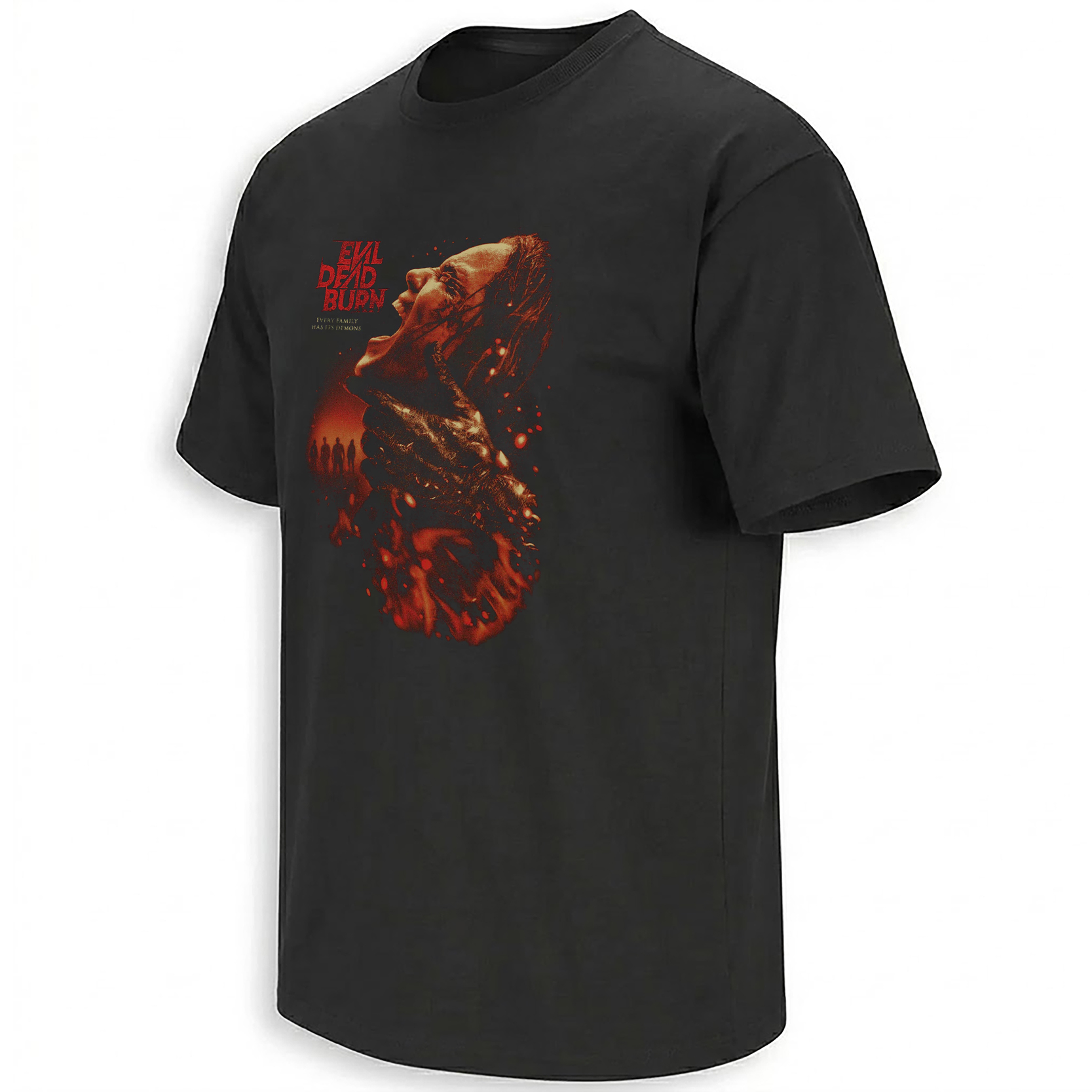
The Every Family Has Its Demons Shirt corrupts that tradition. Instead of presenting a calm group portrait, the artwork isolates a possessed face in profile, stretched upward as though caught between agony, transformation and surrender.
Behind that dominant figure, a smaller row of human silhouettes remains visible near the lower edge. Their reduced scale makes them feel less like individual characters and more like a family memory: the people who entered the house together before identity, loyalty and physical form began to collapse.
Why the Face Looks Like a Body Fighting Itself
The artwork’s most effective decision is its refusal to make the possessed figure look static. The head is thrown backward, the mouth is open and the neck appears pulled by forces moving in opposite directions. The result does not resemble a posed villain. It resembles a body caught during transformation.
The profile also preserves enough humanity to make the image uncomfortable. The eye socket, jawline and skin texture remain recognizable, but the face has been pushed beyond normal proportion and expression. It occupies the unstable space between victim and threat that has always made Deadites distinctive.
Evil Dead possession rarely erases personality completely. The demons imitate voices, exploit relationships and use remembered pain against the survivors. A familiar face therefore becomes more dangerous than an anonymous creature because recognition remains part of the attack.
The upward profile creates the sensation of an exorcism running in reverse. Instead of something leaving the body, the image suggests an outside force entering, expanding and taking control while fragments of the original person remain visible beneath the transformation.
Red and Orange Turn the Portrait Into Heat
The design is built almost entirely from black, dark red, burnt orange and small flashes of pale light. That restricted palette allows the figure to feel less like a conventional photograph and more like an image developed through fire.
Dark red establishes the body and the title, linking the composition to blood without relying on bright splatter effects. Orange appears across the face and neck like reflected flame, suggesting that the possessed figure is not merely injured but being consumed from within.
The black garment becomes negative space around the body. With no bright background and no theatrical border, the figure seems to emerge directly from darkness. The small points of red around the portrait resemble sparks, fragments or droplets suspended at the instant the transformation becomes irreversible.
This is where the artwork connects visually with the word “Burn.” Fire is not illustrated literally. Instead, the portrait itself has the color and texture of something exposed to extreme heat, making the film title and the human body part of the same damaged surface.
The Design Balances Poster Horror and Bootleg Energy
Although the composition uses cinematic imagery, it does not behave like a standard studio poster. The title is positioned to the upper left rather than centered above the portrait, and the slogan appears beneath it in much smaller type. That imbalance gives the artwork the feeling of an underground horror print or vintage bootleg graphic.
The figure extends vertically through the center of the garment, creating the narrow, elongated silhouette associated with old metal shirts, European horror posters and limited-color screen prints. The distressing prevents the image from appearing digitally polished, which suits a franchise built around damaged film texture, practical effects and physical mess.
The large possessed portrait communicates character, physical terror and the dramatic scale of a theatrical horror image.
The limited palette, distressed texture and asymmetrical title placement give the design the personality of a discovered cult-film graphic.
This combination matters because horror apparel often lives between official promotion and fan interpretation. The strongest pieces do not simply reproduce a poster. They condense the emotional logic of the film into an image that still feels expressive after the release campaign has ended.
Family Horror Has Become the New Center of Evil Dead
The original Evil Dead films were built around friends, cabins and young people trapped by their own curiosity. The newer entries have increasingly moved the franchise toward family structures, where possession carries a different emotional cost.
The isolated cabin became part of a story about addiction, mistrust and whether a group could recognize genuine suffering before it became supernatural.
Possession entered a Los Angeles apartment and turned motherhood, sibling loyalty and domestic protection into the central emotional stakes.
A grieving widow enters her late husband’s family home, where buried abuse and strained loyalties become inseparable from the Deadite attack.
That shift explains why “Every Family Has Its Demons” feels so natural for this stage of the franchise. Evil Dead is no longer asking only what happens when people discover the Book of the Dead. It is increasingly asking what possession reveals about the relationships already surrounding them.
Why the Film’s Brutality Has Divided Viewers
The critical conversation around Evil Dead Burn has concentrated on one question: does extreme physical violence deepen the family story, or does it eventually overwhelm it?
Supportive reactions have emphasized Vaniček’s command of practical effects, extended action sequences and the disturbing personality given to individual Deadites. In that reading, the violence is not random decoration. It is the visible form of family resentment, coercion and long-contained rage.
More critical reactions have argued that the film’s relentless brutality leaves too little space for suspense, emotional rhythm or the slapstick invention associated with Sam Raimi’s original trilogy. From that perspective, the movie understands pain but does not always transform it into imaginative horror.
The disagreement strengthens the tagline rather than weakening it. Audiences may differ on the execution, but they are debating the same thematic center: a family whose supernatural violence is inseparable from the emotional damage already present inside the home.
The Shirt Works as a Release-Era Memory Object
A film graphic becomes culturally interesting when it preserves more than a title. This design captures the specific conversation surrounding Evil Dead Burn in July 2026: the family-centered story, the argument over its brutality and the question of whether modern Evil Dead should pursue trauma, comedy, gore or all three at once.
The slogan carries that discussion in a compact form. “Every Family Has Its Demons” can be read literally by viewers who want the Deadite spectacle, psychologically by viewers focused on Alice’s experience or culturally as a summary of the franchise’s movement toward domestic horror.
Within the broader Movies Shirts collection, the graphic functions as a release timestamp rather than a generic horror image. It records the film at the point when audiences were still processing its violence, comparing it with Evil Dead Rise and deciding what kind of future the franchise was building.
That is why the possessed portrait matters. It does not attempt to illustrate every character, weapon or sequence. It preserves one face, one tagline and one emotional idea: the family is the source of comfort, memory and identity, but it can also be the place where horror learns your name.
Frequently Asked Questions
What does “Every Family Has Its Demons” mean in Evil Dead Burn?
The phrase refers both to the literal Deadites possessing the family and to the grief, abuse, resentment and hidden trauma already affecting the household before the supernatural attack begins.
When was Evil Dead Burn released?
Evil Dead Burn opened in U.S. theaters on July 10, 2026, as the sixth feature film in the Evil Dead franchise.
Who is the central character in Evil Dead Burn?
The film centers on Alice, a woman who seeks refuge with her late husband’s family before the gathering becomes a Deadite possession nightmare.
Why does the shirt use a possessed portrait?
The distorted profile captures the film’s central idea that a familiar family face can remain recognizable while becoming a vessel for supernatural violence and buried emotional conflict.
How does the artwork reflect the word “Burn”?
Burnt red, copper and orange tones make the portrait appear scorched from within, connecting the human transformation visually to the film’s title without depicting literal flames.
The Every Family Has Its Demons design preserves Evil Dead Burn through its possessed portrait, scorched palette and family-horror tagline, while the wider movie culture archive follows the images and phrases that turn theatrical releases into lasting visual memory.
Every Family Has Its Demons Shirt captures Evil Dead Burn’s family-horror theme through a scorched red possessed portrait, shadowed family silhouettes and the tagline that defines the film’s story of grief, trauma and Deadite possession.