
Tyler Tolbert Kept Getting Another Hit Until History Had to Notice
Twelve consecutive plate appearances, twelve hits and one unlikely place in baseball history turned a Kansas City utility player’s sudden offensive eruption into one of the most joyful record chases of the 2026 season.
By the time Tyler Tolbert stepped toward the plate late in Kansas City’s July 7 game at Citi Field, the question had become wonderfully simple: could he produce another hit? He had already transformed an ordinary early-July road trip into a live record watch, with every ground ball, line drive and hurried infield throw carrying historical weight.
Tolbert finished the Royals’ 16–12 comeback victory over the New York Mets with five hits in six at-bats, including a two-run home run and four singles. Combined with the hits he had collected against Philadelphia, the run reached 12 consecutive plate appearances with a hit, tying a major-league record that stretched across multiple generations of baseball history.
The timing made the surge feel even stranger and more appealing. Tolbert had built much of his professional identity around speed, defense, energy and situational value rather than being treated as the centerpiece of an offense. Then, for a brief stretch in July, the ball seemed to find open grass, slow infield seams and just enough space before a defender’s glove every time he swung.
The streak became compelling because it never looked inevitable. Every new hit felt like baseball finding another way to keep the story alive.
An Unlikely Record Chase Built One Swing at a Time
Baseball records often arrive with ceremony already attached. A superstar approaches a round number, a countdown appears on broadcasts and every at-bat is framed in advance as a possible historical event. Tolbert’s streak developed differently. It gathered meaning while it was already happening.
His five-hit performance against Philadelphia created the first wave of attention. A night later in New York, the sequence kept extending: a home run, a clean single and then a series of infield hits that demanded speed out of the batter’s box. The hits did not all look alike, which made the run feel less mechanical and more alive.
Some were driven. Others required urgency, placement and the kind of pressure Tolbert naturally creates with his legs. By the seventh inning, the streak had moved beyond an impressive hot spell. He had tied the major-league mark with his fifth hit of the night, while teammates gathered at the dugout rail and even the road crowd understood what it was watching.
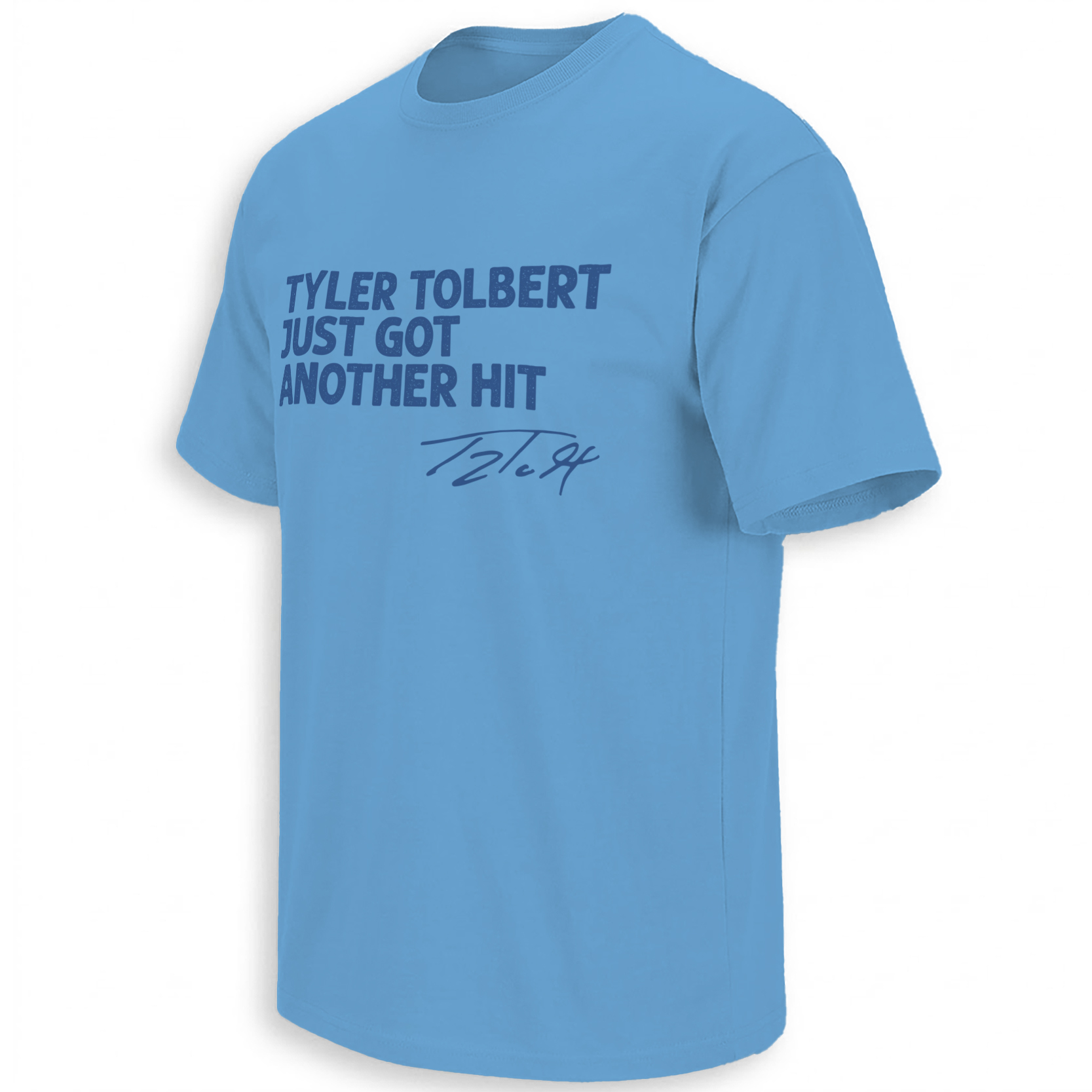
Why “Another Hit” Became the Perfect Language for the Moment
The phrase works because it captures repetition without making the achievement feel dry. A record such as 12 consecutive plate appearances with a hit can sound statistical when written in a box score. “Another Hit” translates it into the emotional rhythm of watching the streak unfold.
Each plate appearance began with the same possibility. The pitcher could end it. A sharp line drive could find a glove. A slow roller could be handled cleanly. Instead, the sequence kept producing the same result. Hit. Reset. Another hit.
The artwork channels that repetition through bold headline typography and a Royals-centered blue palette. Rather than presenting the streak as a formal museum plaque, it gives the moment the energy of a stadium sign or celebratory sports page. Tolbert remains the focal point, while the wording carries the disbelief that followed him through each successive at-bat.
The blue-and-white treatment connects the record directly to Kansas City, while the oversized “Another Hit” wording mimics the accumulating rhythm of the streak. The composition feels immediate rather than historical, preserving the sensation of watching the number grow in real time.
The Joy of Watching a Role Player Own the Entire Night
One reason the story spread so quickly was Tolbert’s position within the Royals’ identity. This was not a long-established batting champion adding another predictable line to his résumé. Tolbert entered the run known for the parts of baseball that are often described as useful rather than glamorous: defensive flexibility, speed, hustle and energy.
That background gave every hit additional emotional weight. Teammates were not merely reacting to a number. They were reacting to a player whose work is usually expressed through preparation, movement and small advantages suddenly occupying the center of the baseball world.
The clubhouse celebration after the game reflected that affection. Kansas City marked the achievement with a Champagne toast, and the bat used during the streak was headed toward Cooperstown. The object itself became evidence of how quickly an ordinary piece of equipment can be transformed by context: one bat, one week and a place in the historical record.
How Speed Changed the Shape of the Streak
Tolbert’s final three hits in the record-tying game were infield singles. That detail matters because it makes the streak inseparable from the player who created it. Another hitter might have needed towering home runs or repeated hard contact. Tolbert used the pressure already built into his game.
An infield hit contains a different kind of suspense. The ball remains visible inside the frame. A defender charges. The throw begins. The runner reaches. For several seconds, the entire play becomes a race whose conclusion is not obvious until the umpire signals safe.
Across baseball discussion, that combination of historic production and familiar Tolbert-style urgency made the streak feel authentic rather than random. The numbers were extraordinary, but the way he reached them still looked like him.
A Royals Moment Bigger Than the Standings
A season does not need to be moving perfectly for a night to become memorable. Kansas City entered the stretch searching for momentum, yet the back-to-back offensive explosions against Philadelphia and New York gave supporters something immediate to follow and celebrate.
The 16–12 win at Citi Field was chaotic even without the record. The Royals erased multiple deficits and produced a seven-run seventh inning. Tolbert’s streak gave that comeback a central character, turning a wild summer game into a story that could be summarized with one name and one recurring result.
That moment now sits inside the broader Kansas City Royals collection, where player surges, franchise references and fleeting baseball phrases become a visual record of the season. The wider MLB Shirts collection places it alongside the many ways baseball turns isolated games, records and dugout reactions into shared fan memory.
Why the Streak Will Remain Memorable
Tolbert did not break the record. His attempt ended with a flyout in the ninth inning. Yet the ending does not reduce what came before it. Tying a mark held across more than a century is already enough to separate the stretch from the normal flow of a season.
The streak also produced multiple layers of history. Tolbert became the first player since Roberto Clemente in 1970 to record consecutive five-hit games. His bat was selected for the Hall of Fame. A player previously defined by speed and defensive value suddenly had his name connected to a list extending back to the early twentieth century.
Years later, the complete box scores may require explanation. The phrase will not. “Another Hit” captures the sensation that made the run feel impossible: every time the streak appeared ready to stop, Tolbert found one more route to first base.
Frequently Asked Questions
What MLB record did Tyler Tolbert tie?
Tyler Tolbert tied the major-league record by recording a hit in 12 consecutive plate appearances during his July 2026 surge with the Kansas City Royals.
When did Tyler Tolbert reach 12 consecutive hits?
He reached the mark on July 7, 2026, during Kansas City’s 16–12 comeback victory over the New York Mets at Citi Field.
How many hits did Tolbert have against the Mets?
Tolbert finished the game 5-for-6 with a two-run home run and four singles, including the infield hit that tied the record.
Why was Tyler Tolbert’s streak so unexpected?
Tolbert had primarily been valued for speed, defensive versatility and energy, making his sudden run of historic offensive production especially surprising.
What does the “Another Hit” design represent?
The graphic captures the repeated anticipation surrounding Tolbert’s streak, when every plate appearance became another chance to extend a rare piece of Royals and MLB history.
The Tyler Tolbert Another Hit design preserves the rhythm of that record chase, while the wider Kansas City Royals archive follows the player moments and baseball language shaping the team’s 2026 season.
Tyler Tolbert Another Hit Shirt captures the Kansas City Royals speedster’s record-tying run of hits in 12 consecutive plate appearances through bold Royals colors and the phrase that defined each new at-bat.