Eight Names Build Tampa Bay’s 2026 Baseball Identity
No player portraits, no conventional club crest and no baseball illustration. The design asks eight surnames to represent Tampa Bay’s balance of power, contact, speed, starting pitching and late-inning relief.
By early July 2026, Tampa Bay had again turned restrained preseason expectations into one of the American League’s strongest records. At 52–36 and first in the AL East, the Rays were being defined less by one universal superstar than by the interaction of several very different player types.
Junior Caminero supplied the loudest power. Chandler Simpson changed games through speed and contact. Yandy Díaz and Jonathan Aranda shaped the lineup through controlled at-bats, while Shane McClanahan, Drew Rasmussen, Nick Martinez and Bryan Baker represented different phases of the pitching plan.
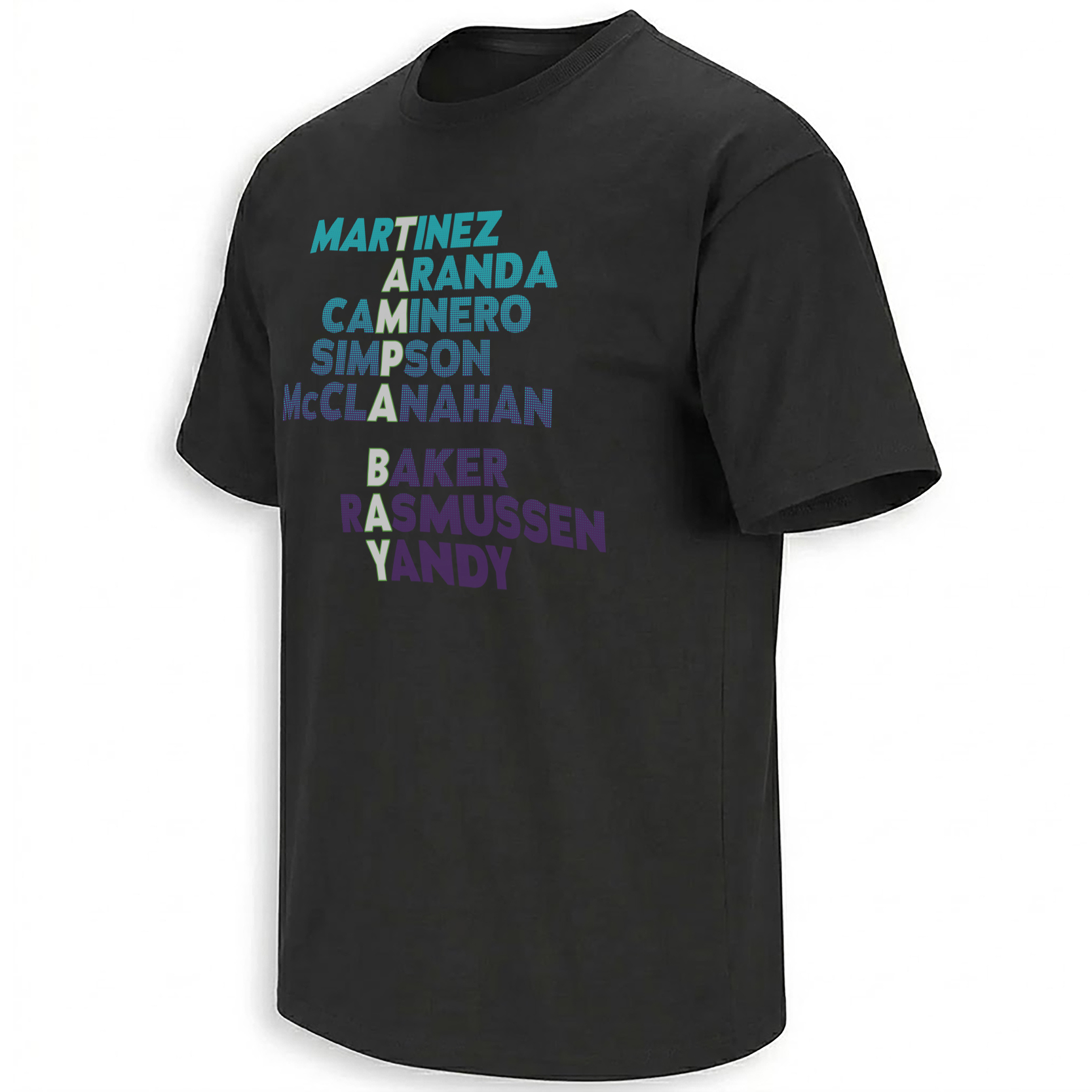
The Tampa Bay Rays Names Shirt converts that structure into typography. Each player receives a different scale, color and angle, but the names remain close enough to form one vertical team portrait.
A logo identifies the franchise. A list of names identifies the particular version of the franchise playing right now.
Why Eight Names Can Describe a Full Team
The artwork does not claim to reproduce the complete active roster. Its selection works more like a cultural snapshot, choosing players whose roles explain the 2026 team’s internal balance.
Martinez and McClanahan represent veteran starting presence. Rasmussen adds one of the season’s most important rotation stories, while Baker gives the lower half a late-inning relief identity.
Above them, Aranda and Yandy describe Tampa Bay’s controlled offensive approach. Caminero supplies headline power, and Simpson introduces the speed that prevents the lineup from being understood through home runs alone.
Junior Caminero gives the composition its emerging-star energy and central offensive weight.
Yandy Díaz and Jonathan Aranda represent patient, productive at-bats and lineup stability.
Chandler Simpson adds a faster rhythm built around contact, pressure and movement on the bases.
Martinez, McClanahan, Rasmussen and Baker connect the rotation to the final outs.
The Artwork Behaves Like a Vertical Lineup Card
The Tampa Bay Rays Names Shirt stacks surnames across the upper front of a solid black field.
MARTINEZ opens the composition in bright turquoise italic lettering. ARANDA follows in a lighter green-and-teal treatment. CAMINERO and SIMPSON occupy broader blue lines before McCLANAHAN stretches across the widest central position.
A deliberate gap separates the upper group from BAKER, RASMUSSEN and YANDY. That space creates a subtle division between the first visual movement and the names anchoring the lower half.
Caminero Gives the List Its Center of Gravity
Junior Caminero had reached 27 home runs by July 9, making his surname one of the most immediately recognizable offensive signals in the composition.
His placement near the upper middle gives the design a natural focal point without making the other names disappear. CAMINERO is broad and heavily colored, but it remains part of the same typographic stack.
That hierarchy mirrors his place in the club’s public identity. He is the emerging power star, yet Tampa Bay’s success still depends on the roster machinery around him.
Simpson Changes the Pace of the Artwork
Chandler Simpson’s surname appears directly below Caminero, but the players represent different forms of offensive pressure.
Caminero can change the score with one swing. Simpson changes defensive attention through contact, acceleration and the constant possibility of taking another base.
Including both names prevents the design from reducing Tampa Bay to a single offensive formula. Power and speed occupy neighboring lines because the lineup works through contrast.
McClanahan Is the Widest Name for a Reason
McCLANAHAN stretches across the center in one of the composition’s broadest lines. Part of that is practical—the surname is long—but the scale also gives a familiar Rays pitcher visual authority.
Shane McClanahan’s return restored a recognizable left-handed presence to the rotation. The typography lets that continuity occupy the midpoint between the hitter group above and the lower pitching-and-veteran section.
The design does not rank the players statistically. Scale, line length and color create visual rhythm, allowing recognizable roles to emerge without converting the shirt into a formal depth chart.
Why Yandy Is the Only First Name
The bottom line reads YANDY rather than DÍAZ. That choice reflects the familiarity attached to his first name inside Rays culture and gives the composition a warmer, more personal ending.
Most of the design behaves like a roster document built from surnames. “Yandy” breaks that pattern just enough to signal a player whose identity has become conversational shorthand among supporters.
Positioned at the base in pale green and purple, the name stabilizes the vertical list and closes the artwork with one of the lineup’s most established offensive figures.
The Gradient Replaces a Traditional Team Logo
Turquoise, aqua, green, blue and purple move through the names against a black background. The palette recalls Tampa Bay’s broader visual world—water, light, tropical color and late-night stadium glow—without directly reproducing a standard club mark.
Black allows each line to retain its own color identity. It also gives the graphic a contemporary poster quality, closer to music-festival typography or a neon lineup announcement than conventional baseball apparel.
That approach fits a franchise frequently associated with finding competitive value through combinations rather than one overwhelming visual symbol.
A Roster Graphic Is a Timestamp
Team logos remain stable across many seasons. Roster graphics become historical almost immediately.
Trades, injuries, promotions and role changes will eventually alter how these names appear together. That temporary quality is not a weakness. It is what makes the design a record of a specific point in the 2026 season.
The shirt captures the moment when Caminero’s power, Simpson’s speed, Yandy’s presence and the selected pitching group were collectively describing a first-place Rays team.
Where the Design Fits in Tampa Bay Baseball Culture
Within EllieShirt’s Tampa Bay Rays collection , the names graphic offers a quieter alternative to player portraits, slogans and mascot-driven artwork.
The wider MLB collection places it inside baseball’s long tradition of lineup cards, scorebook names, jersey lettering and roster records.
Its cultural value comes from treating names as enough. Fans already know the swings, deliveries, speeds and personalities attached to them. The typography activates those memories without illustrating every one.
Frequently Asked Questions
Which players appear on the Tampa Bay Rays Names Shirt?
The design features Nick Martinez, Jonathan Aranda, Junior Caminero, Chandler Simpson, Shane McClanahan, Bryan Baker, Drew Rasmussen and Yandy Díaz.
Is this the complete 2026 Rays roster?
No. It highlights eight recognizable hitters and pitchers who represent several important parts of Tampa Bay’s 2026 team identity.
Why is Caminero included?
Junior Caminero is one of Tampa Bay’s most visible power hitters and had reached 27 home runs by July 9, 2026.
Which pitchers appear in the artwork?
The pitching names are Nick Martinez, Shane McClanahan, Bryan Baker and Drew Rasmussen.
Why is McClanahan one of the widest names?
His long surname naturally spans the composition, while the central scale also gives one of Tampa Bay’s most recognizable pitchers added visual emphasis.
Why does the bottom line say Yandy instead of Díaz?
The first-name treatment reflects how familiar Yandy Díaz has become within Rays fan language and gives the typography a more personal closing line.
Does the design contain a Rays logo or player portraits?
No. The team identity is communicated entirely through player names, color, scale and vertical composition.
The Tampa Bay Rays Names design preserves the selected 2026 core, while the Rays baseball archive follows the individual players, moments and visual language surrounding Tampa Bay’s season.
Tampa Bay Rays Names Shirt stacks Martinez, Aranda, Caminero, Simpson, McClanahan, Baker, Rasmussen and Yandy into a cool-toned 2026 roster graphic representing the club’s power, speed and pitching balance.