The Knicks Trophy Is Not Holding the Team. The Team Is the Trophy.
New York’s 2026 title can be remembered through Brunson’s 45-point closeout, the Game 4 comeback or the Canyon of Heroes. This roster-built trophy offers another reading: every name becomes part of the structure that ended a 53-year wait.
In July 2026, the Knicks’ championship roster was already beginning its transition from active depth chart to historical record. Free agency had started, offseason decisions were changing the next team and the names connected to the title were becoming fixed inside one completed season.
That shift is what makes a roster graphic meaningful. A live roster answers who is available now. A championship roster answers who was there when the story reached its ending.
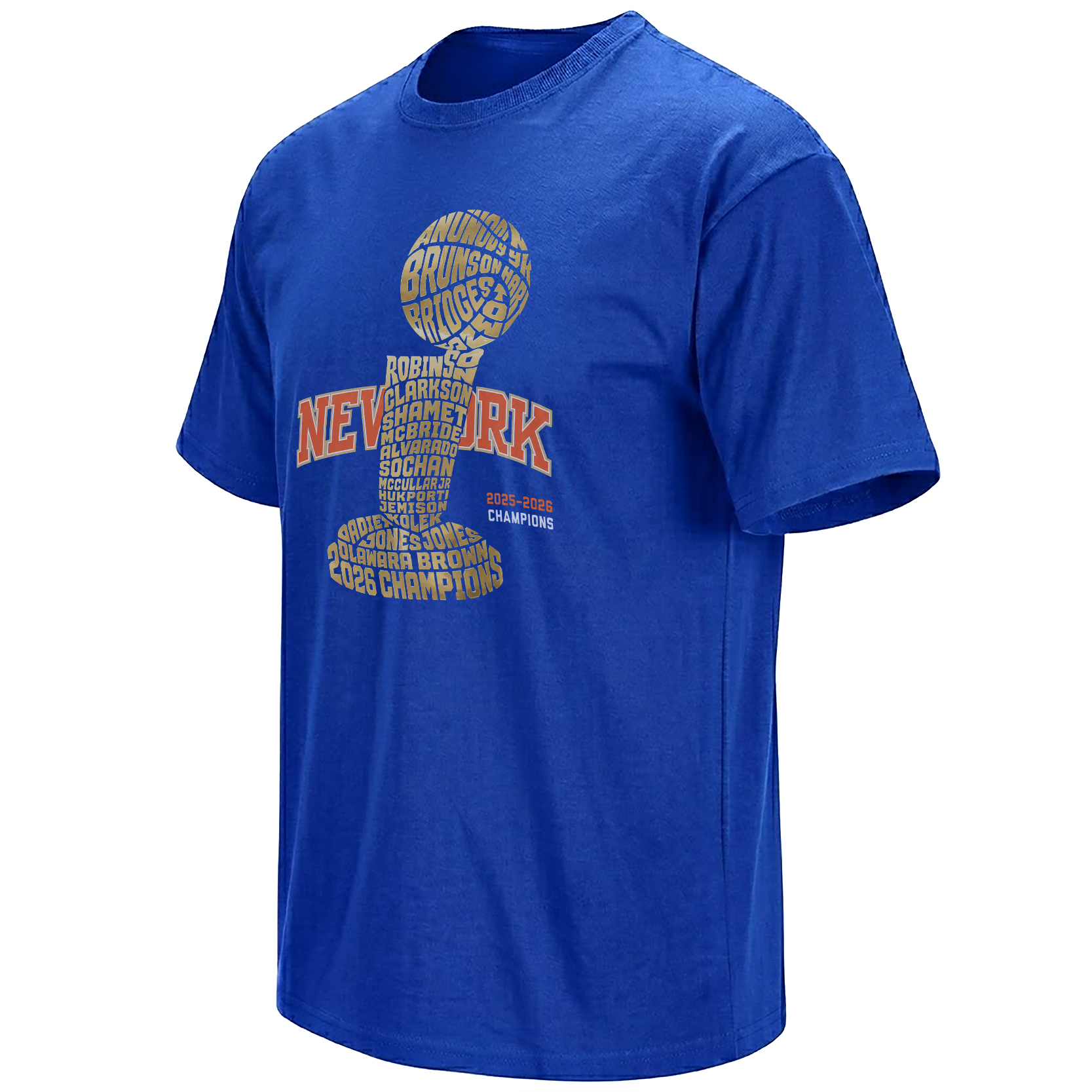
The Knicks Roster Trophy design takes that distinction literally. Instead of printing player names beside a trophy, it uses those names to construct the basketball, stem and base. The award is not placed above the roster. The roster becomes the award.
A trophy normally symbolizes the team’s achievement. Here, the names reveal that the achievement had no shape until the team built it.
A Championship Is Usually Reduced to Its Biggest Star
Basketball memory naturally moves toward one central figure. The winning team receives a trophy, and the Finals MVP becomes the face attached to the championship.
For New York, that figure was Jalen Brunson. He closed the Finals with a Knicks-record 45 points in Game 5 and received the Bill Russell Finals MVP trophy after leading the franchise to its first championship since 1973.
None of that minimizes his importance. It does, however, create a familiar problem in the way championship teams are remembered. One performance becomes the headline while the structure supporting it gradually disappears.
The roster trophy pushes in the opposite direction. Brunson remains prominent, but his name is locked beside Anunoby, Towns, Bridges and Hart inside the basketball at the top. Even the Finals MVP becomes one part of the larger form.
The Basketball at the Top Belongs to the Core Five
The most immediately readable part of the artwork is the circular basketball formed from the surnames of OG Anunoby, Jalen Brunson, Karl-Anthony Towns, Mikal Bridges and Josh Hart.
Thin curved lines suggest traditional basketball panels, but the names provide the real surface. Each word bends or interlocks with the others, allowing the five most recognizable members of the lineup to create one unified object.
Anunoby, Brunson, Towns, Bridges and Hart form the rounded top, representing the core most visible throughout New York’s title run.
Rotation and supporting names create the narrow central column, visually carrying the star-built basketball above them.
The lower roster widens into a foundation beneath the trophy, ending with the curved declaration “2026 Champions.”
The structure does not claim that every player carried an identical role. Instead, it shows that different roles can belong to the same construction.
The Artwork Makes the Championship Roster Its Own Monument
The Knicks Roster Trophy Shirt uses only typography and a small number of structural lines. There are no action photographs, illustrated portraits or separate trophy image.
From a distance, the composition reads as a gold basketball trophy beneath an oversized New York wordmark. At closer range, the viewer discovers that almost every visible surface is made from player surnames.
The New York Wordmark Interrupts the Trophy on Purpose
The orange-and-white New York lettering is larger than any individual surname. It stretches horizontally across the narrow trophy stem, briefly breaking the vertical reading of the composition.
That interruption establishes the hierarchy of the design. The players construct the trophy, but the city remains the identity surrounding their achievement.
Orange brings the visual language back to the Knicks after the gold typography has created the championship object. White highlights give the wordmark the dimensional feel of collegiate athletics, arena signage and traditional New York basketball graphics.
No player name is printed larger than New York. The composition celebrates individual contributors while insisting that every one of them entered history through the same city and franchise.
The Supporting Names Carry the Weight
Mitchell Robinson, Jordan Clarkson, Landry Shamet, Miles McBride and Jose Alvarado appear inside the narrower middle section, joined by Jeremy Sochan, Kevin McCullar Jr., Ariel Hukporti, Trey Jemison III and Tyler Kolek.
Their names are physically smaller than those forming the basketball, but their placement is conceptually important. They create the stem—the structure between the visible star core and the wider base.
This is roster typography functioning as basketball analysis. Supporting players do not always produce the most memorable images, yet they keep the team standing through matchup changes, injuries, foul trouble, back-to-backs and postseason adjustments.
Scoring runs, defensive possessions, rebounds and pressure minutes are the moments supporters can identify from individual games.
Practice work, lineup flexibility, injury coverage and role acceptance rarely become posters, but they determine whether a roster remains functional.
Why Names Can Tell the Story Better Than Faces
Player collages communicate emotion through expressions, action poses and visual recognition. Name art creates a different relationship with the audience.
Surnames read like entries in an official record. They recall box scores, jerseys, arena introductions and the roster lists printed inside season programs.
Arranging those names into a trophy combines documentation with symbolism. The viewer can first understand the championship shape and then search through it, discovering individual contributors the way someone studies an engraved monument.
That process rewards attention. The artwork offers an immediate image from across the room and a more detailed roster experience when viewed closely.
The Design Records a Completed Team, Not the Next Depth Chart
July creates a complicated moment for championship rosters. The parade is still recent, but free agency has already begun separating the title team from the roster that will defend it.
The player names in this design should therefore be read historically. They represent the group attached to the completed 2025–26 championship season, not a guarantee that every name will remain part of the 2026–27 lineup.
That difference makes the artwork stronger with time. A current roster graphic eventually becomes outdated. A championship roster becomes an archive because the event it records can no longer change.
Brunson’s 45 Points Became the Final Signature
The Finals ended with Brunson producing 45 points in Game 5, the largest Finals scoring performance in Knicks franchise history. That closeout supplied the championship with a clean final image: the captain controlling the deciding game and then receiving Finals MVP.
The trophy design does not illustrate that performance directly. Instead, it places Brunson’s surname inside the basketball alongside the teammates whose work gave his final performance a championship context.
That choice keeps the piece from becoming another individual Finals MVP tribute. Brunson’s name matters because of what he did; its position matters because even the defining closer remained part of a roster construction.
The 53-Year Wait Changed the Meaning of Every Name
New York had not won the NBA championship since 1973. That distance turned the 2026 roster into something larger than the latest successful Knicks team.
Every player attached to the title became part of the answer to a question New York supporters had carried for decades: who would finally end the wait?
This is why the supporting names matter beyond ordinary roster completion. They are not simply employees from one season. They belong to the group that closed the longest championship gap in franchise history.
Gold Typography Changes the Royal-Blue Field
The royal-blue garment creates a saturated team field without requiring a large Knicks logo. Against it, the gold names appear almost engraved.
Gold naturally carries trophy associations, but it also gives small text enough separation to remain discoverable. Orange and white are reserved for New York and the season marker, creating a hierarchy between roster material, city identity and historical date.
The limited palette keeps the concept readable. More colors would divide the names into competing pieces. Gold allows them to merge into one object while the orange wordmark cuts across the center with controlled emphasis.
A Trophy Made From Language Fits New York
New York sports culture is verbal. It lives through headlines, radio arguments, tabloid back pages, arena chants, nicknames and the constant retelling of what happened the night before.
A typographic trophy belongs naturally inside that environment. It transforms the roster into language first and image second, making the championship something that can be read as well as seen.
The oversized New York wordmark carries the confidence of a headline, while the names underneath operate like the reporting that supports it.
The Piece Complements Other Knicks Championship Artifacts
The 2026 title produced many visual entry points. Game-specific graphics preserve the 29-point comeback. Player portraits preserve Brunson, Anunoby and the defining stars. Trophy and parade designs capture the public celebration.
The roster trophy preserves construction. It asks viewers to think less about one moment and more about how the people surrounding those moments made them possible.
That perspective belongs naturally inside the New York Knicks Shirts collection , where the title is documented through roster art, individual heroes, Finals moments and New York-specific championship symbolism.
The wider NBA Shirts archive places the concept within basketball’s broader tradition of commemorating champions through names, numbers, city colors and trophy silhouettes.
Why the Trophy Becomes More Meaningful at Close Range
From a distance, the artwork makes a simple statement: New York, champions, trophy.
Close inspection complicates that statement. The trophy dissolves into surnames. The ball becomes a five-player core. The stem becomes a rotation. The base becomes the wider structure supporting the season.
That change in scale mirrors the way championship history is often understood. The result appears simple in a record book. The closer one looks, the more people, roles and decisions become visible inside it.
A Championship Ledger Written in Player Names
The word “ledger” fits because the piece records contributions without trying to reproduce every highlight. Names stand in for minutes, possessions, practices, injuries and individual paths that converged during one season.
The trophy shape gives those entries a final total. It says that the season balanced, the work produced a result and the roster can now be read as a completed championship account.
That is the central cultural idea behind the design: New York did not win because a trophy appeared at the end of the Finals. The trophy appeared because enough names had already built its structure.
Frequently Asked Questions
What is the Knicks Roster Trophy Shirt?
It is a typography-based New York championship design that arranges the names of the 2025–26 Knicks players into the shape of a basketball trophy.
Which Knicks form the basketball at the top?
The upper basketball is built from the surnames of OG Anunoby, Jalen Brunson, Karl-Anthony Towns, Mikal Bridges and Josh Hart.
Which supporting players appear in the trophy typography?
Visible supporting names include Mitchell Robinson, Jordan Clarkson, Landry Shamet, Miles McBride, Jose Alvarado, Jeremy Sochan, Kevin McCullar Jr., Ariel Hukporti, Trey Jemison III and Tyler Kolek.
Why are the player names shaped like a trophy?
The structure communicates that New York’s championship was built by the roster, with stars, rotation players and supporting contributors forming different parts of the same object.
What season does the design celebrate?
It celebrates the completed 2025–26 season and the Knicks’ 2026 NBA championship.
Who won the 2026 NBA Finals MVP?
Jalen Brunson won Finals MVP after scoring a Knicks Finals-record 45 points in the championship-clinching Game 5.
Why is New York printed larger than the player names?
The oversized wordmark establishes the city and franchise as the shared identity connecting every player inside the championship structure.
Is the artwork a current 2026–27 roster chart?
No. It is best understood as a historical record of the completed 2025–26 championship group rather than a live depth chart for the following season.
The Knicks Roster Trophy design records the complete title group through typography, while the wider Knicks championship archive follows the players, comebacks and city symbols that defined New York’s 2026 season.
Knicks Roster Trophy Shirt arranges the names of New York’s 2025–26 champions into a gold basketball trophy, turning Brunson, Towns, Bridges, Anunoby, Hart and the supporting roster into the structure of the title itself.