The Knicks Did Not Just Win Gold. They Turned the Big Apple Into the Trophy.
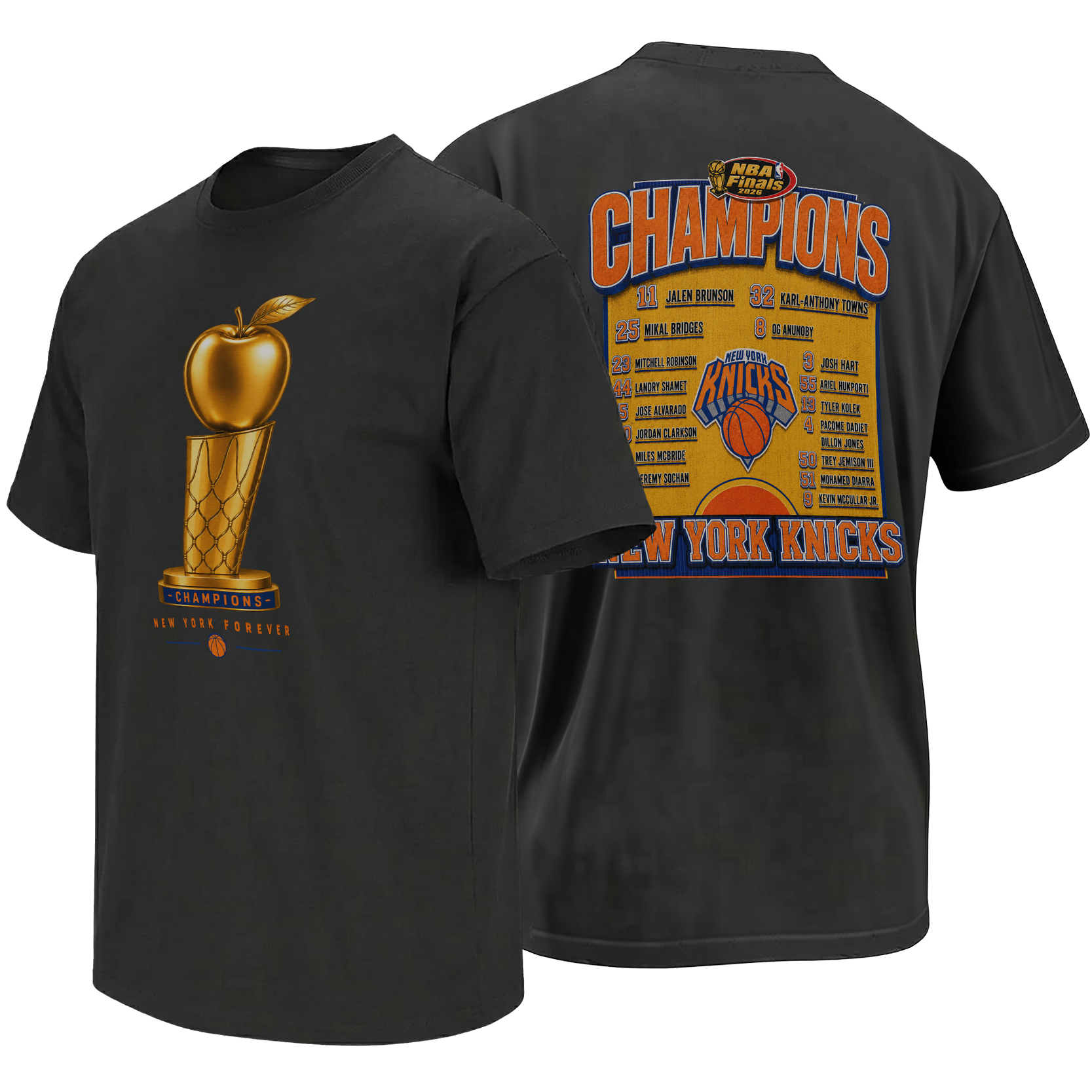
The Golden Apple Champions design gives New York’s 2026 title a symbol that belongs only to this city: a polished apple lifted above a basketball-net pedestal, with the complete championship roster printed like the permanent record on the reverse.
By July 2026, the Knicks’ championship had already produced its permanent images: Jalen Brunson holding the Finals MVP trophy, blue-and-orange confetti, Lower Manhattan packed for the parade and a roster that ended New York’s 53-year wait.
Yet championships are not remembered only through official trophies. Cities create their own symbols around victory. In New York, the most natural transformation was almost inevitable: the Big Apple became golden.
The image works because it merges two identities that had spent the entire postseason moving toward each other. The Knicks supplied the basketball history. New York supplied the mythology. Once the title was secured, the apple no longer represented only the city—it could stand above a net like the championship object the city had been waiting half a century to claim.
The trophy says the Knicks won the league. The golden apple says New York believes the championship belongs to the city itself.
Why the Big Apple Became the Perfect Championship Symbol
“The Big Apple” carries enough cultural weight to identify New York without a skyline, borough map or Statue of Liberty silhouette. It is a nickname, a tourism emblem and a piece of city shorthand recognized far beyond basketball.
Turning that apple into gold changes its emotional function. Gold marks achievement, rarity and the end of a long search. The city emblem becomes a prize, while the ordinary fruit shape acquires the visual authority of a championship monument.
The transformation also feels specific to the scale of New York’s celebration. A normal trophy graphic could belong to any champion. A golden apple can belong only to the Knicks and the city that turned their Finals run into a shared civic event.
Identifies New York immediately, allowing the front graphic to communicate city identity without depending on a crowded skyline or word-heavy layout.
Converts the apple from a decorative city emblem into a basketball monument, visually connecting New York’s nickname to the championship court.
Gives the symbol trophy status and transforms a familiar civic image into a record of the season New York finally reached the top.
The Front Graphic Creates a Trophy New York Can Call Its Own
The Golden Apple Champions Shirt does not recreate the Larry O’Brien Trophy. Instead, it invents a New York-specific championship object.
A metallic apple stands on top of a tall pedestal patterned like a basketball net. Beneath it, a narrow “Champions” plate gives the object ceremonial authority, while “New York Forever” places the victory inside a longer city story.
The restraint of the front matters. It does not need player portraits, multiple dates or a large team wordmark. The apple is allowed to stand alone, polished and centered, as though it has already become an official civic monument.
The Front Is the Symbol; the Back Is the Evidence
A gold apple, net-textured pedestal and “New York Forever” line create a clean emblem that reads like a city-made trophy rather than standard Finals merchandise.
A large “Champions” headline, 2026 Finals mark, Knicks identity and player roster convert the reverse into a basketball record of who completed the title run.
The two sides answer different questions. The front asks what the championship meant to New York. The back asks who made it happen.
Together, they create a stronger memory object than either approach could produce alone. City mythology gives the title emotional scale, while the roster keeps the graphic connected to a specific team rather than a generic idea of victory.
The Back Reads Like a Championship Program
The reverse artwork is structured like a commemorative arena poster or season program. “Champions” dominates the top, followed by a 2026 NBA Finals marker and a roster divided around the Knicks logo.
Jalen Brunson, Karl-Anthony Towns, Mikal Bridges, OG Anunoby, Josh Hart and Mitchell Robinson appear alongside the guards, wings, reserves and late-season contributors who completed the championship roster.
That wider roll call matters. Finals memory naturally narrows toward stars and game-winning moments, but a championship roster is built through a full season of lineup adjustments, bench minutes, injuries, practices and role acceptance.
The large back print does not rank the players by fame. It places names and numbers inside one shared championship frame, allowing the supporting cast to remain part of the object fans use to remember the season.
Why the Roster Is More Powerful After the Offseason Begins
NBA rosters start changing almost immediately after the final celebration. Contracts expire, trades develop and new signings begin reshaping the next season before supporters have fully processed the last one.
That makes a championship roster graphic increasingly historical with time. It does not attempt to predict the 2026–27 depth chart. It preserves the completed 2025–26 group at the moment when every name still belonged to the same title story.
The distinction is essential. A current roster page is temporary information. A championship roster is a closed archive. It records the exact combination of stars, rotation players and supporting figures attached to one completed result.
Brunson’s Team Became New York’s Team
Jalen Brunson’s Finals MVP award supplied the title run with a clear central figure, but the season’s cultural power came from how quickly the entire roster became familiar across the city.
Brunson represented control and late-game authority. Towns supplied size and expressive energy. Anunoby became inseparable from the defining Game 4 comeback. Bridges and Hart carried two-way movement and the long-running Villanova connection. Robinson represented continuity with earlier versions of the franchise.
The roster board lets those identities coexist without turning the design into a crowded portrait collage. Names and numbers are enough because the championship run has already taught supporters what each one represents.
Gold Changes the Emotional Temperature of Knicks Colors
Knicks blue and orange normally communicate speed, city energy and Madison Square Garden intensity. Gold introduces a different mood: permanence.
On the front, gold dominates because the city symbol has reached trophy status. On the back, blue and orange return to frame the roster, reconnecting the polished monument with the team’s everyday visual identity.
The black garment is an important part of the composition. It creates enough darkness for metallic gold to appear luminous while allowing the blue-and-orange back print to maintain the force of a vintage championship poster.
The artwork uses gold as memory rather than decoration. Blue and orange describe the team that played the games; gold describes what that team became after the final result entered New York history.
“New York Forever” Expands the Title Beyond One Season
“New York Forever” is effective because it refuses to make the city temporary. The championship belongs to 2026, but the relationship between the Knicks and New York extends across generations of supporters who carried the franchise through much longer periods without a title.
For fans who remembered 1973 only through archive footage, the 2026 victory created the first championship images they could call their own. For older supporters, it connected a new roster to a city memory that had remained unfinished for more than five decades.
The line beneath the golden apple therefore behaves like an inscription on a monument. It does not merely announce that New York won. It suggests that the city’s connection to the moment will remain after the celebration, parade and next season have passed.
From the Finals to the Canyon of Heroes
The Knicks’ five-game victory over San Antonio ended the competitive story, but the parade completed the cultural one. Lower Manhattan gave the roster a setting larger than the arena and turned a basketball championship into a citywide public ritual.
Confetti, trophies and player appearances allowed supporters to see the team outside the contained logic of the Finals. The players were no longer moving between possessions. They were being presented as the people who had changed New York sports history.
The Golden Apple concept belongs naturally to that post-Finals atmosphere. It feels less like something created before the title and more like an emblem that could appear after the city had already decided to gild the entire summer.
A Different Kind of Knicks Championship Artifact
Most 2026 Knicks graphics preserve one of three things: the trophy, a player or a famous game. This design adds a fourth category by preserving the city itself.
The apple is not an official NBA award, and that is precisely why it carries cultural value. It represents the way supporters create their own language around a championship, combining league history with the local symbols that make the result feel personal.
Within the wider New York Knicks Shirts collection , the Golden Apple sits beside player moments, Finals slogans and trophy graphics as a city-centered interpretation of the same historic run.
The broader NBA Shirts archive places that New York symbolism inside the larger visual culture of basketball championships, where every winning city develops its own way of translating a league result into local memory.
Why the Design Feels Like a Championship Relic
A relic gains meaning because it appears to hold a story larger than its physical form. The polished apple, narrow pedestal and understated front text give the object that quality.
It looks as though the city has manufactured an alternative trophy from its own mythology. The net pattern supplies basketball legitimacy. The gold surface supplies ceremonial weight. The roster on the back supplies the names required to authenticate the season.
That combination allows the piece to function as both emblem and record: one side remembers the feeling, the other preserves the facts.
Frequently Asked Questions
What does the golden apple represent in the Knicks design?
The apple represents New York City’s “Big Apple” identity, while the gold finish transforms that familiar symbol into a city-specific championship trophy.
Why is the apple placed on a basketball-net pedestal?
The net pattern connects the New York symbol directly to basketball, making the apple look like a ceremonial trophy created specifically for the Knicks’ championship.
What appears on the back of the Golden Apple Champions Shirt?
The back features a large 2026 champions composition with an NBA Finals mark, Knicks identity and the roster associated with New York’s championship season.
Why is the 2026 roster important to the artwork?
The roster identifies the specific players and supporting contributors attached to the completed title run, turning the back graphic into a historical team record.
How long had the Knicks waited for another NBA championship?
New York’s previous championship came in 1973, so the 2026 title ended a 53-year wait.
What does “New York Forever” mean in the design?
The phrase places the 2026 championship inside the longer relationship between the Knicks, the city and generations of supporters rather than treating it as a temporary celebration.
Is the back print meant to represent the 2026–27 roster?
No. It is best understood as a commemorative record of the completed 2025–26 championship team, not a live depth chart for the following season.
The Golden Apple Champions design joins Big Apple symbolism with the names behind the title, while the wider Knicks championship archive follows the roster, Finals moments and city language that defined New York’s 2026 run.
Golden Apple Champions Shirt turns New York’s Big Apple into a polished basketball trophy, pairing a “New York Forever” front emblem with the Knicks roster that completed the franchise’s historic 2026 NBA championship season.