
Munetaka Murakami’s Sakura Slugger Graphic Turns South Side Power Into a Japan-to-Chicago Baseball Artifact
Munetaka Murakami’s 2026 White Sox chapter has been built on violent left-handed power, adaptation pressure and Japanese baseball mythology arriving on the South Side. The sakura design captures that crossover in one clean swing frame.
Murakami did not arrive in Chicago as a blank rookie. He arrived carrying the memory of NPB home-run feats, the “Murakami-sama” aura, and the expectation that his left-handed power could become one of the most visually interesting stories in the White Sox season.
By late May, that expectation had already become box-score reality. Murakami reached the 20-homer mark in his first MLB season, putting his early White Sox pace into the same team-history conversation as Frank Thomas and Jim Thome through the club’s first 55 games. Even with a later hamstring setback and rehab path, the larger story remained clear: Chicago had imported more than a bat. It had imported a baseball mythology.
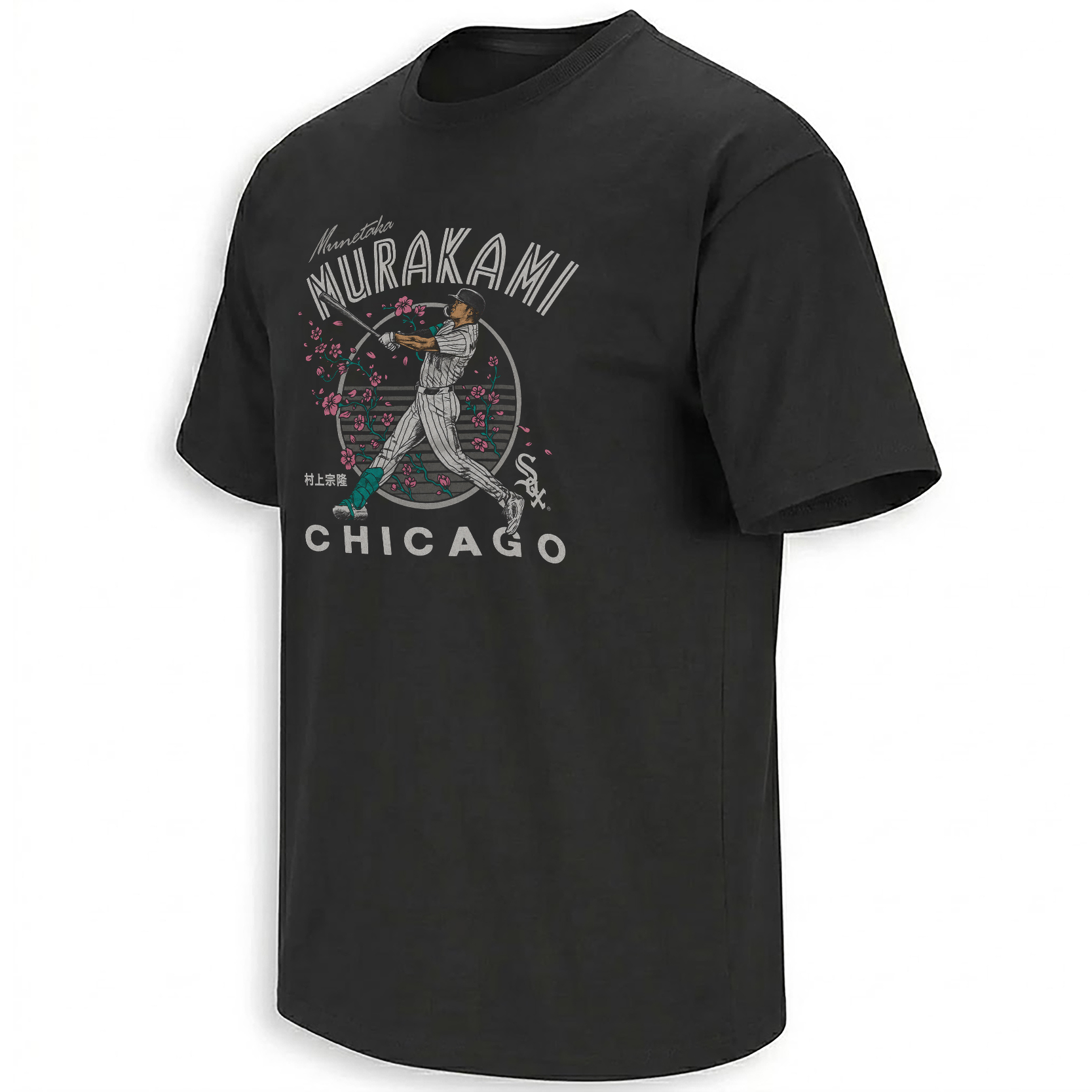
That is why the sakura artwork feels right. It does not treat Murakami as a generic slugger dropped into a black tee. It frames him as a Japan-to-Chicago cultural figure: pinstripes, blossoms, Japanese text, Chicago lettering, and a swing that makes the whole composition feel like a baseball postcard from a new South Side era.
Murakami’s White Sox story is not only about how far the ball travels. It is about how far a baseball identity can travel with it.
Why Murakami’s Chicago Arrival Felt Bigger Than a Roster Move
International baseball arrivals carry a different emotional charge because fans are not simply meeting a new player. They are meeting a reputation. Murakami came with highlights, translated nicknames, scouting questions, power projections and the complicated curiosity that follows a Japanese star into MLB.
The White Sox context made that arrival even sharper. Chicago needed new offensive identity, and Murakami’s early homer pace gave the South Side something loud to organize around. The swing-and-miss conversation was real, but so was the damage. That tension made him fascinating: not polished into safety, not quiet, not ordinary.
A shirt like this works because it preserves that tension. It does not smooth Murakami into a standard player-name graphic. It keeps the cultural markers visible.
The Shirt as a Sakura Slugger Poster
The Munetaka Murakami Shirt uses a black base, arched “MURAKAMI” lettering, a pinstripe swing illustration, pink sakura blossoms, Japanese characters and bold Chicago grounding. The design reads like a crossover poster: part South Side baseball, part Japanese slugger tribute, part modern MLB global-culture artifact.
The blossoms are not decoration only. They create motion around the bat path and soften the violence of the swing. That contrast is what makes the design memorable: the hitter is built around power, but the graphic language adds elegance, heritage and atmosphere.
Why Sakura Changes the Tone of the Power Graphic
A normal slugger design might chase only aggression: heavy type, bat speed, explosion lines, oversized numbers. This one chooses a more layered visual language. The sakura blossoms introduce memory, seasonality and Japanese cultural reference without removing the baseball force.
That balance matters for Murakami because his MLB story is already a fusion. Fans are watching the translation of power from NPB to the American game, from Japanese nickname culture to White Sox discourse, from one baseball visual vocabulary to another.
The strongest visual move is the contrast between the black White Sox base and the soft sakura motion. It makes Murakami’s swing feel powerful, but also rooted in a Japan-to-Chicago identity rather than generic home-run imagery.
Where This Fits in the White Sox Archive
The design belongs naturally inside the Chicago White Sox collection, where South Side player graphics, new-era bats and team-specific visual language can sit together as a running archive of Chicago baseball mood.
It also fits the broader MLB Shirts & Apparel collection, because Murakami’s story is not only a White Sox story. It is part of MLB’s larger global exchange, where Japanese stars, American ballparks and fan-made visual culture keep reshaping what baseball identity looks like.
The Swing Still Carries the Story
The most important part of the artwork is still the swing. Everything else—the blossoms, the type, the Japanese text, the Chicago wordmark—exists to frame that one action. Murakami’s appeal begins with the possibility that any pitch in his damage zone can become a souvenir.
That is why the shirt has life beyond one game. It captures the bigger Murakami question: what happens when a Japanese power legend starts building a new mythology in a city that needed a fresh one?
Frequently Asked Questions
What is the Munetaka Murakami Shirt about?
The shirt is a Chicago White Sox-inspired Munetaka Murakami design built around his Japanese slugger identity, sakura artwork and South Side MLB chapter.
Why does the design include sakura blossoms?
The sakura blossoms connect the graphic to Murakami’s Japanese baseball roots while adding motion and elegance around the power swing.
Why is Murakami important to White Sox fans in 2026?
Murakami became one of Chicago’s most compelling offensive storylines, combining left-handed home-run power with the attention that follows a Japanese star’s MLB transition.
What does the black base add to the design?
The black base gives the pink sakura, white pinstripes and Chicago lettering strong contrast, making the design feel tied to White Sox visual identity.
How does this fit MLB crossover culture?
It fits because modern MLB fandom often treats international player arrivals as cultural moments, not just roster moves. This design preserves Murakami’s Japan-to-Chicago identity in visual form.
The Munetaka Murakami Shirt turns his Chicago power chapter into a sakura slugger graphic, while the wider Chicago White Sox archive and MLB collection track the player stories, international crossovers and baseball graphics shaping the season.
Munetaka Murakami Shirt captures the Chicago White Sox slugger’s Japan-to-South Side story through sakura blossoms, Japanese text, arched name lettering and a pinstripe power swing graphic.